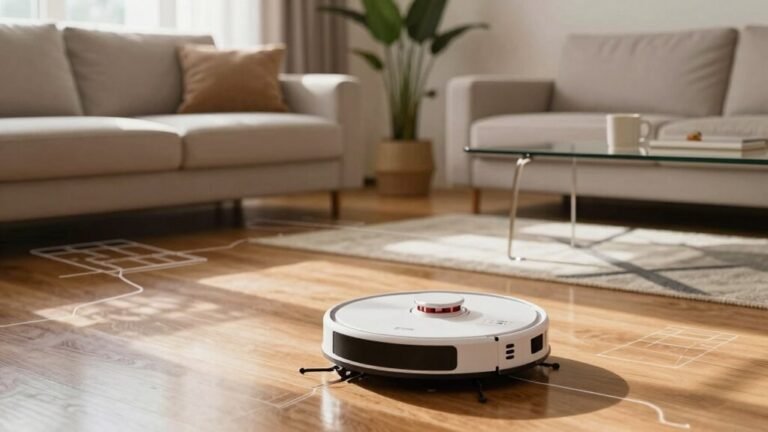
How Robot Vacuums Learn Your Floor Plan Over Time
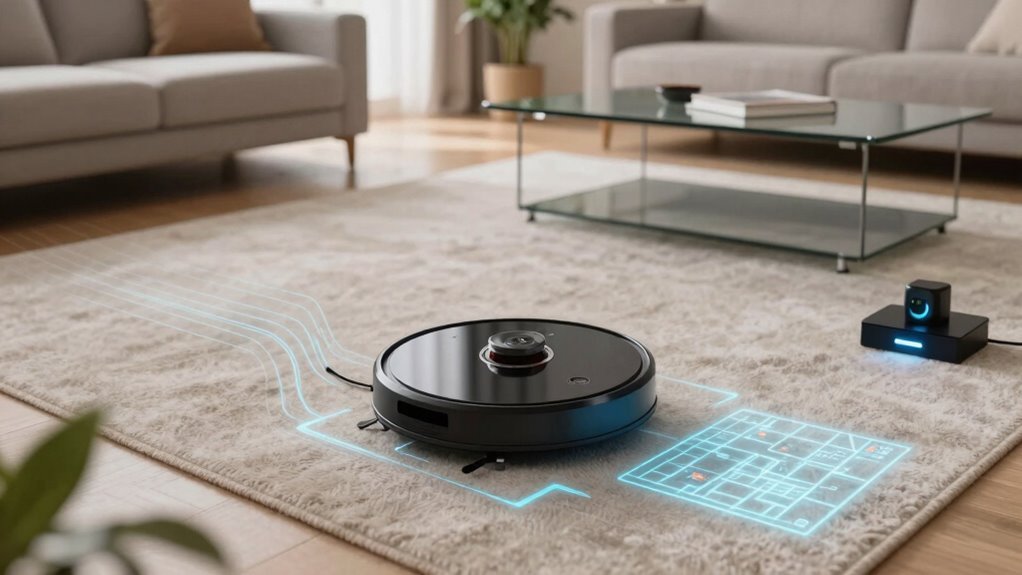
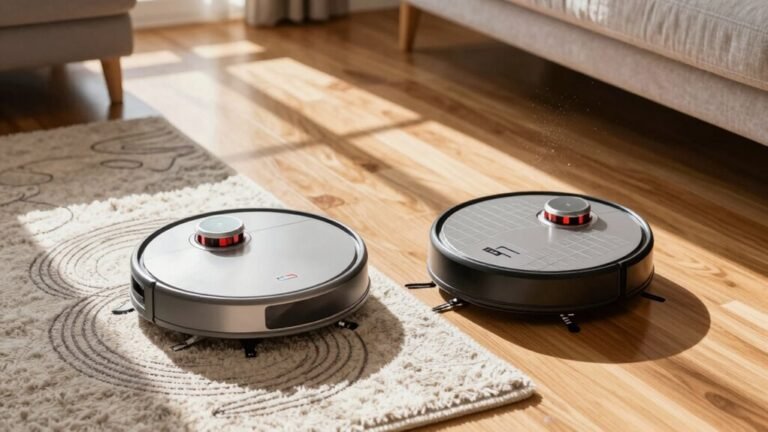
Your robot vacuum learns your floor plan by acting like a tiny, tireless explorer, using lasers, cameras, and sensors to map every wall and corner. It scans its surroundings continuously, building a detailed layout of your home over time.
The robot remembers furniture positions, recognizes obstacles like toys, and avoids pet bowls, updating its memory as things change. This ability to learn your floor plan allows it to navigate more efficiently with each cleaning cycle.
Over time, it adapts to rearranged rooms and adjusts its internal blueprint without losing track. Even in dark rooms or across multiple floors, advanced models use smart navigation to stay oriented.
How Robot Vacuums Map Your Home
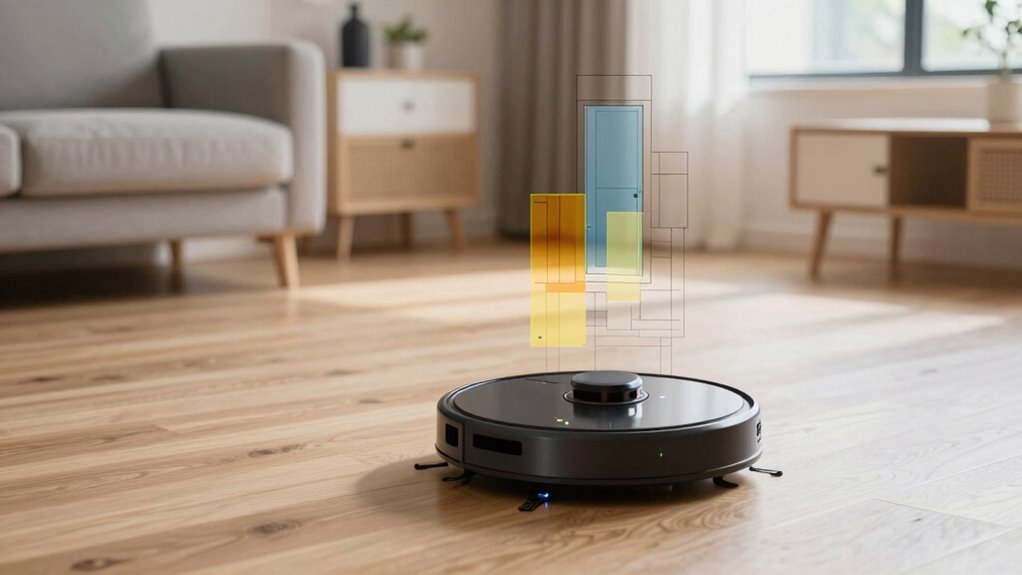
Ever wonder how your robot vacuum learns your home like a pro? It starts by scanning everything—walls, couches, your weirdly placed floor lamp— using smart tech like LIDAR lasers or camera-based vSLAM.
As it zips around, it’s not just cleaning; it’s building a digital map in real time, kind of like a tiny cartographer with a dustbuster.
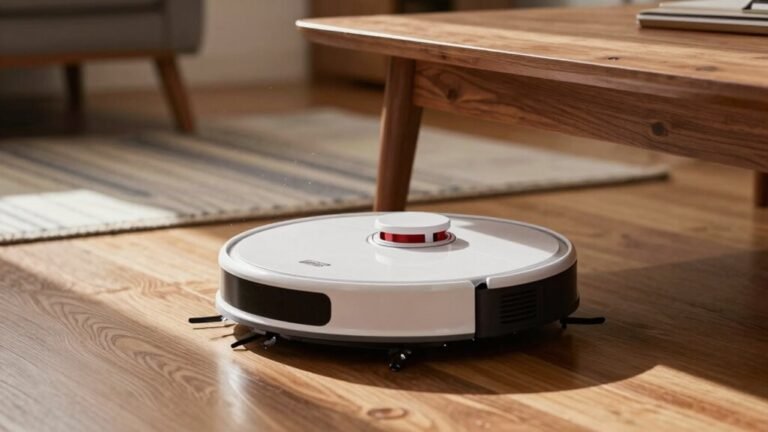
It remembers where the coffee table lives and how tight the hallway is, then plans the quickest route without doubling back.
And don’t worry, it won’t forget your layout overnight—it saves floor plans and updates them, so next time, it’s even sharper.
Some models even combine dToF sensors and infrared brains to skip bumps and avoid face-planting down stairs.
Think of it as your home’s very own mapping ninja, quietly memorizing every corner, all while dodging socks and pet toys like a boss.
This learning process allows for systematic, area-based navigation over time.
How Sensors Build a Room Layout
Your robot vacuum isn’t just wandering around hoping for the best—it’s using a smart lineup of sensors to build a clear picture of your home, kind of like putting together a puzzle blindfolded, but way more accurate.
LiDAR spins lasers to map every wall, even in the dark, while cameras capture landmarks like doors and furniture using Visual SLAM.
Infrared sensors help it feel the space, detecting edges and avoiding bonking into tables.
Wall sensors keep it skimming neatly along baseboards, and gyroscopes track turns so it doesn’t lose its way.
Cliff sensors stop it from committing stairway suicide, and smart obstacle detectors spot toys, cords, or pet bowls with a knowing wink.
Over time, all these sensors work together—like a tiny navigation dream team—mapping room by room, avoiding chaos, and learning the quirks of your layout, so it cleans smarter, not harder. This continuous improvement is driven by AI + Machine Learning, which enables the vacuum to adapt and refine its cleaning paths over multiple cycles.
Smart Mapping: Remembering Your Floor Plan
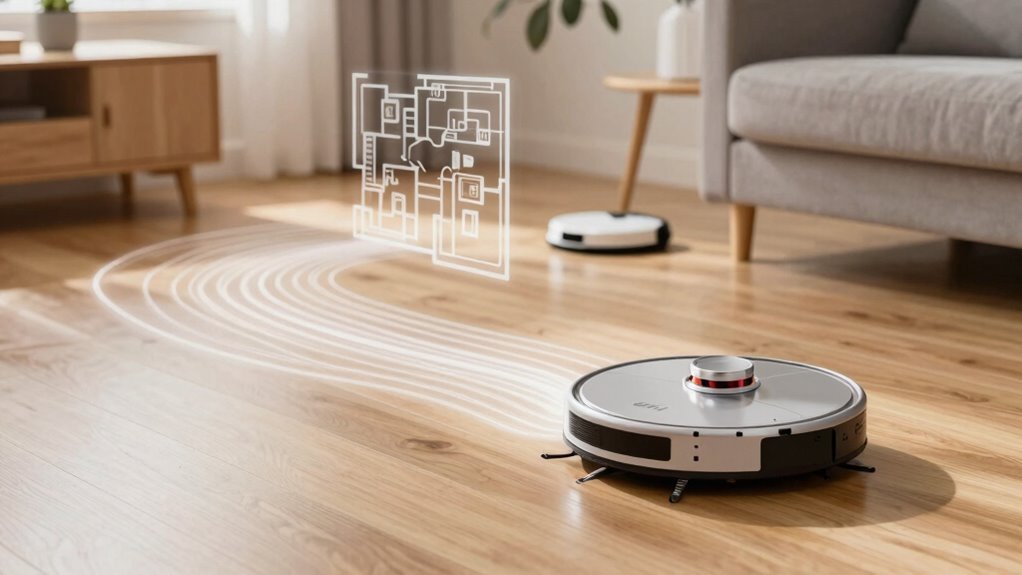
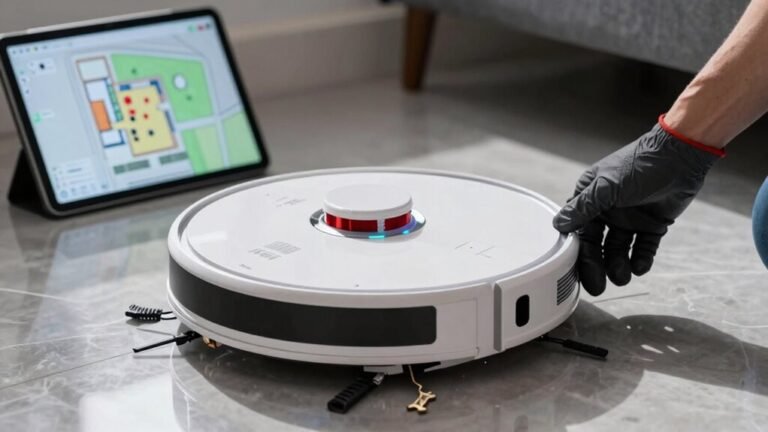
Once it’s mapped your space, your robot vacuum doesn’t forget—instead, it saves that digital blueprint like a savvy little GPS pro who’s always ready to go.
It remembers every room, hallway, and corner, even learning names like “Living Room” or “Pet Chaos Zone” (okay, maybe not that last one).
Whether you’ve got one floor or three, it stores multiple maps and swaps between them like a pro.
Move the couch? No problem—it updates the map instantly.
Plus, with app control, you can pick rooms to clean, set virtual boundaries, or banish it from your sock fortress—all from your phone.
- Saves and recalls full home layouts with ease
- Stores maps for multiple floors, no mix-ups
- Automatically labels rooms for targeted cleaning
- Updates maps when furniture moves—no tantrums
- Lets you control zones and schedules from your couch
How Robot Vacuums Learn to Avoid Obstacles
How does your robot vacuum dodge a rogue sock one minute and sidestep a dog toy the next without missing a beat? It’s not magic—it’s smart sensors and AI working together.
Lasers, cameras, and infrared beams scan the room hundreds of times per second, spotting obstacles before you even see them.
When it spots something, its onboard brain quickly figures out if it’s a shoe, a cord, or something gross on the floor.
Using clever algorithms, it decides whether to go around, steer clear, or safely nudge past.
Thanks to data from multiple sensors, it adapts in real time, even in dim light.
It doesn’t just stop—it contours around furniture, getting close (like 5mm close!) without bumping.
And yes, it learns from each near-miss, getting sharper every run.
Your vacuum’s not just cleaning—it’s dodging drama like a pro.
Navigating Multi-Floor Homes
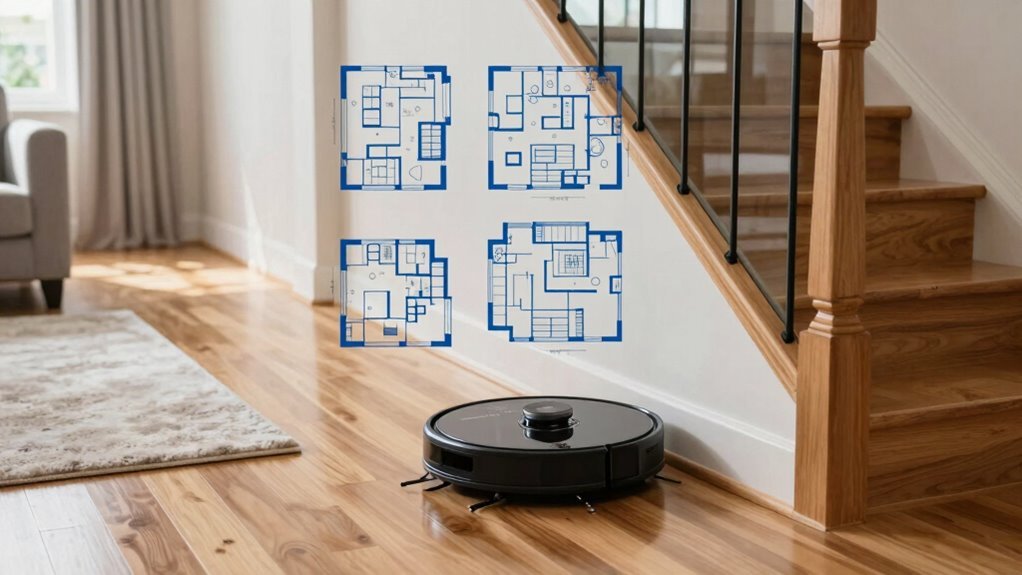
Ever wonder how your robot vacuum keeps from getting lost when your home spans more than one level?
It doesn’t climb stairs (wouldn’t that be something!), but it’s smart enough to handle multi-floor living.
After mapping each level, it uses landmark recognition and precise sensors to know exactly where it is—no matter the floor.
You’ll just carry it between levels (it’s light, promise), and it picks up right where it left off.
- Stores 3–5 unique floor plans for different levels
- Uses LiDAR and cameras to map with crazy accuracy
- Automatically recognizes which floor it’s on after setup
- Adjusts cleaning patterns based on floor type and room
- Controlled by app or voice—you can say, “Clean the basement!”
Just like that, your robot’s ready to conquer every level—no GPS required.
Setting Virtual Boundaries That Stick
Drawing invisible lines in your home just got way easier—thank your robot vacuum’s brain. You set virtual boundaries through your app, and the bot remembers them like a pro, no strings—or magnetic strips—attached. Just tap, drag, and boom: keep the robot out of your cat’s sacred snack zone or that messy toy graveyard.
| Feature | Why It Rocks |
|---|---|
| LiDAR & dToF sensors | Draw laser-precise barriers, no guesswork |
| App editing | Change zones anytime, even in pajamas |
| Mode-specific limits | Say “no mopping here” while vacuuming’s fine |
| Voice assistant sync | Tell Alexa to tweak boundaries hands-free |
You’re in charge, the robot obeys, and your floors stay clean—on your terms. It’s like giving your home a smart security bouncer, minus the attitude.
When and Why Re-Mapping Happens
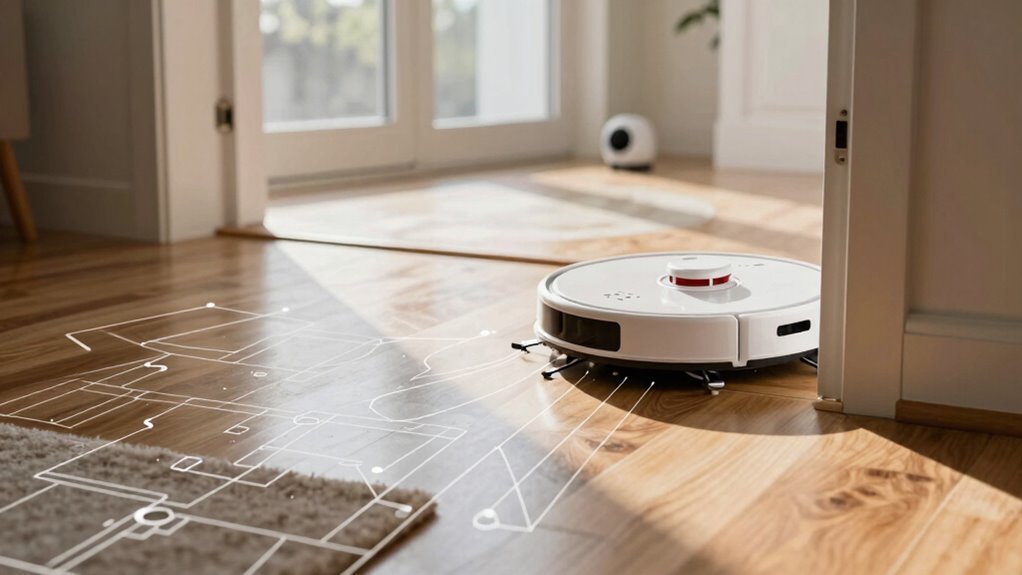
So, what happens when your robot vacuum suddenly acts like it’s never seen your living room before? Well, it’s not forgetting you—it’s just recalibrating.
When its confidence in your floor plan drops below 60–70%, or when you move the couch three inches (yes, it notices), it triggers a re-map.
Tall lamps in front of blank walls? That’ll confuse its LIDAR faster than a cat on a Roomba.
But don’t worry—this smart little robot isn’t starting over blindly.
- It spots big changes, like new furniture or shifted shelves
- LIDAR stumbles on tricky spots, like poles near walls
- It uses doorways and windows as anchor points to stay on track
- Short 15-minute update cycles can fix small map wobbles
- You can tweak maps in the app instead of begging it to try again
Your vacuum’s not lost—it’s learning.
Frequently Asked Questions
How Long Does It Take to Learn a New Layout?
It usually takes just one full cleaning run—about 3 to 5 minutes per room—to learn a new layout.
You’ll see your robot zip around, snapping pics of walls and furniture like it’s on a sightseeing tour.
By the time it docks, it’s already got the basics down.
After a few more cleans, it’s zooming smarter, dodging socks like a pro, and remembering your kitchen from your living room—no GPS required!
Can Robot Vacuums Map in the Dark?
Yes, you can vacuum in the dark—robots got night vision!
Using LiDAR, infrared, and smart sensors, they zip around your pitch-black living room like tiny undercover agents.
No need for nightlights; these bots rely on laser pulses and 3D mapping to dodge furniture and stairs.
Some even use AI to remember obstacles, so your dog’s chew toy won’t be a midnight surprise.
Darkness? More like game time for your robo-helper!
Do They Work on Shiny or Reflective Floors?
Yeah, they totally work on shiny or reflective floors!
Modern robot vacuums use smart LiDAR and hybrid sensors that won’t get fooled by glossy tiles or mirrored surfaces.
They bounce laser beams like pros, avoid confusing reflections, and still map your space accurately.
Just keep sensors clean and tweak lighting if needed.
Think of them as tiny, fearless explorers—no shiny floor’s gonna trip them up for long!
Can Multiple Users Access the Same Map?
Yeah, you and your folks can share the map, no problem!
With Roborock, just add teammates through your app, and boom — everyone sees the same smart setup.
Eufy lets family join the fun via email invites.
Wyze and iRobot also share the spotlight, letting others help with cleaning chores.
Just make sure all accounts play nice — same country, same team, same squeezy!
Who knew robot vacs could bring the household together?
Does Wi-Fi Affect Mapping Accuracy?
Yeah, Wi-Fi totally affects mapping accuracy—don’t blame your vacuum when it gets confused in dead zones!
Weak signals mean sketchy maps, like trying to text with one bar.
A strong, stable connection keeps your robot’s brain sharp, especially during its first roam.
Go for 5GHz speed near the router, or 2.4GHz for reach.
Toss in an extender if needed, and boom—your bot maps like a pro, no awkward bumps or ghost rooms!
Conclusion
You’ll laugh when your robot vacuum finally dodges the dog’s chew toy like a ninja avoiding laser beams. Over time, it learns your home like it’s starring in its own tiny spy movie, mapping every corner with quiet confidence. No more clueless bumbling—it knows where to clean, what to avoid, and even remembers your favorite rug. Pretty soon, you’ll forget it wasn’t born here.
References
- https://us.3itech.com/blogs/news/how-does-robot-vacuum-mapping-work
- https://us.narwal.com/blogs/robot-vacuum/mapping-vs-no-mapping
- https://www.ecovacs.com/us/robot-vacuums/robot-vacuums-with-mapping
- https://www.target.com/c/robotic-vacuums-floor-care-home-appliances/smart-mapping/-/N-4y73oZ1rvvyyspic6
- https://maticrobots.com
- https://www.sharkninja.com/vacuums-air-care/vacuum-cleaners/robot-vacuums
- https://www.eufy.com/blogs/robovac/how-do-robot-vacuum-maps
- https://in.dreametech.com/blogs/tips-tricks/how-robot-vacuum-navigation-works-sensors-mapping-smart-cleaning-explained
- https://us.narwal.com/blogs/product/robot-vacuum-mapping
- https://www.therobotreport.com/sensor-breakdown-how-robot-vacuums-navigate-and-clean/