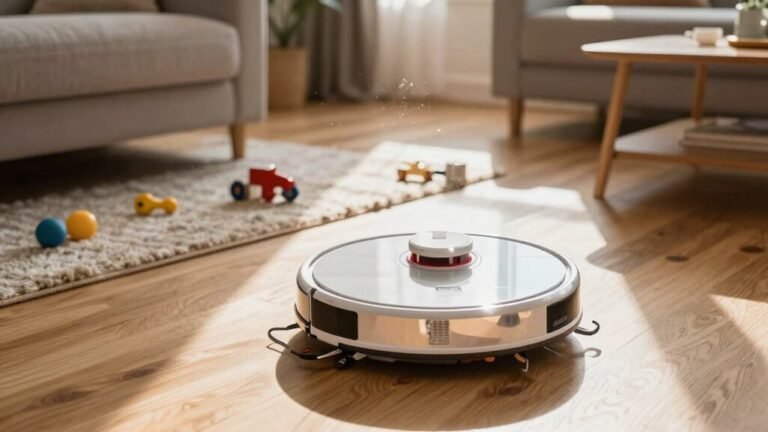
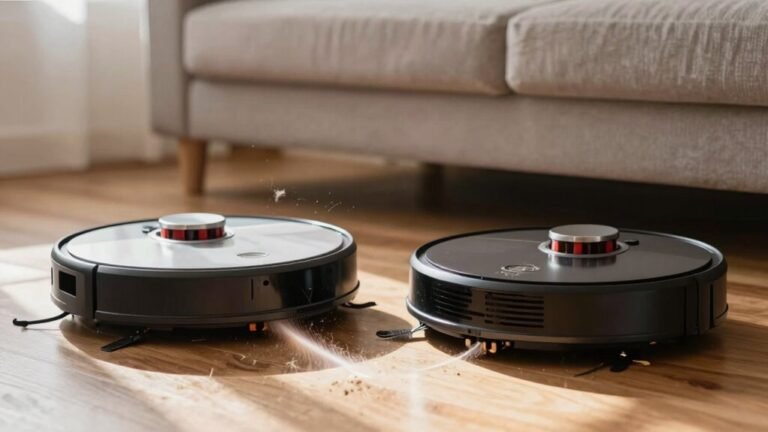
What Is vSLAM in Robot Vacuums?
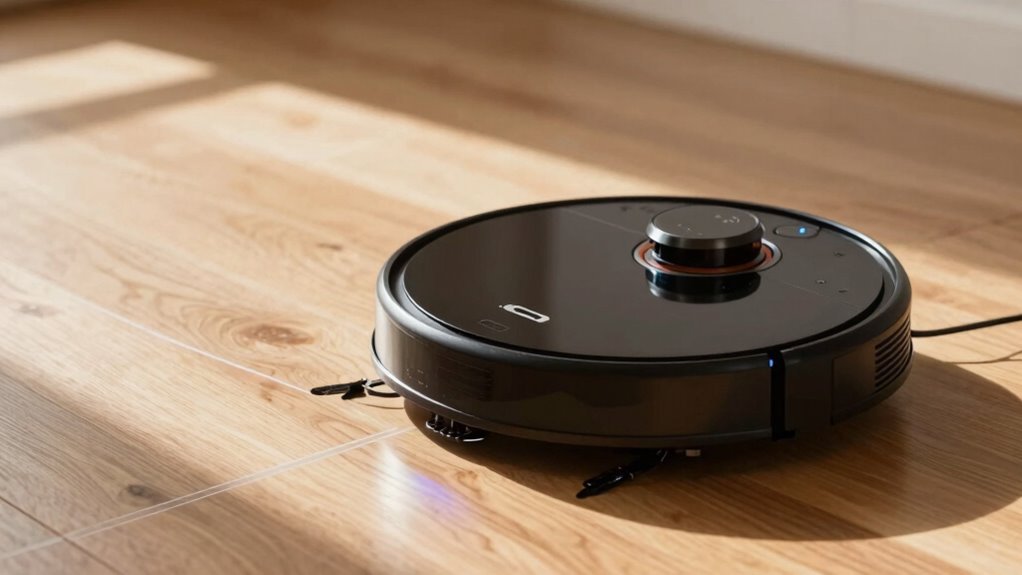
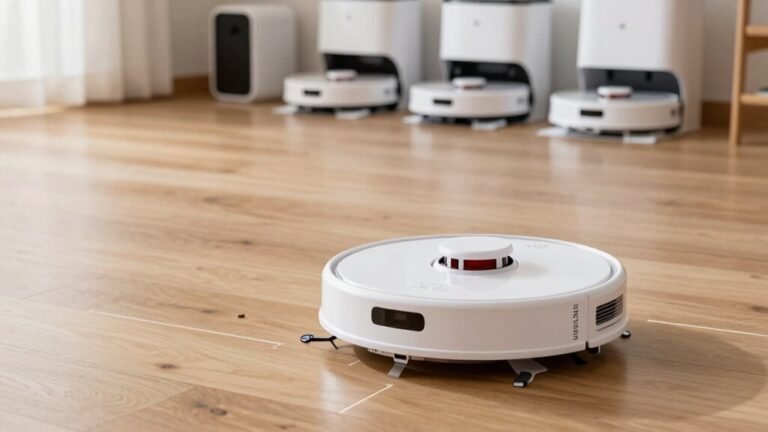
You’ve got a robot vacuum that’s basically a tiny detective, using vSLAM to “see” your walls, ceiling, and coffee table with a smart camera on top. This technology, known as vSLAM, allows the robot to visually map its surroundings by detecting key features in the environment.
It tracks visual clues—like corners and textures—while combining data from sensors to map your home in real time. Think of it as GPS for your floor, minus the satellites and with more zigzags.
The robot vacuum learns your layout, avoids repeating the same spot, and can even remember different rooms. It navigates efficiently, constantly adjusting its path as it moves through your space.
Wonder how it handles the dark or what happens when things go sideways? There’s a fun fix for that.
What Is vSLAM in Robot Vacuums?
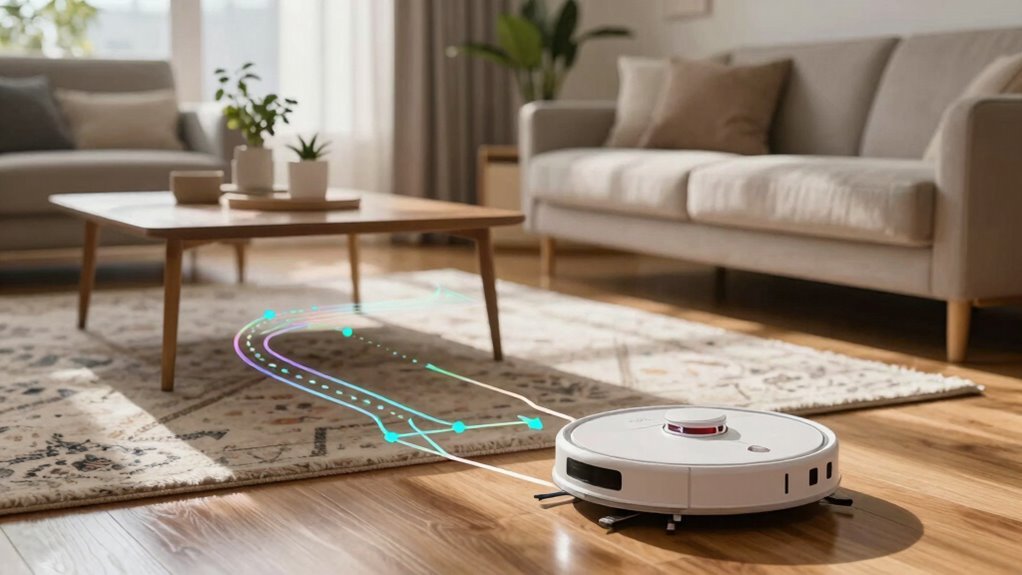
Ever wonder how your robot vacuum “sees” the room and doesn’t just spin in circles like it’s dizzy? Well, it uses something called vSLAM—Visual Simultaneous Localization and Mapping. You’re basically giving your vacuum robot eyes and a brain!
It snaps pictures of ceilings, walls, and furniture with a top-mounted camera, then uses smart algorithms to build a map while tracking where it is. It grabs over 230,000 data points every second, blends info from gyroscopes and wheel sensors, and even remembers landmarks like your coffee table or front door.
It’s like how you’d recognize your kitchen in the dark—just smarter and less clumsy. Sure, it struggles in dim light or blazing sun, but hey, nobody’s perfect.
With vSLAM, your little robo-helper doesn’t just clean—it learns, adapts, and navigates like a pro, minus the coffee breaks. Vision sensors in these systems can be monocular, stereo, omnidirectional, or RGBD.
How vSLAM Helps Vacuums Navigate Your Home
Zipping around your living room like a tiny, determined explorer, your robot vacuum uses vSLAM to actually *see* where it’s going—no, it’s not magic, but it’s pretty close.
It spots corners, edges, and your chunky sofa like visual breadcrumbs, using them to figure out its spot and track movement.
As it rolls, it’s constantly recognizing furniture, doors, and walls, building a mental cheat sheet of your home.
Thanks to cameras and smart math, it knows where it’s been and where it hasn’t—so it doesn’t clean the same spot twice like it forgot.
Even in low light, it teams up camera smarts with gyro help to stay on course.
Best part? It’s affordable, efficient, and surprisingly clever—like a mini detective with a mop, solving the mystery of your messy floors one room at a time.
This smart navigation is powered by AI + Machine Learning, allowing the vacuum to learn and adapt its cleaning path over time.
How vSLAM Builds a Real-Time Map
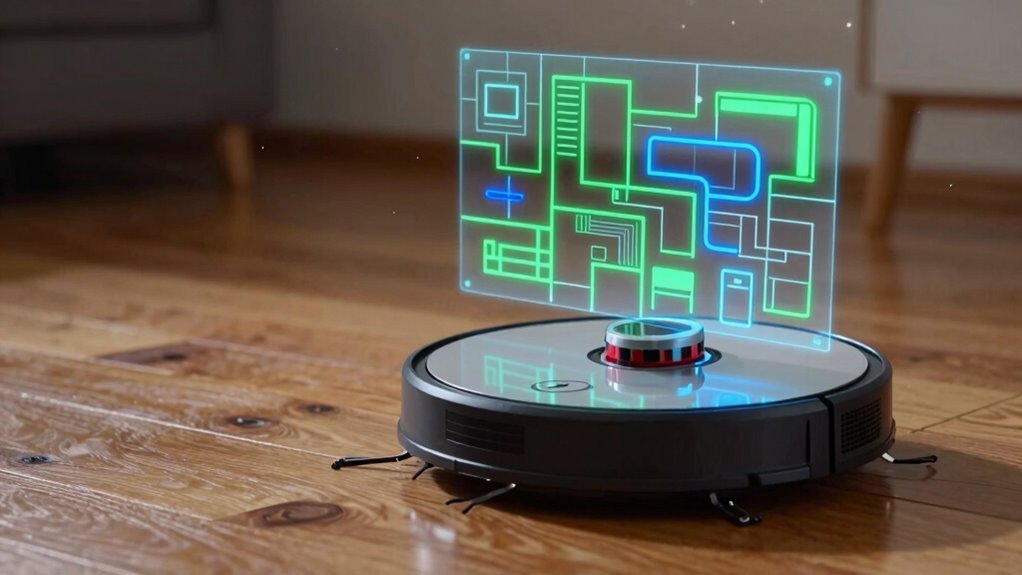
How does your robot vacuum suddenly “get” where it’s going—like it finally read the owner’s manual?
Well, it’s using vSLAM to build a real-time map as it rolls.
Your robo-vacuum’s camera snaps images fast—over 230,000 data points every second—spotting corners, edges, and textures it can track.
As you watch it zip around the coffee table, it’s actually comparing each new frame to the last, figuring out how far it’s moved.
It combines that with motion sensor data to update its position instantly.
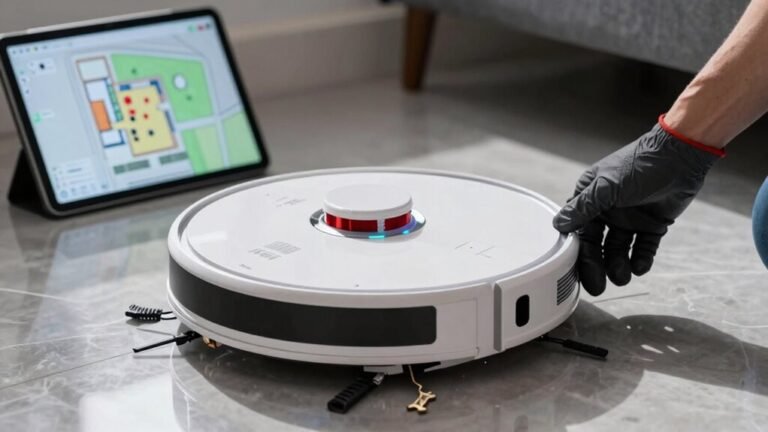
The robot maps feature points in 3D, placing itself and your furniture in real time.
Every second, it tweaks the map, marking where it’s been—and where it still needs to clean.
It’s not magic (though it feels like it); it’s smart math, constant updates, and a little robotic determination.
Why Cameras Are Key to vSLAM Accuracy
What makes your robot vacuum so good at remembering where the couch leg is—or dodging your slippers like a pro? It’s the camera, your bot’s own set of eyes!
It snaps pictures of your room, spotting corners, edges, and furniture like visual breadcrumbs.
With 230,400 data points every second, it’s basically a speed reader for spaces.
It uses those cool feature points to build a 3D-style map and knows exactly where it is—no guessing.
Sure, it needs decent lighting (nobody likes tripping in the dark), but in good light, it’s quick, sharp, and accurate down to 5 cm.
Cameras team up with motion sensors to stay steady, and smart AI helps it learn your home.
Without the camera, your robot would be, well, half-blind.
vSLAM vs. LiDAR in Robot Vacuums
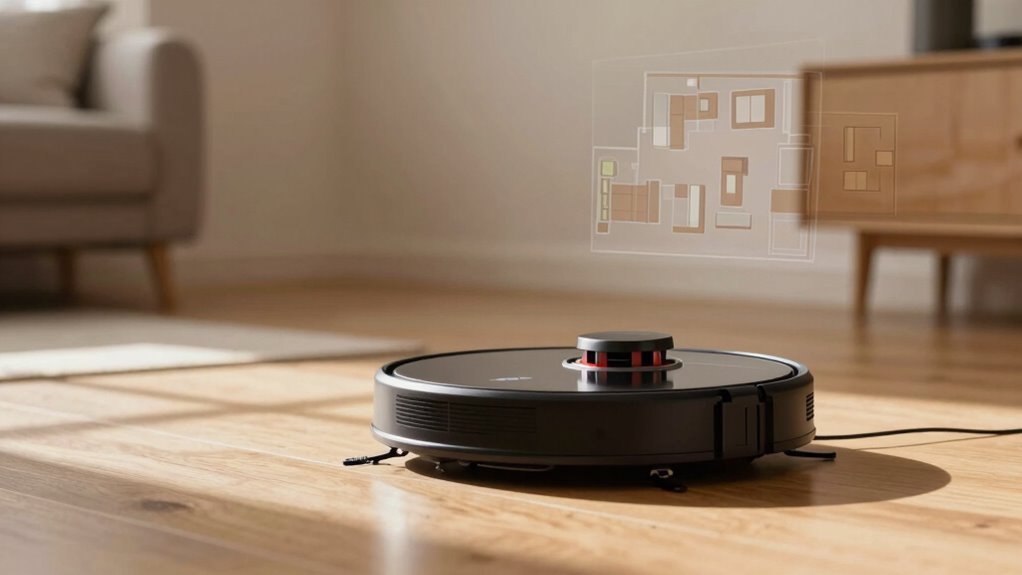
Ever wonder why some robot vacuums glide through your home like they’ve got a GPS in their genes, while others seem to wing it like a rookie in a bumper car? That’s the vSLAM vs. LiDAR showdown! LiDAR’s laser precision maps fast, works in the dark, and cleans smarter—no wonder it’s the pro champ. But vSLAM? It’s the budget-savvy buddy, affordable and sleek, though it stumbles in dark, blank hallways. You want reliability and speed? LiDAR’s your go-to. Prefer a slim vacuum that sneaks under the couch? vSLAM wins on design.
| Feature | LiDAR 😍 | vSLAM 😅 |
|---|---|---|
| Accuracy | Laser-sharp | Needs visual clues |
| Speed | Maps in one go | Takes multiple runs |
| Low-light Performance | Works like magic | Gets confused |
| Cost | Pricier | Wallet-friendly |
How vSLAM Pinpoints Your Vacuum’s Location
You’re zipping around the house, vacuum in tow, and it’s not bumping into the coffee table like it’s playing pinball—thanks to vSLAM doing the heavy lifting behind the scenes.
Cameras in your robot spot corners, edges, and textures, tracking them like visual breadcrumbs.
These landmarks help it figure out exactly where it is, even if the couch moved a bit.
It’s not just guessing—wheels count rotations while cameras and sensors team up to measure movement and direction.
Software smarts handle tricky light or a quick swivel, keeping everything on track.
Every pass updates the map, focusing only on new changes—no redoing the whole thing.
Walls act like reliable anchors, while fancy math pieces together your home in 3D.
And no, it doesn’t need GPS—your living room is its world, and vSLAM’s got the map covered, one smart step at a time.
Smart Path Planning for Faster Cleaning
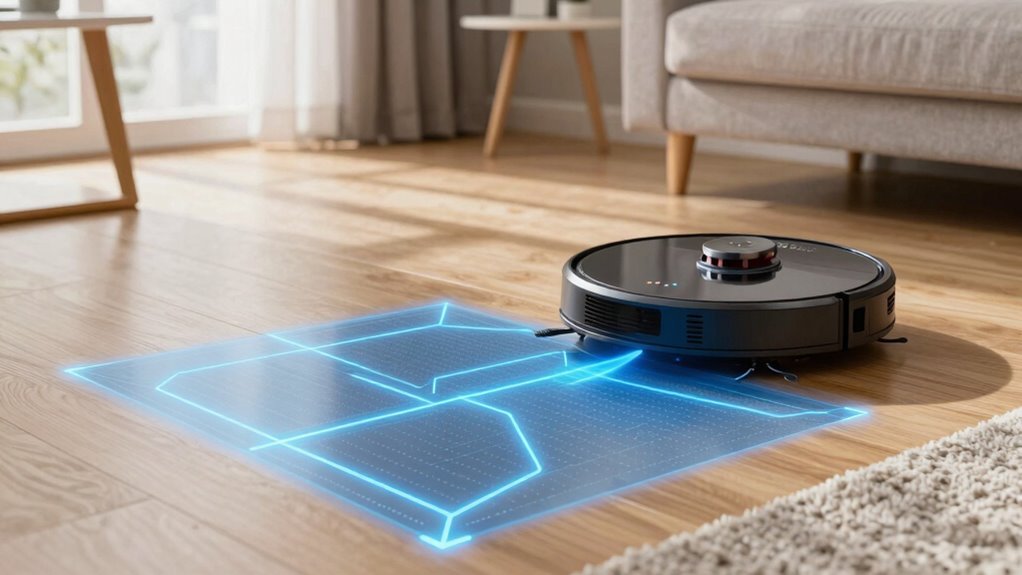
Zipping through your home like a tiny, determined racecar, your robot vacuum now knows exactly where to go—and how to get there fast.
Using smart algorithms like A* and D*, it plots the quickest route, dodging furniture and recalculating on the fly when your dog trots across the room.
No more clueless bumping—your bot follows neat grid patterns, covering every inch without wasting time.
It learns your home’s layout over time, remembers high-traffic zones, and even adjusts cleaning based on when you’re usually home.
Thanks to vSLAM, it won’t revisit freshly cleaned spots or get stuck in a corner like it’s pondering life choices.
With real-time sensor fusion and slick obstacle detection, it zips from room to room like it’s got a GPS and a caffeine boost.
Cleaning just got smarter, faster, and a whole lot more fun to watch.
Does vSLAM Work in the Dark?
Your robot vacuum may zip around like it’s got a map etched in its memory, thanks to smart path planning that avoids bumps and wasted moves.
But when the lights go out, that clever vSLAM system starts to squint.
Cameras need light to spot walls, furniture, and your stray socks—without them, it gets confused fast.
Dim rooms mean blurry visuals, leading to wobbly navigation or even giving up early.
While LiDAR robots laugh at the dark, vSLAM models can stumble, especially on dark floors under dark ceilings.
Some, like Dyson’s, cheat with built-in LEDs, giving their cameras a nightlight to work with.
But most? They’d rather not.
For best results, leave a light on or schedule cleanings during the day.
Otherwise, your robot might just be spinning in circles, literally and figuratively—poor guy!
Best Robot Vacuums With vSLAM
| Model | Key Feature | Perfect For |
|---|---|---|
| Roomba S9 | Twin rubber brushrolls | Pet parents |
| Roomba J7+ Combo | Mop attachment | Spill fighters |
| Roomba S series | Strongest suction | Deep cleaners |
| Roomba I series | Smarter automation | Tech lovers |
| Roomba J series | Hazard ID | Clutter champs |
Cleaning’s about to get a whole lot smarter—and way more fun.
Why vSLAM Gets Confused and How to Fix It
Ever wonder why your robot vacuum suddenly acts like it’s lost in space, spinning in circles or refusing to enter a perfectly normal room?
Yeah, vSLAM can get confused—just like you in a dark hallway.
But don’t worry, most hiccups have simple fixes.
- Turn on the lights—dim rooms trick your robot into thinking there’s a cliff or unknown zone.
- Tame the shine—wipe sensors and steer clear of mirrors or glossy floors that create visual chaos.
- Tidy up first—moving toys, cords, or furniture throw off its carefully mapped routes.
- Remap regularly—delete old maps and start fresh to avoid ghost walls or phantom obstacles.
A quick reboot or firmware update often works wonders too. Think of it as giving your little robo-brain a sip of coffee. With a few tweaks, your vacuum will be zipping around like a pro again—no more existential crises allowed!
Frequently Asked Questions
Can vSLAM Work on Carpets With No Patterns?
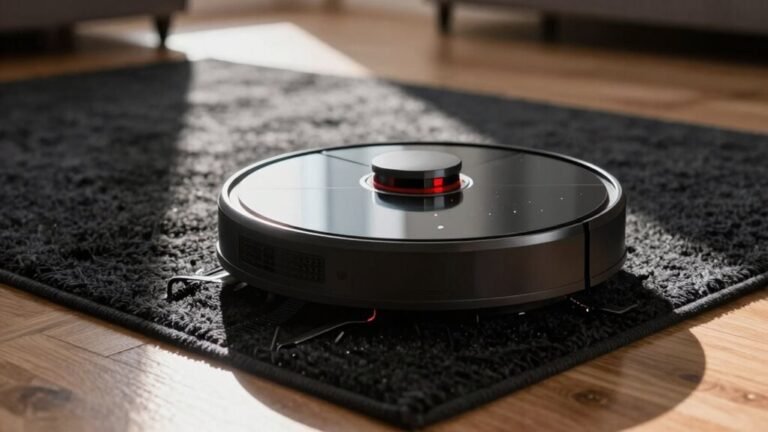
No, you’ll struggle with totally blank carpets—vSLAM needs visual clues like textures or furniture edges to get its bearings.
Without patterns, it’s like trying to navigate a white room with no doors.
But don’t worry, it usually teams up with gyroscopes and accelerometers to stay steady on rugs.
While it stumbles on plain floors, it rocks at dodging your coffee table—just keep a few landmarks in sight!
Does vSLAM Require Wi-Fi to Function Properly?
No, you don’t need Wi-Fi for vSLAM to work—your robot’s got eyes!
It uses its camera to spot room features like corners and edges, then maps everything on the fly.
You’re good to go even in a basement with zero signal.
Think of it like a tiny, methodical explorer with a photographic memory.
No internet? No problem—it’s mapping just fine all on its own.
Is vSLAM Safe for Home Privacy and Data?
You’re safe—vSLAM keeps your privacy intact.
It maps your home using ceiling shots and sensors, but the data stays on the robot, no spying servers involved.
Sure, it uses cameras, but they’re staring up, not snooping at your stuff.
Low-light? No problem—it might struggle, but at least no one’s watching.
Think of it as a nosy but clueless robot that forgets everything the second it powers down.
Can vSLAM Detect Small Objects Like Socks?
You’re not gonna love this—vSLAM spots socks about as well as a giraffe sees its own feet, awkwardly!
Since it uses upward-facing cameras, tiny, low-profile things like socks often slip under its radar.
It’s great with furniture legs and bigger stuff, grabbing 230,400 data points per second, but floor-hugging clutter?
Not so much.
Does vSLAM Improve Over Time With Use?
Yeah, vSLAM does get better over time—it’s like your vacuum learns the lay of the land.
You’ll see it mapping faster and nailing sharp turns with confidence.
It uses what it’s learned from past cleanings, spots errors, and smooths them out.
Think of it leveling up, not overnight, but after a few rounds.
It’s not magic, but close—your robot’s basically a student acing its homework every day!
Conclusion
You zip through chores, your robot zips through rooms. vSLAM spots clues, maps corners, and learns layouts. It sees with smart eyes, plans clean paths, and avoids sock piles like landmines. Light or dim, it navigates fast, cuts cleaning time, and skips repeats. Cameras do the magic, not lasers. Sure, it might hiccup near mirrors or shadows, but a quick reset? Back in action. With vSLAM, your floors stay fresh—and your vacuum? Smarter than your average Roomba.
References
- https://www.allaboutcircuits.com/news/what-is-visual-slam-not-just-a-tech-for-roomba-vacuums/
- https://in.dreametech.com/blogs/tips-tricks/how-robot-vacuum-navigation-works-sensors-mapping-smart-cleaning-explained
- https://www.youtube.com/watch?v=5O8VmDiab3w
- https://us.narwal.com/blogs/product/robot-vacuum-mapping
- https://www.techadvisor.com/article/2283951/robot-vacuum-navigation-types-explained.html
- https://miko.ai/blogs/technology/visual-slam-for-self-navigating-indoor-social-robots
- https://mrdvs.com/visual-slam-overview/
- https://www.interlakemecalux.com/blog/slam-navigation-robotics
- https://milvus.io/ai-quick-reference/what-is-visual-slam-and-how-is-it-used-in-robotics
- https://www.therobotreport.com/sensor-breakdown-how-robot-vacuums-navigate-and-clean/