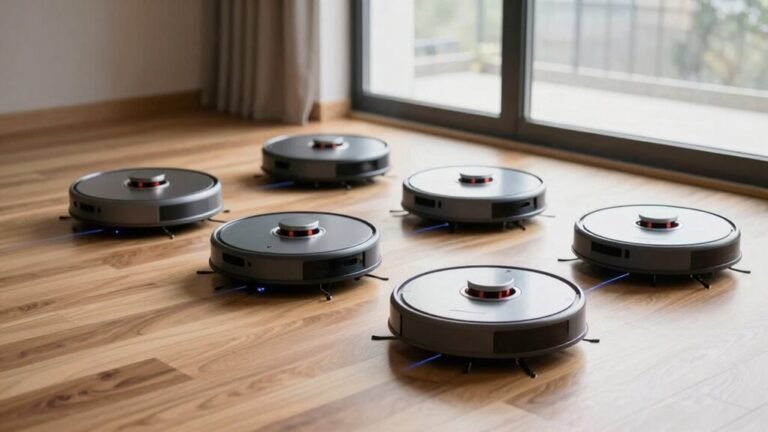
Can Robot Vacuums Work in the Dark?
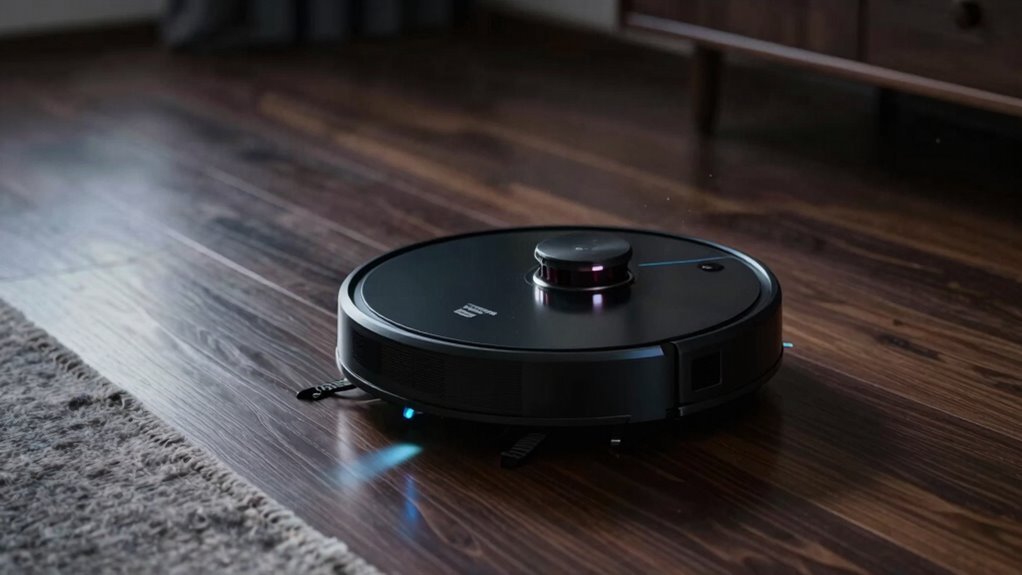
You bet your robot vacuum can tackle the dark—no nightlight needed! Robot vacuums are designed to operate efficiently in complete darkness using advanced technology.
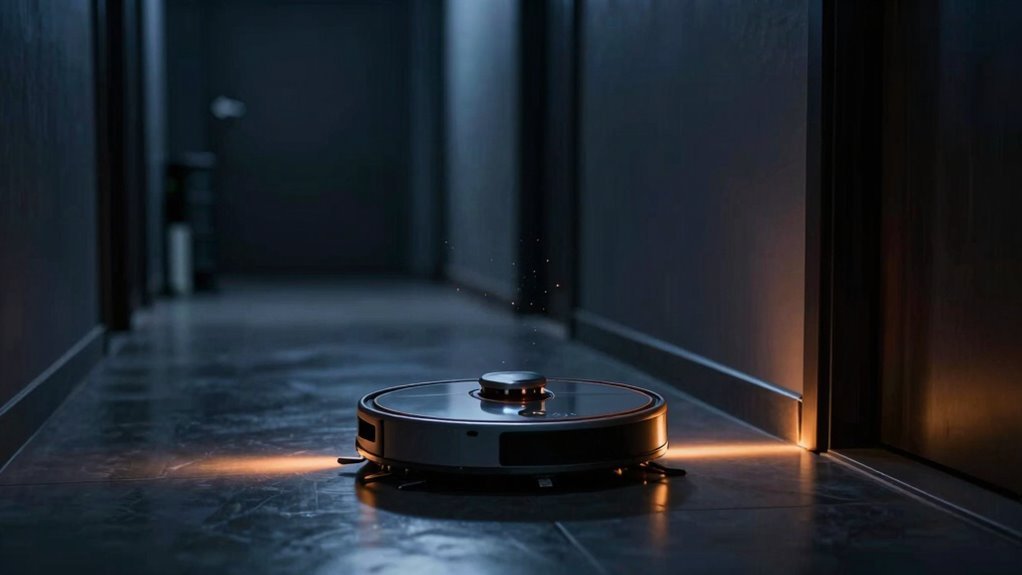
It zips around using invisible lasers and smart sensors that map walls and avoid stairs, even in total blackout. While camera-based bots might fumble, LiDAR-powered ones thrive, seeing the room like a ninja with super senses.
Just keep the floor clear, and let it work its magic. Stick around, and you’ll uncover the secrets behind its midnight moves.
How Do Robot Vacuums See in the Dark?
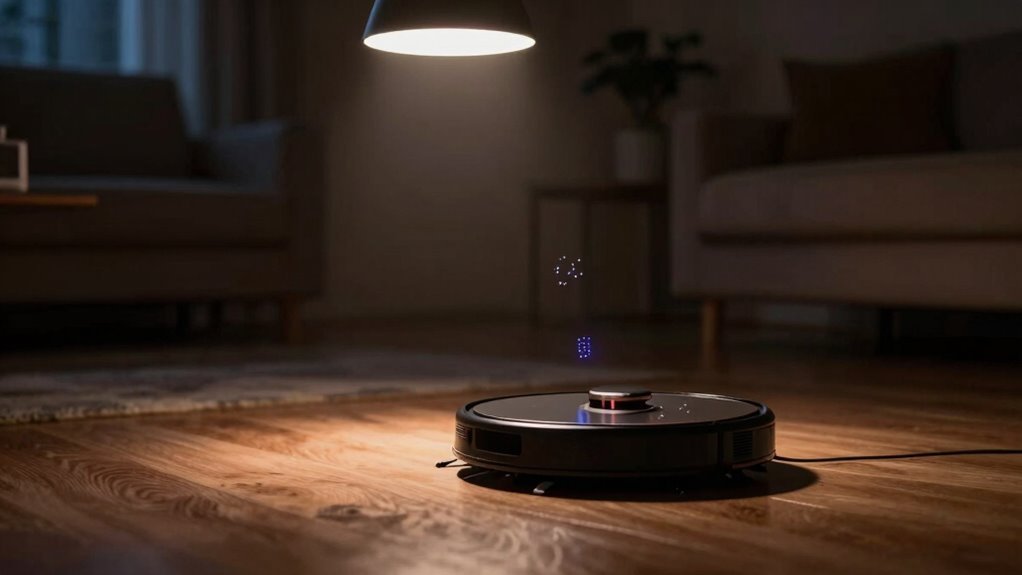
When the lights go out, your robot vacuum doesn’t fumble around like you might in your kitchen at night—thanks to some pretty smart tech under the hood.
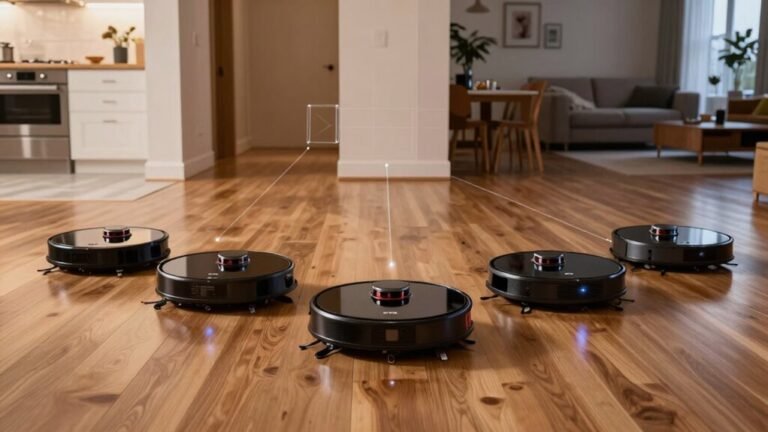
It uses LiDAR, shooting tiny lasers in all directions, even in pitch black, to measure distances and map walls.
Think of it as echolocation, but with light—super accurate and totally cool.
The rotating sensor scans 360 degrees, thousands of times per second, so it never misses a couch leg or stray slipper.
Infrared sensors help it avoid cliffs (aka stairs), and dToF tech times laser pulses to build a depth map faster than you can say “clean sweep.”
It’s not guessing—it’s calculating, turning darkness into data.
No need for nightlights; your robot’s got its own invisible flashlight.
And while you’re blindly grabbing the wrong snack from the pantry, it’s gliding smoothly, mapping, avoiding, and vacuuming like a tiny, tireless ninja in the dark.
Advanced models even use dToF LiDAR for pinpoint mapping in complete darkness.
Can They Map a Room in Total Darkness?
Ever wonder how your robot vacuum handles a room so dark you’d trip over your own shoes?
If it’s got LiDAR, pitch-black is no problem.
That little spinner on top shoots out invisible laser pulses, scanning 360 degrees to measure distances and build a map—all without a single ray of light.
Using smart SLAM tech, it tracks where it is, plans clean paths, and remembers rooms, even during late-night runs.
Premium models with dToF lasers nail tight corners and avoid glossy floor glitches like pros.
Infrared and gyro sensors pitch in, too, helping it stay on course.
Sure, camera-based bots struggle when it’s totally dark—like trying to draw a map blindfolded—but LiDAR robots?
They’re rocking the dark like night ninjas, mapping flawlessly while you dream.
This is because LiDAR navigation works in dark spaces (LiDAR navigation).
Totally lit.
Well, not literally.
Why Some Fail in Dark or Low-Light Rooms
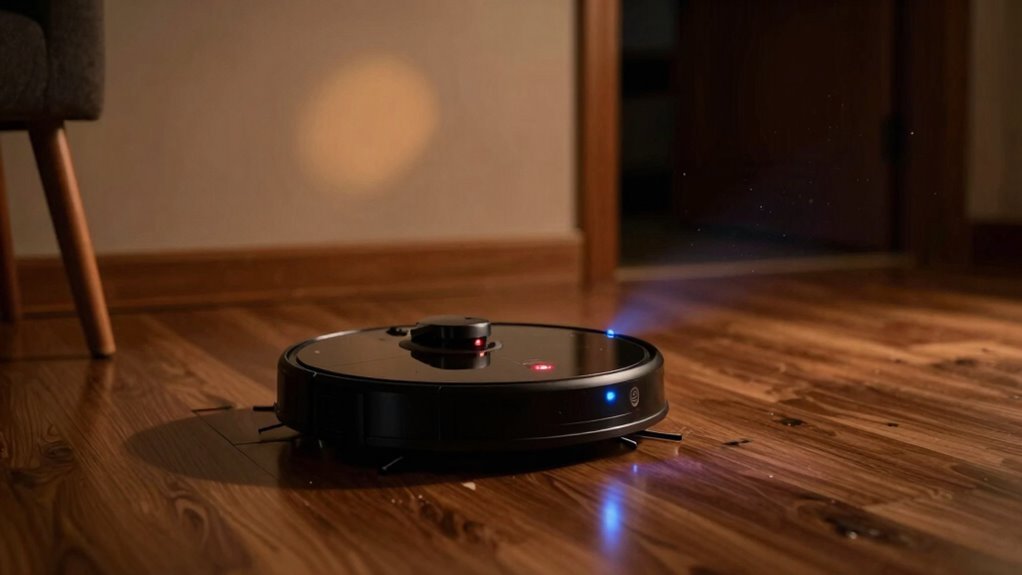
What if your robot suddenly turns clueless the moment the lights go out?
Well, many models rely on cameras to see where they’re going, and in the dark, those cameras struggle—fast.
Without enough light, they can’t spot landmarks, so they lose their sense of direction.
Some even mistake dark rugs or shadows for cliffs and panic, backing away like they’ve seen a ghost.
Optical sensors get confused, bumping into furniture or skipping spots altogether.
If your bot doesn’t have LiDAR or night-vision smarts, it’s basically vacuuming blindfolded.
Cheap cameras overexpose bright spots and miss details in dim corners, making maps messy.
Even the smartest algorithms can’t save a robot drowning in darkness.
Do Nightlights Help Robot Vacuum Navigation?
So, will flipping on a nightlight actually help your robot vacuum do its job better in the dark?
Well, it depends—your robot’s tech matters more than you’d think.
If it uses a camera to “see” the room, a soft glow helps it map corners and avoid bumping into things.
But if it’s powered by lasers or infrared, flipping on a light won’t make a bit of difference—it’s already got night vision!
- Camera-based bots love nightlights – they spot details better in gentle, even light.
- Humans benefit too – no more tripping over the robot during midnight raids to the kitchen.
- Dark floors? Light helps sensors – stops your bot from thinking every shadow is a cliff.
How to Optimize Cleaning in the Dark
How do you make sure your robot vacuum tackles the dark like a pro?
Clear cables, toys, and socks first—those sneaky hazards can confuse sensors when it’s pitch black.
Secure pet bowls and curtains so they don’t go on an accidental joyride.
Skip mirror tiles or glass decor near the floor; they’ll mess with the laser like a disco light.
Use a LiDAR-powered model—it maps the room like a ninja, even in total darkness.
Save your maps during the day, then let it rip at night with virtual walls guarding tricky zones.
Stick to simpler rooms after sunset, and keep those docking areas on a neutral surface so it doesn’t get lost.
Clean the sensors regularly—dust bunnies fool even the smartest bots.
And hey, if your carpet’s darker than midnight, test it first.
A little prep makes your robot’s nightly grind smooth, smart, and surprisingly fun.
Frequently Asked Questions
Can Robot Vacuums Clean in Pitch-Black Basements?
Yeah, you can totally send your robot vacuum into that pitch-black basement without a second thought.
If it’s got LiDAR or infrared sensors, it’ll map the space, dodge boxes, and clean corners like a pro—no light needed.
Just imagine it zipping around in the dark, quietly conquering dust bunnies and forgotten sneakers.
Pretty cool, right?
Just keep the area somewhat clutter-free, and let your little robo-hero do its thing while you relax.
Do Dark Floors Confuse Robot Vacuums?
Yeah, dark floors *do* confuse some robot vacuums—ironic, right?
They’re not scared of the dark, but jet-black tiles or rugs? Those trick their sensors into thinking there’s a cliff.
You’ll see them hesitate, spin, or bail fast.
But don’t sweat it—models with LiDAR or lasers laugh at dark floors.
They map like pros.
Clean your sensors too; dust makes everything worse.
Smart choice = no more robot meltdowns on your sleek, stylish floor.
Are Robot Vacuums Safe to Use at Night?
Yes, you can safely run your robot vacuum at night—no need to keep the lights on!
It uses smart sensors and lasers to “see” in the dark, dodging furniture and stairs like a pro.
It won’t bump into your cat (or your socks), thanks to infrared tech and clever AI.
Plus, it quietly cleans while you sleep, then zips back to its dock.
Think of it as your home’s midnight janitor—efficient, polite, and never asks for coffee.
Do Robot Vacuums Work Under Beds With No Light?
You bet they do—68% of LiDAR-powered robot vacuums clean under beds in total darkness without a hitch!
You’ll love how they zip under your bed, using lasers and smart sensors instead of eyes, like tiny nocturnal ninjas.
They map the space, dodge dust bunnies (and actual socks), and come out unscathed—all while you’re fast asleep and dreaming of cleaner floors.
Can I Use My Robot Vacuum in a Windowless Room?
Yes, you can totally use your robot vacuum in a windowless room—no sunlight needed!
If it’s got LiDAR or infrared sensors, it’ll zip around like a tiny night-vision spy.
It maps the space, dodges obstacles, and finds its dock, all in the dark.
Just keep the floor clear and the sensors dust-free.
Think of it as your room’s personal, hardworking ninja.
Quiet, smart, and always ready to roll—literally!
Conclusion
You’ve got this, robot in the dark! With smart sensors, it zips around like a bat in a cave, using echoes instead of light. Most handle darkness just fine, especially if they’ve mapped the room first. A nightlight? Nice touch, but not a must. Keep the floor clutter-free, and your little buddy will breeze through like it’s golden hour. Cleaning in the dark? Totally doable—your home’s safe with its tiny, tireless ninja.
References
- https://www.ecovacs.com/us/blog/robot-vacuum-dark-floors-environments
- https://us.3itech.com/blogs/news/lds-vs-dtof-lidar-navigation-in-robot-vacuums
- https://in.dreametech.com/blogs/tips-tricks/how-robot-vacuum-navigation-works-sensors-mapping-smart-cleaning-explained
- https://www.switch-bot.com/blogs/robot-vacuum/robot-vacuums-lidar-dark-cleaning
- https://newsroom.roborock.com/us/news/understanding-how-robot-vacuums-navigate-and-how-it-significantly-impacts-your-cleaning-experience-
- https://forums.wyze.com/t/does-the-robot-vacuum-need-light/234384
- https://homesupport.irobot.com/s/article/31161
- https://www.eufy.com/blogs/robovac/how-do-robot-vacuums-work
- https://us.narwal.com/blogs/product/can-robot-vacuum-work-night
- https://www.youtube.com/watch?v=JO_HveEAYwQ