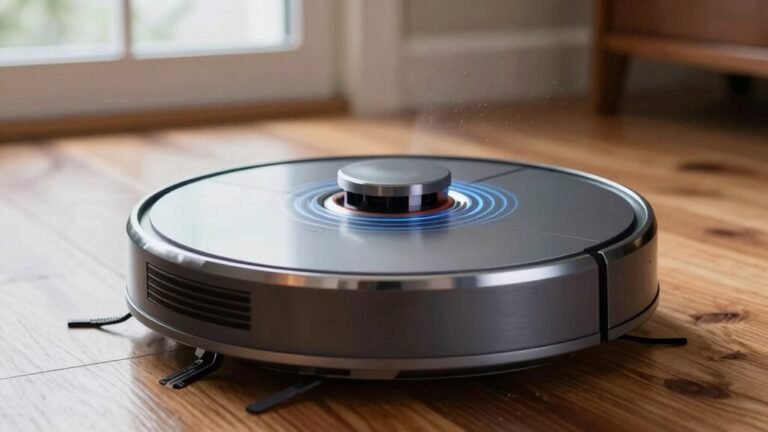
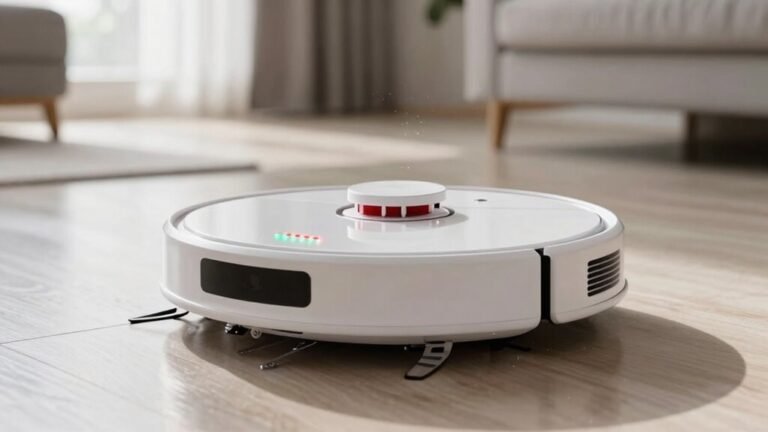
The Evolution of Robot Vacuums: Past to Present
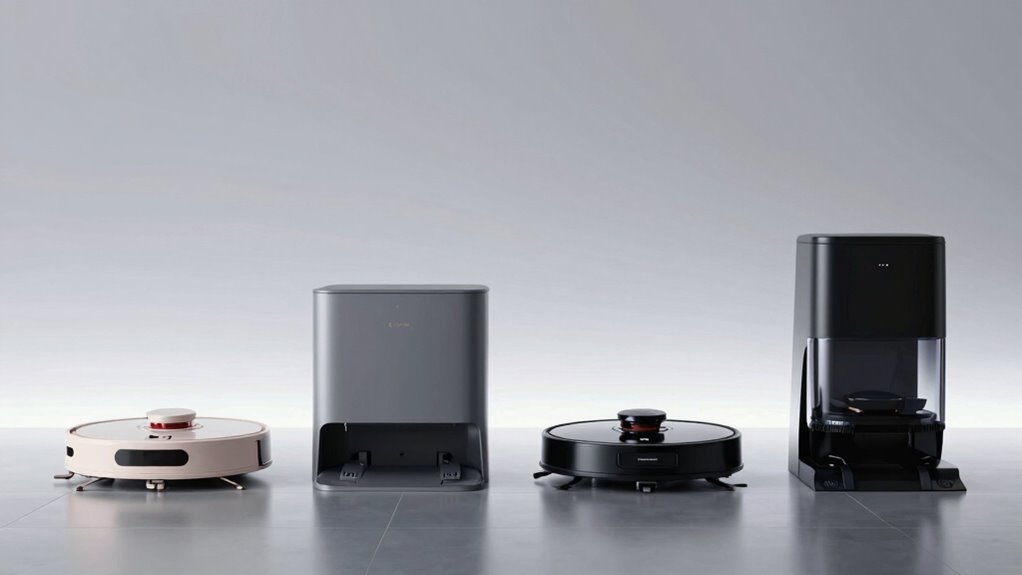
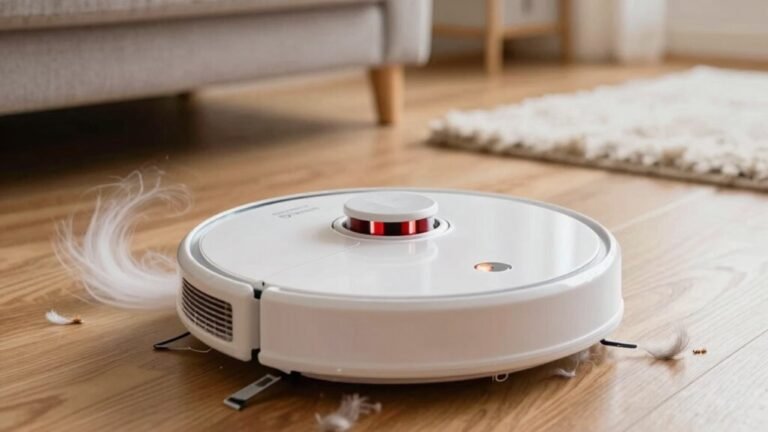
You’ve come a long way from robotic pinballs that bumped blindly around your home. Today’s robot vacuums use smart navigation and infrared sensors to map your space efficiently, avoiding obstacles like couches and table legs with precision.
These advanced devices rely on Wi-Fi connectivity, apps, and voice commands, transforming them into high-tech helpers you can control effortlessly. With features like self-emptying bins and mopping pads, cleanup has never been simpler or more automated.
Equipped with cameras and sensors, modern robot vacuums can even dodge your socks and remember the location of your dog’s bowl. They’ve evolved into clever robo-butlers that handle daily messes with minimal input from you.
The First Robot Vacuums: Why Early Models Failed
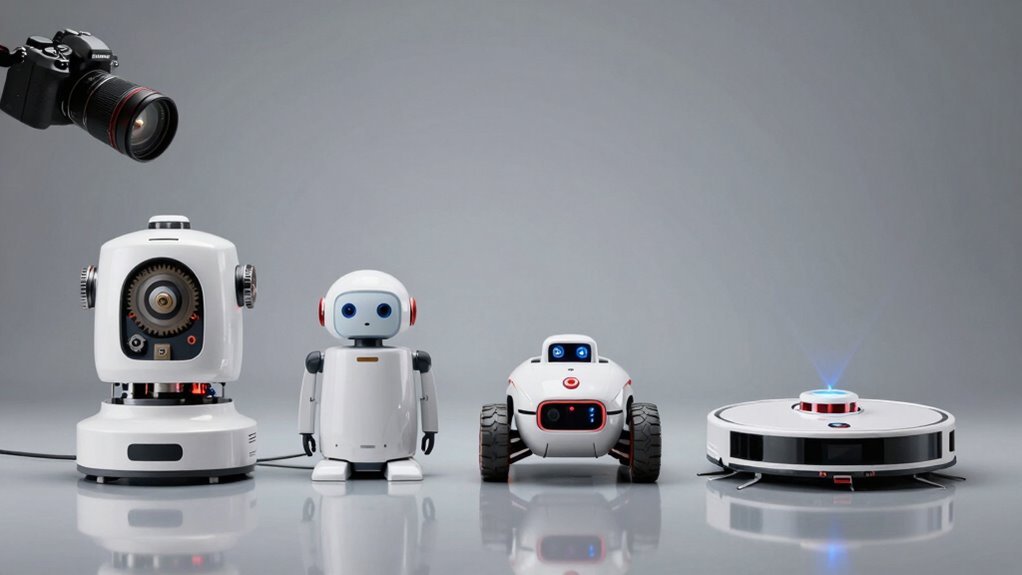
Ever wonder what the very first robot vacuum looked like?
Picture something straight out of a retro sci-fi dream—Donald G. Moore patented one in 1956 that already had vacuuming *and* mopping skills, all controlled by a single button.
Pretty cool, right?
But here’s the catch: it never hit stores.
Fast-forward to 1996, and Electrolux launched the Trilobite, the first consumer model.
It bounced around like a confused bumper car, thanks to its bat-inspired ultrasonic sensors.
Sure, it avoided crashes *mostly*, but it left messy little corners and often gave up near walls.
You’d still need to babysit it—or just grab a regular vacuum.
It was expensive, kinda clumsy, and let’s be honest, more novelty than helper.
Still, you gotta cheer for its effort.
Without these quirky pioneers, we wouldn’t have today’s sleek, smart cleaners.
They failed forward—and cleaned the path for the Roomba.
Later models achieved 2-in-1 vacuuming and mopping, a key feature Moore originally envisioned.
How Bumping Became Smarter With Infrared Sensors
| Year | Model | Smart Bumping? |
|---|---|---|
| 1996 | Electrolux Trilobite | Nope, just bashed and bounced |
| 2002 | iRobot Roomba | Yes! Infrared dodged obstacles |
| 2014 | Dyson 360 Eye | Heck yes—360 vision + infrared |
| 2020 | Most models | Bumping? Rarely, if ever |
Infrared cliff sensors also stopped robots from diving down stairs—talk about a lifesaver! Virtual walls replaced magnetic strips, and cleaning modes got smarter. You’d laugh seeing old models now, bouncing like confused bumper cars. Thanks to infrared, your robot now nimbly weaves around toys, cords, and that wobbly table. Bumping didn’t disappear—it just got a brain upgrade. This leap in navigation was made possible by the shift from basic sensors to more sophisticated sensors and mapping.
Why Random Paths Disappeared With Mapping Tech?
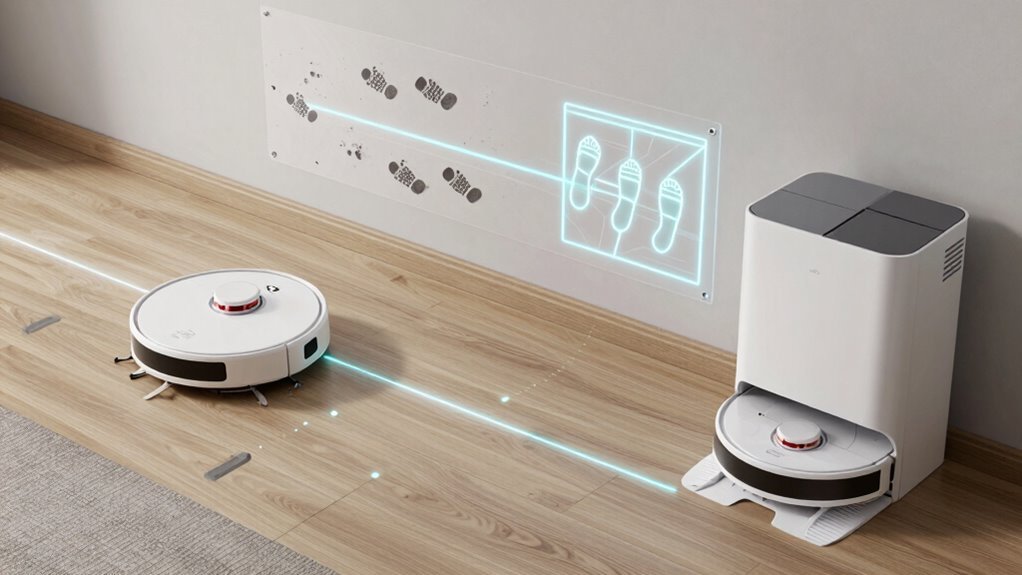
How on earth did robot vacuums go from drunken zigzags to cleaning like they’ve got a PhD in home organization? Simple—mapping tech kicked random paths to the curb. You don’t need luck anymore; you get *smarts*.
Here’s why the upgrade was a no-brainer:
- No more guesswork: Instead of bumping blindly, your vacuum now maps every wall, couch, and corner like a pro cartographer.
- Full coverage, no repeats: It remembers where it’s been, so no spot gets missed—or cleaned five times.
- Faster, smarter cleaning: With SLAM and LiDAR, it zips through rooms in neat, efficient lines, not chaos.
It’s like swapping a tumble drunk for a ninja—quiet, precise, and always on target.
You get cleaner floors without the comedy routine.
Mapping didn’t just help your robot grow up—it gave it a real plan.
Robot Vacuums Get Connected: Wi-Fi and App Control
What if your vacuum could take orders like a loyal sidekick—starting a clean while you’re halfway through your commute or showing off its map like it’s posting vacation photos? Thanks to Wi-Fi, it can. Since iRobot launched the app-connected Roomba 980 in 2015, robot vacuums evolved into smart home stars. You can schedule cleans from your couch, adjust suction with a tap, or watch real-time progress like it’s a live stream. Voice commands via Alexa or Google Assistant let you boss it around hands-free—“Hey, clean the kitchen!”—while over-the-air updates keep it smarter over time.
| Feature | What It Does |
|---|---|
| App Control | Start, schedule, and monitor cleanings remotely |
| Voice Commands | Use Alexa or Google Assistant to control cleaning |
| Real-Time Maps | See where it’s been and where it’s going |
| Remote Alerts | Get notified about battery or full bins |
| OTA Updates | New tricks rolled out automatically through Wi-Fi |
How AI Helps Robot Vacuums Recognize Cords and Toys?
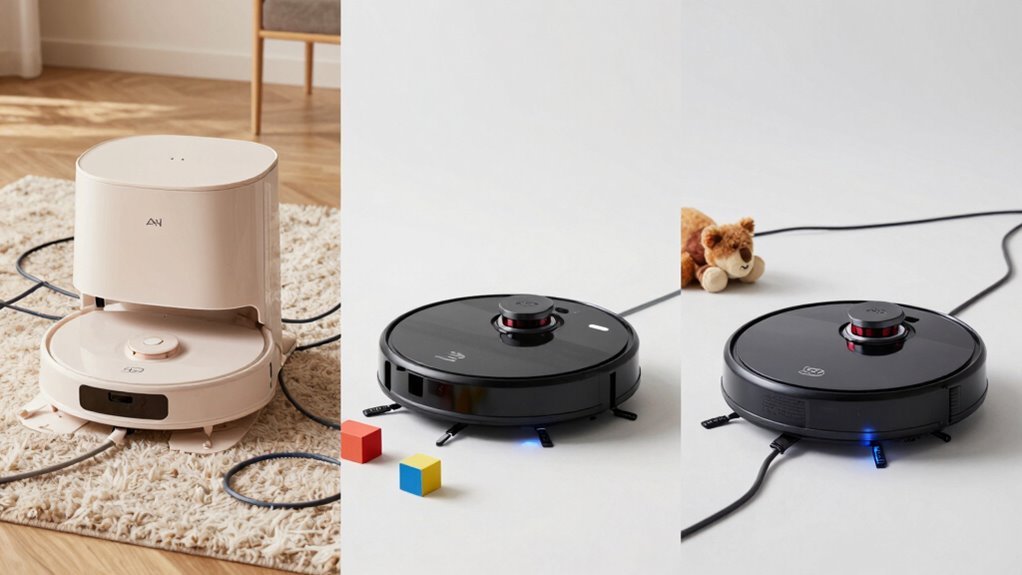
Ever wonder how your robot vacuum suddenly became so smart it dodges your kid’s stray Lego pieces and that tangled phone charger like a seasoned pro? That’s AI working hard behind the scenes, turning your little cleaning bot into a sharp-eyed navigator.
Here’s how it nails those tricky obstacles:
- Smart Eyes: Cameras and sensors like RGBD and ToF scan objects in 3D, spotting cords and toys as small as 2cm.
- Brains + Memory: It learns from each run, recognizing your socks versus a shadow and remembering where your dog left that squeaky toy.
- Teamwork Tech: Fusing camera smarts with laser precision, it adapts instantly—even in dim light or messy rooms.
No more yanking cords from its brushes or finding it helplessly stuck under a toy truck. Thanks to AI, your vacuum doesn’t just clean—it *thinks*. And hey, who knew robots could grow up so fast?
LiDAR Navigation: The Era of Laser-Perfect Mapping
From the moment it starts gliding across your floor, your robot vacuum isn’t just wandering—it’s mapping, measuring, and mastering every inch with laser precision.
Using LiDAR, it zips invisible laser beams around the room, bouncing them off walls and furniture to build a real-time map in milliseconds.
No more bumping cluelessly—it *sees* where it’s going, even in pitch-black darkness.
With SLAM tech, it knows exactly where it’s while charting the whole space.
Older models spin a laser on top like a tiny lighthouse, but newer ones use sleek, solid-state dToF that’s faster and slimmer.
It plans smart, straight-line paths, slashes cleaning time by nearly half, and dodges obstacles like a pro.
You can set no-go zones or tell it to focus on the living room—because now, it *gets* your home.
Who knew a little robot could be this sharp—and this handy?
Hands-Free Cleaning: The Rise of Self-Emptying Bins
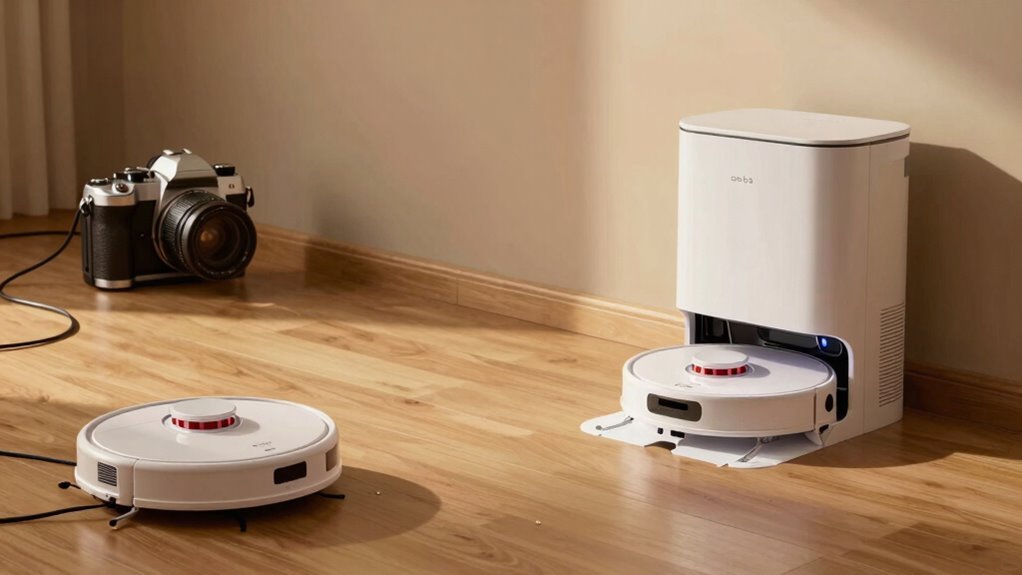
You’ve already seen how robot vacuums map your home with laser-sharp smarts—now imagine one that doesn’t just clean like a genius but also tidies up after itself.
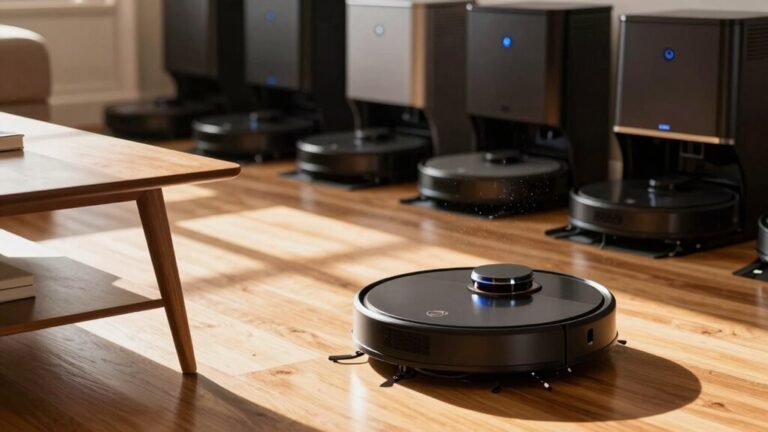
Welcome to hands-free cleaning, where your robot dumps its own trash—no more unpleasant bin-emptying duty! Thanks to self-emptying bases, you’re free from daily dust drama.
- Smart stations use strong suction to pull debris from the robot into a sealed bag that holds weeks’ worth of junk—seriously, it’s like magic with less mess.
- Top brands like Roborock and iRobot lead the charge, with models that auto-empty, mop, and even clean their pads—talk about overachievers!
- HEPA filters and cyclonic tech keep allergens contained, so your air stays fresh and your sneezes stay quiet.
It’s not just convenient—it’s a mini household revolution. Who knew laziness could look this smart?
Smart Obstacle Avoidance: Cameras That See Your Socks
Say hello to robot vacuums that finally learn where your socks went—not to steal them, but to avoid them!
You’ve seen the old bump-and-go bots, but now, smart cameras actually *see* your clutter.
Using front-facing lenses and clever AI, they spot socks, shoes, and even pet messes before running into them.
Infrared lights help them see in the dark, while 3D depth sensors map obstacles in real time.
No more tripping over cords or squashing stray Legos.
With systems like AIVI and StarSight, your bot doesn’t just dodge—it understands.
It slows for a shoelace, skirts around a blanket edge, and gives pet waste a wide berth.
Sensor fusion blends camera smarts with laser precision, so it adapts to any room, any light.
You get smoother cleaning, fewer snags, and yes, your favorite sock stays safe.
Who knew a little robot could be this thoughtful—and this good at laundry hide-and-seek?
Voice Control and Multi-Floor Maps: Modern Commands
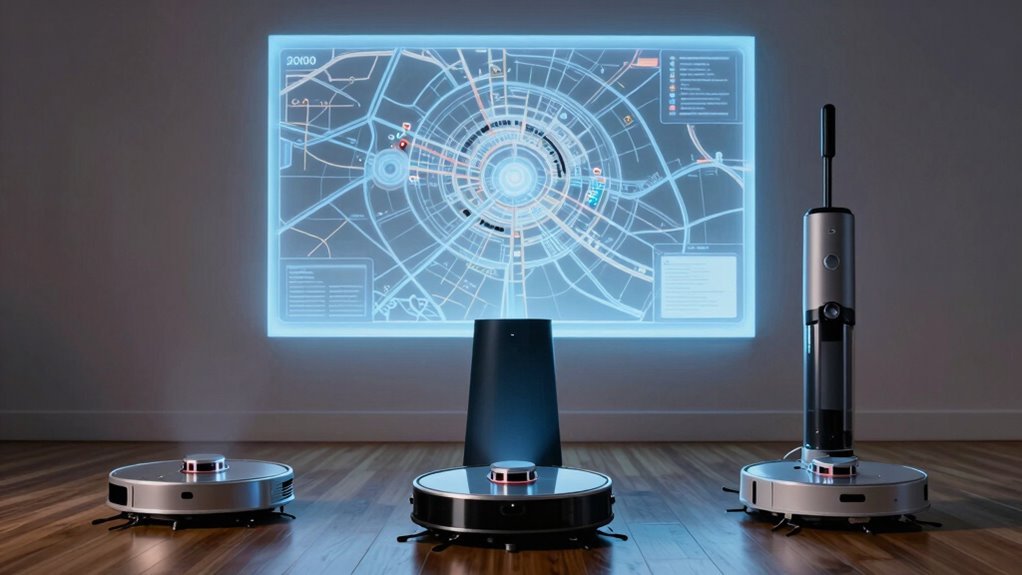
Meet the era of robot vacuums that don’t just listen—they get you.
You can now command your cleaner like a smart sidekick, and it’ll chat back while maneuvering multiple floors like a pro.
Thanks to voice-smart tech and slick mapping, these robots handle homes with ease, even chatting through Bixby or Alexa as they work.
- Voice that understands: With AI like NarMind 2.0 and ChatGPT-style smarts, your robot recognizes objects and follows natural talk, like “Clean around the dog’s water bowl.”
- Mapping that climbs: Using leg-wheels or retractable LiDAR, models like Saros Rover and Dreame X60 glide over thresholds and map upstairs without getting lost—or grumpy.
- Commands that adapt: Say “Steam the kitchen” and the Bespoke AI Jet Bot fires up hot sanitizing cleanup—all thanks to chip-powered voice IQ.
Your house has never been this talkative.
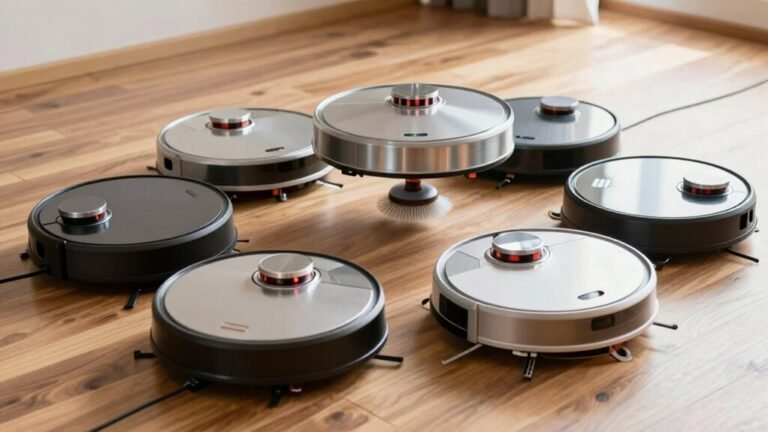
What Today’s Best Robot Vacuums Can Really Do?
What can your robot vacuum actually handle these days—dust bunnies, spilled cereal, or even last night’s sauce disaster?
You’re covered.
With suction power up to 24,000 Pa, models like the Mova V50 Ultra Complete chew through messes like a tiny vacuum beast.
Spilled juice?
The Roborock Saros 10R mops it with hot, self-cleaning pads—no yuck left behind.
Thanks to smart navigation using LiDAR and AI cameras, your bot maps the whole house, dodges socks, toys, and even pet bowls like it’s got eyes.
The Ecovacs X12 spots stains with infrared tech and scrubs them like it’s on a mission.
And when it’s done?
It returns to its dock, empties itself, washes the mop, and even dries it.
You just kick back and enjoy the clean.
Honestly, it’s like having a robot butler who never complains.
Frequently Asked Questions
Can Robot Vacuums Clean Carpets as Well as Hard Floors?
You’re in luck—robot vacuums clean hard floors like champs, but carpets? They’re good, not perfect.
On low- to medium-pile, they’ve got your back, sucking up dirt and pet hair with ease.
Thick carpets? They sometimes stumble, but models like Dreame X50 Ultra power through with strong suction and smart brushes.
Just don’t expect them to deep-clean your shag rug like a pro steam cleaner—they’re not magic, but close!
Do They Work in Complete Darkness?
Yes, they totally work in complete darkness—no night light needed!
Your robot vacuum uses its own laser light to see, so it’s not scared of the dark like you might be.
It maps rooms, dodges toys, and avoids stairs all in pitch black, thanks to smart LiDAR tech.
Think of it as a tiny, fearless explorer with a flashlight on its head, cleaning while you sleep—how cool is that?
How Often Should I Replace the Filters?
You’ll need to replace your filters more often than your goldfish needs a new bowl—usually every 2 to 6 months.
Clean them weekly, especially with pets, and tap out dust regularly.
If you see gunk, smell funky odors, or notice your vacuum gasping like it’s running a marathon, it’s definitely time.
Check your model’s quirks, and never skip the dry-before-reinstall step!
Are Robot Vacuums Safe Around Pets?
Yeah, robot vacuums are totally safe around pets!
They’ve got smart sensors that spot your furry friend and steer clear.
With soft edges, quiet operation, and waste-avoidance tech, they won’t scare or hurt your pet.
They even dodge pet bowls and beds—talk about thoughtful!
Most pets go from “What IS this thing?” to BFFs in days.
Just hit start, and let your robo-helper tidy up—safely.
Can They Get Stuck on Power Cords?
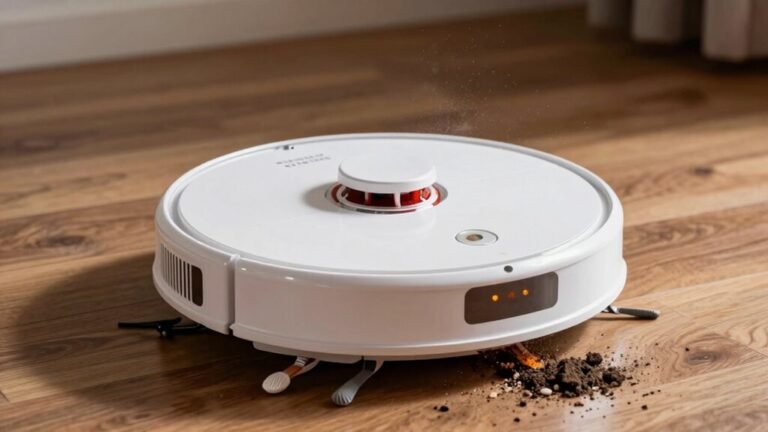
Yeah, robot vacuums can get stuck on power cords—especially if they’re lying around loose on the floor.
Those spinning brushes love to grab thin cords like they’re playing tug-of-war.
You’ve probably seen it happen: your little vacuum suddenly dancing in circles, tangled up like it lost a fight with a charger.
It’s kind of hilarious—until you realize it might damage the cord or the vacuum.
Conclusion
You once laughed at robot vacuums, picturing them helplessly trapped, bumping into legs and sneaking under socks like clueless pets. Now they map your home, dodge your kid’s toys, and empty themselves—basically doing chores better than you. Irony? You bought one to be lazy, and now you’re impressed by how *hard* it works. Who’s the robo-slave now?
References
- https://vacuumwars.com/history-of-the-robot-vacuum-cleaner/
- https://aeno.com/blog/robot-vacuum-cleaner-history-who-made-the-first-robot-vacuum/
- https://us.narwal.com/blogs/product/robot-vacuum-history
- https://www.vacuumcleanerhistory.com/vacuum-cleaner-development/history-of-robotic-vacuum-cleaner/
- https://www.lefant.com/blogs/reviews/evolution
- https://us.roborock.com/blogs/blog/the-development-of-the-robot-vacuum
- https://neakasa.com/blogs/all/how-about-the-history-of-a-smart-vacuum-robot
- https://thamtus.com/blogs/blog/the-history-of-robot-vacuum-cleaner
- https://www.eufy.com/blogs/robovac/when-was-the-robot-vacuum-invented
- https://www.robotspecialist.com.au/blogs/news/the-evolution-of-robot-vacuums