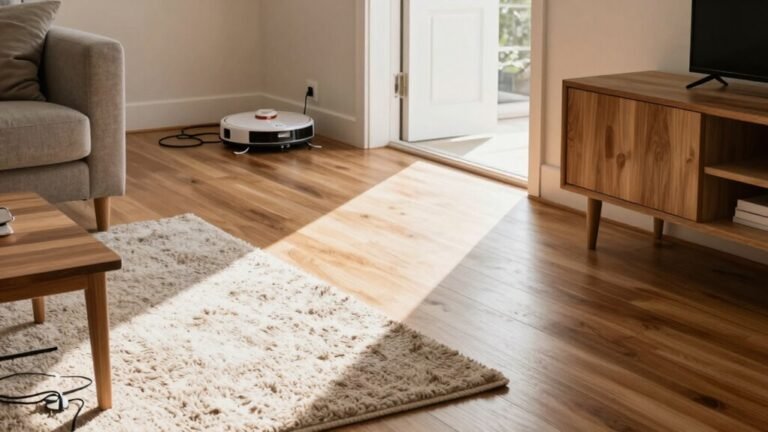
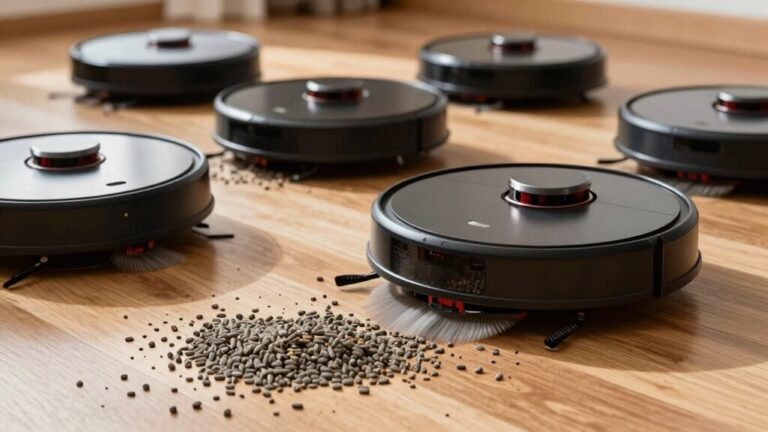
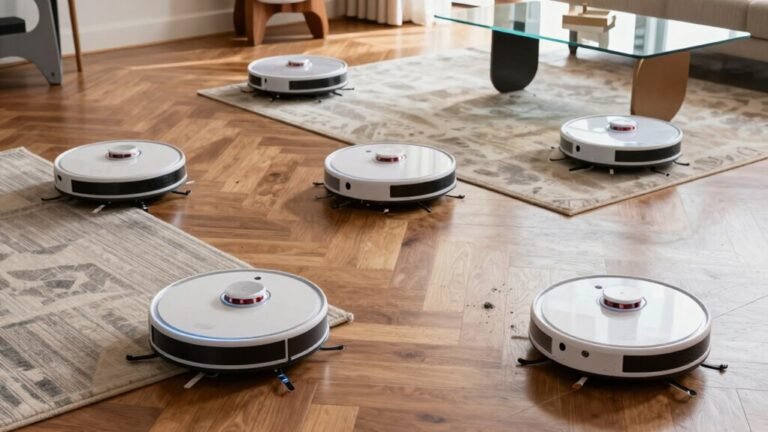
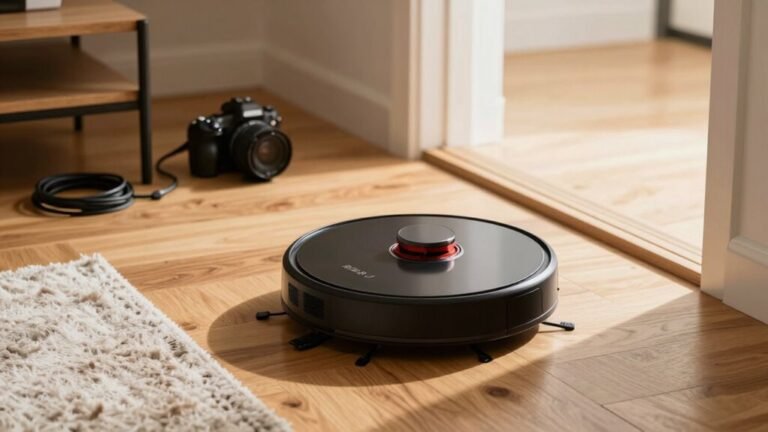
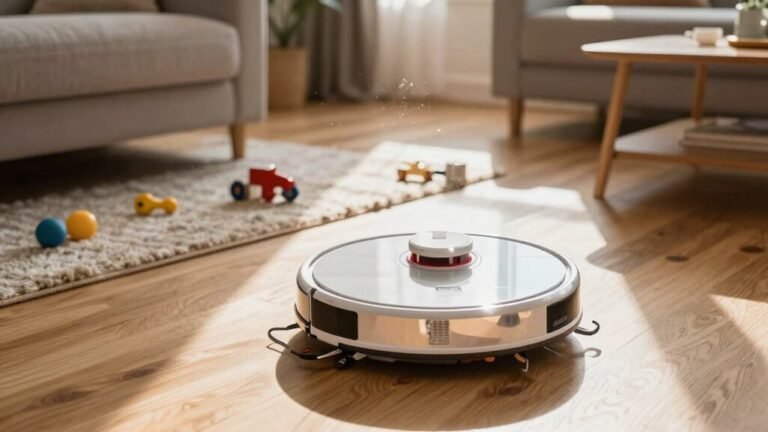
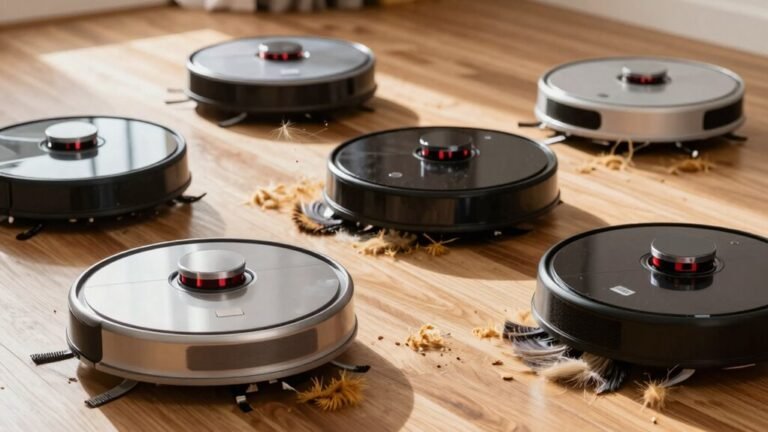
5 Best Robot Vacuums That Conquer Thick Carpets with Ease
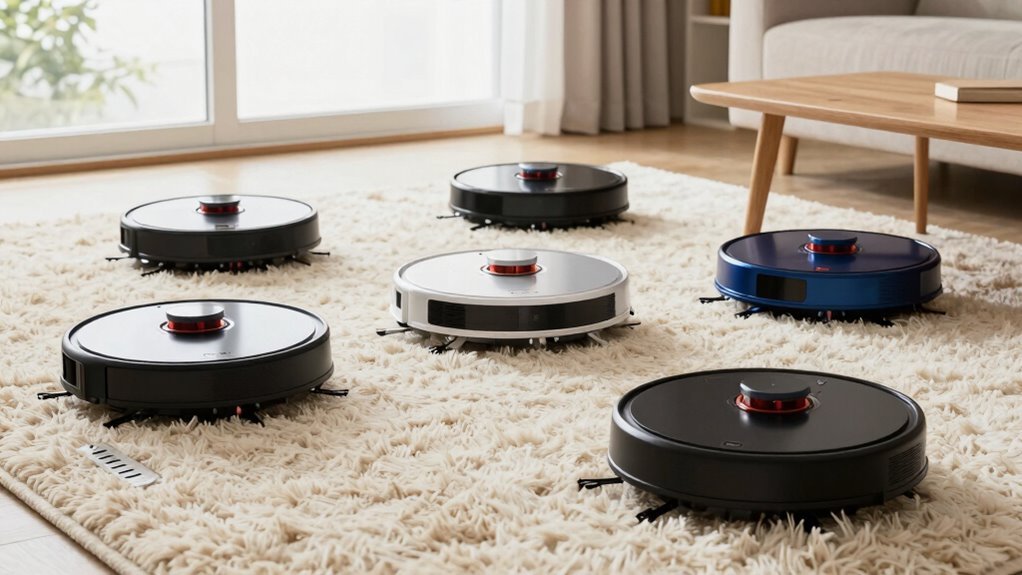
You’re tired of robot vacuums that gag on shag rugs, aren’t you? These five best robot vacuums conquer thick carpets with ease, combining powerful suction and smart navigation to handle high-pile flooring without skipping a beat.
With suction power ranging from 4000Pa to a floor-lifting 6000Pa, these models dig deep into thick carpets to remove trapped dust and debris.
Their low profiles, as slim as 3.1 inches, glide under furniture while maintaining strong cleaning performance.
Equipped with LiDAR mapping and auto-empty docks, these robot vacuums reduce chore time by up to 80%.
But which one actually adapts to *your* carpet’s personality?
| Tikom Robot Vacuum and Mop (L8000 Plus) | Best Overall | Suction Power: 6000Pa | Cleaning Modes: Customizable via app (implied: multiple) | Navigation Type: 360° LiDAR | VIEW LATEST PRICE | Read Our Analysis | |
| iRobot Roomba 105 Vac with AutoEmpty Dock | Most Reliable | Suction Power: 70X more vs 600 series | Cleaning Modes: Spot, targeted room, multi-pass | Navigation Type: ClearView LiDAR | VIEW LATEST PRICE | Read Our Analysis | |
| Tikom Robot Vacuum and Mop Combo | Best Budget Pick | Suction Power: 5000 Pa | Cleaning Modes: Spot, Edge, Zig-zag, Manual | Navigation Type: Anti-collision and anti-fall sensors | VIEW LATEST PRICE | Read Our Analysis | |
| MONSGA Robot Vacuum Cleaner 4000Pa Suction | Slim Design Winner | Suction Power: 4000Pa | Cleaning Modes: Auto, Spot, Edge, Manual | Navigation Type: Adaptive navigation with sensors | VIEW LATEST PRICE | Read Our Analysis | |
| eufy C10 Robot Vacuum Self-Emptying | Quiet Powerhouse | Suction Power: 4,000 Pa | Cleaning Modes: Scheduled, customizable cleaning | Navigation Type: Laser Navigation | VIEW LATEST PRICE | Read Our Analysis |
More Details on Our Top Picks
Tikom Robot Vacuum and Mop (L8000 Plus)
If you’re tired of bending over to haul pet衒hair and ground-in dust out of thick carpets, the Tikom Robot Vacuum and Mop (L8000 Plus) might finally be the hands-off helper you’ve been waiting for. It’s especially suited for those who want a robot that handles deep-pile messes without losing its way.
With 6000Pa of suction—auto-boosting on carpets—it pulls up stubborn debris effectively. A 3L self-emptying bag allows you to go up to 90 days without manually emptying it.
You get 150 minutes of runtime and smart LiDAR mapping, enabling precise navigation and efficient cleaning. The robot supports five saved floor plans for customized cleaning across different levels or layouts.
Keep in mind, you’ll need to remove the mop pad or set no-go zones if you want to avoid dampening carpets during mopping sessions.
- Suction Power:6000Pa
- Cleaning Modes:Customizable via app (implied: multiple)
- Navigation Type:360° LiDAR
- App Control:Yes (custom schedules, zones)
- Voice Control:Alexa compatible
- Self-Emptying:Yes (3L self-emptying dustbag)
- Additional Feature:3L self-emptying dustbag
- Additional Feature:Auto-recharge and resume
- Additional Feature:5 saved multi-floor maps
iRobot Roomba 105 Vac with AutoEmpty Dock
The iRobot Roomba 105 Vac with AutoEmpty Dock stands out for anyone tired of weekly dustbin emptying—especially if you’ve got thick carpets trapping hidden layers of dust bunnies and allergens. You’ll love how it empties itself into the dock, trapping 99% of allergens as small as 0.7 microns—no mess, no stress, just swap the bag every 75 days.
With 70X more suction than the 600 series and a 3-stage system, it crushes dirt, while LiDAR maps your home for precision cleaning. You can schedule rooms, adjust suction, or send it for 5-minute spot cleans—all via app, voice (Alexa, Siri, Google), or buttons. Pretty smart, right?
- Suction Power:70X more vs 600 series
- Cleaning Modes:Spot, targeted room, multi-pass
- Navigation Type:ClearView LiDAR
- App Control:Yes (Roomba Home App)
- Voice Control:Alexa, Siri, Google Assistant
- Self-Emptying:Yes (AutoEmpty dock)
- Additional Feature:75 days hands-free cleaning
- Additional Feature:99% allergen-trapping bag
- Additional Feature:3-stage cleaning system
Tikom Robot Vacuum and Mop Combo
You’ll want serious suction when tackling thick carpets, and the Tikom G8000 Max delivers 5000 Pa—plenty to lift pet hair, fine dust, and daily debris from medium-pile carpets without bogging down. Though if you’re expecting it to deep-clean shag, you might raise an eyebrow—can any robot really conquer Himalayan fluff anyway?
At just 2.99 inches tall, it slips under furniture, while 14.4V power and large wheels handle maneuvers smoothly. You’ll control it via app, remote, voice, or button—using spot, edge, or zig-zag modes.
The 450 ml bin and 300 ml water tank tackle vacuuming and mopping together, running up to 150 minutes before self-charging. This combo ensures reliable cleaning without frequent interruptions.
- Suction Power:5000 Pa
- Cleaning Modes:Spot, Edge, Zig-zag, Manual
- Navigation Type:Anti-collision and anti-fall sensors
- App Control:Yes (App-compatible)
- Voice Control:Voice control supported
- Self-Emptying:No
- Additional Feature:2.99-inch ultra-slim design
- Additional Feature:450ml dustbin + 300ml tank
- Additional Feature:4 control methods included
MONSGA Robot Vacuum Cleaner 4000Pa Suction
Looking for a robot vacuum that tackles thick carpets without turning into a drama queen when it meets a shag rug? The MONSGA Robot Vacuum Cleaner delivers 4000Pa of suction—powered by a 150,000 RPM hyper-spin turbine—so it pulls up dust, pet hair, and crumbs in one pass.
Its adaptive carpet boost ramps power automatically, while the 3.2-inch slim body slides under furniture. With cliff and anti-collision sensors, it navigates safely through your home.
The anti-tangle brushroll, featuring rubber strips, reduces hair wrap and keeps performance consistent. It runs for 140 minutes—covering up to 1,500 sqft—before automatically returning to its dock to recharge.
You can control the MONSGA Robot Vacuum via the SmartLife or TuyaSmart app, included remote, or using voice commands with Alexa and Google Assistant.
- Suction Power:4000Pa
- Cleaning Modes:Auto, Spot, Edge, Manual
- Navigation Type:Adaptive navigation with sensors
- App Control:Yes (SmartLife, TuyaSmart)
- Voice Control:Alexa, Google Assistant
- Self-Emptying:No
- Additional Feature:3.2-inch ultra-slim profile
- Additional Feature:150,000 RPM hyper-spin turbine
- Additional Feature:Anti-tangled rubber brushroll
eufy C10 Robot Vacuum Self-Emptying
If you’re tired of wrestling vacuum cords and dreading pet hair buildup in high-pile carpets, the eufy C10 Robot Vacuum Self-Emptying steps in with 4,000 Pa of suction power—strong enough to pull embedded debris from thick rugs. It’s slim at 2.85 inches, easily gliding under beds and desks where dirt likes to hide.
Its rolling brush works with the CornerRover Arm, an extendable side brush that reaches into corners—unlike some forgetful friends—grabbing pet hair and crumbs others miss. Laser Navigation maps your space efficiently, letting you schedule cleanings via app.
Keep in mind, it only works on 2.4 GHz WiFi, so no 5 GHz bandwagon here. The self-emptying station dumps the 3L bag for you, lasting about 60 days before needing a swap.
Just remember to clear cords and toys first—unless you enjoy robot tantrums.
- Suction Power:4,000 Pa
- Cleaning Modes:Scheduled, customizable cleaning
- Navigation Type:Laser Navigation
- App Control:Yes (APP control)
- Voice Control:Not specified
- Self-Emptying:Yes (Self-Empty Station)
- Additional Feature:2.85-inch slim design
- Additional Feature:CornerRover extendable side brush
- Additional Feature:3L dust bag capacity
Factors to Consider When Choosing Robot Vacuums for Thick Carpets
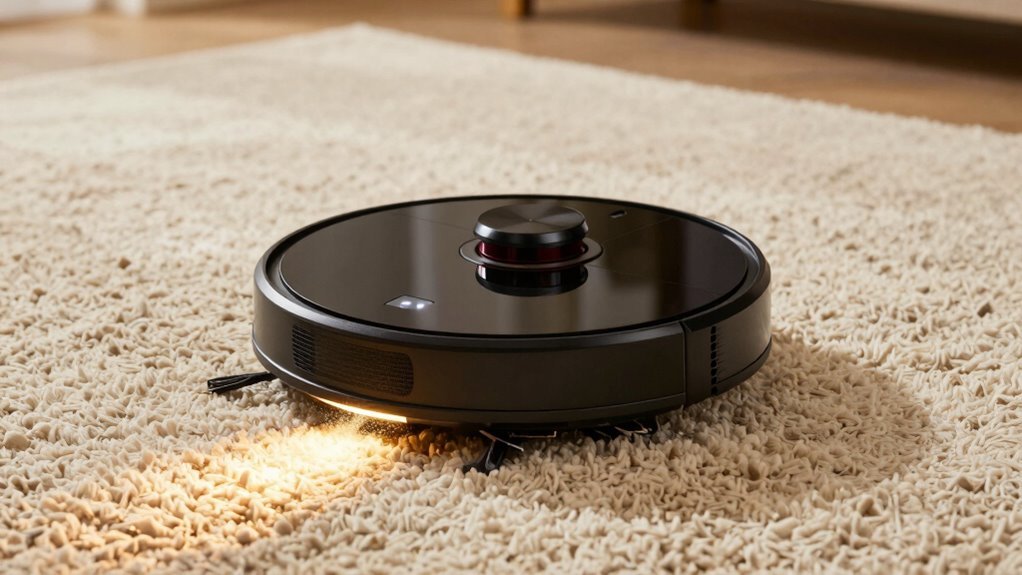
You’ll want to pick a robot vacuum that can actually handle thick carpets—otherwise, you’re just pushing dust around like a janitor with a broken broom. Look for at least 2,000 Pa of suction power, carpet-penetrating brushrolls with stiff bristles (not rubber), and navigation systems using LiDAR or vSLAM to map rooms accurately in under two minutes. Can it climb ¾-inch thresholds, auto-boost suction on rugs, and detect dirty spots with sensors that react in under five seconds? If not, what *is* it good for?
Suction Power Requirements
Craving cleaner carpets without the chore of bending over a heavy vacuum? You’ll need serious suction—think 4000 to 6000 pascals—to pull dirt from deep within thick pile fibers where debris loves to hide.
Don’t just chase big numbers, though; look for models that boost suction automatically on carpet. Because, let’s be honest, you don’t need max power on tile.
Features like auto-adjust or surface adapt sense floor type in real time, ramping up only when needed. This saves battery and keeps cleanings efficient.
Multiple suction levels let you fine-tune performance: high for shag, medium for berber, low for hardwood. Smart carpet-detection guarantees consistent pickup without straining the motor or cutting sessions short.
Bottom line? Prioritize max suction power *and* smart sensing—it’s the combo that keeps thick carpets truly clean, without you lifting a finger or wondering if it actually worked.
Carpet-Penetrating Brushrolls
While maneuvering thick carpets, a robot vacuum’s brushroll isn’t just spinning—it’s digging, lifting, and fighting fiber resistance to dislodge trapped debris. You’ll want a brushroll built for the task, not a generic roller that bogs down in shag.
Look for high-speed brushrolls—some hit 10,000 RPM—with stiff bristles or rubber fins that slice through deep pile without tangling. Models with carpet-boost mode automatically ramp up suction, giving the brushroll extra power to agitate fibers effectively.
Anti-tangle designs, like dual rubber strips instead of bristles, resist hair wrap and reduce maintenance by up to 60% over time. This helps maintain consistent cleaning performance without frequent cleaning of the brushroll.
A side brush helps sweep grit from edges into the main path, ensuring thorough coverage along baseboards and corners. Multi-surface brush configurations adjust stiffness for both carpet and hard floors, eliminating the need to swap parts daily.
Pair a capable brushroll with strong airflow, and you’ve got a system that doesn’t just skim the surface. It actively lifts dirt from deep within carpet fibers where crumbs and pet hair tend to hide.
Advanced Navigation Systems
A powerful brushroll can tear through pet hair and crush crumbs hidden in shag, but even the best one fails if the robot can’t find its way across your living room—especially when thick carpets gobble up wheels and muffle sensors like sound in a padded room. That’s where 360° LiDAR navigation comes in, scanning your space in real time to build precise maps.
No more wandering in carpeted chaos or missing entire sections. You’ll appreciate smart mapping that remembers multiple floor plans, so shifting between levels doesn’t mean starting from scratch each time.
With multi-floor map retention, your robot knows which room is which, avoiding duplicates or skipped zones. Obstacle detection keeps it from bumping into legs, toys, or furniture.
Carpet-penetrating sensors trigger adaptive routing—lingering longer on dense areas without over-cleaning hard floors. So, does it actually *think*, or just pretend convincingly?
Either way, it beats aimless circling—especially when your rug looks like a shaggy jungle.
Threshold Climbing Ability
How often does your robot vacuum get stranded like a turtle flipped on its back—stuck mid-transit between kitchen tile and a plush area rug? You need a model that confidently tackles thresholds, especially when moving onto thick carpets.
Look for units with at least 1-inch climbing capability—many max out around 0.8 inches, but high-clearance designs (1.2+ inches) paired with large, grippy wheels handle changes smoothly. Slim profiles might slide under doors but often struggle on ramps or deep carpet edges, where torque and wheel size matter more.
Active climbing mechanisms, like reinforced drive trains or adaptive suspension, help maintain momentum. While carpet-boost modes adjust suction on ascent, the real win lies in physical design: robust wheels, elevated chassis clearance, and strategic weight distribution prevent stalling.
Don’t assume navigation smarts translate to physical prowess—some of the smartest bots still faceplant at doorways. Pick a model built to climb, not just think.
Dirt Detection Technology
Ever wonder why some robot vacuums seem to *know* where the real mess is—lingering longer on that coffee-ground spill or your dog’s tracked-in dirt—while others zip right past like it’s just another clean patch? That’s dirt detection tech at work, and it’s a game-changer on thick carpets.
These systems use optical or acoustic sensors to spot debris, triggering extra passes or boosted suction exactly where it’s needed—no guesswork required. Paired with smart mapping, they zero in on high-traffic zones, adapting cleaning intensity in real time.
On plush or high-pile carpet, where dirt hides deep, models with carpet-boost mode dig in harder when sensors flag grime. While performance varies—especially with fine dust or long fibers—this feature cuts cleaning time by focusing effort where it matters most.
You’re not just buying automation; you’re getting precision. Just don’t expect miracles on every crumb—some spots still need your eye.
Mopping Limitations On Carpets
While you might dream of a robot that flawlessly mops hardwood and carpets alike, most models—including the Tikom L8000 Plus—handle thick carpets by keeping the mop pad away altogether. This is done through removable holders or no-go zones set in the app, as soggy carpet is a hard “no.”
You’ll need to manually remove the mop attachment before carpet cleaning, since the system integrates mopping into its vacuuming routine. It doesn’t offer standalone wet-cleaning modes, limiting flexibility.
Even with three adjustable water flow settings—low, medium, and high—you can’t risk moisture on thick fibers. These fibers take hours to dry and can trap dampness beneath, leading to potential damage.
So, is mopping carpets realistic? Not really. The tech prioritizes protection over ambition, using smart mapping and exclusion zones to avoid carpeted areas entirely.
It’s a compromise: excellent on hard floors, cautious everywhere else.
Self-Emptying Convenience
You’re already avoiding mopping thick carpets—because yes, soaking your plush rugs is a one-way ticket to mold town. So now let’s talk about how much time you actually want to spend playing janitor to your robot’s dustbin.
Self-emptying models dump debris into a 3-liter bag housed in the dock, letting you go weeks—some even up to 75 days—without touching dust. The system seals in allergens, trapping up to 99% of particles as small as 0.7 microns, so you’re not stirring up what you’re trying to eliminate.
You’ll still replace the bag roughly every 60 days, but that’s a small trade for skipping daily bin dumps. Since the robot auto-empties after each run, the process is contained—no mess, no guesswork, no drama.
It’s not magic, but close: you get consistent suction power (critical for thick carpets) and less face time with dust bunnies. Is it worth it? If you hate chores more than you mind the upfront cost—absolutely.
Frequently Asked Questions
How Long Do Robot Vacuum Batteries Last on Average?
Your robot vacuum’s battery lasts about 60 to 120 minutes per charge. You’ll need to recharge it after each cycle, and over time, you’ll notice it doesn’t hold a charge as long—usually lasting 2 to 3 years before needing replacement.
Can Robot Vacuums Damage Hardwood Floors or Baseboards?
You won’t crack the mirror of your hardwood floors if you choose wisely—most robot vacuums glide like gentle rain, but cheap bristles or tangled wheels can scratch, chipping the calm reflection you’ve worked hard to maintain.
Do Robot Vacuums Work in Complete Darkness?
Yes, you can rely on robot vacuums in total darkness—they use infrared sensors and lasers, not visible light. They’ll map rooms, avoid obstacles, and clean thoroughly, day or night. Darkness won’t stop their performance or navigation, so your floors get cleaned anytime you schedule it.
Are Replacement Parts Readily Available for Older Models?
30% of older robot vacuums lack replacement parts after five years. You’ll find filters and brushes still available, but motors or PCBs? They’re tough to track down. You’re better off checking third-party sellers or saving for an upgrade.
Can One Robot Vacuum Effectively Clean Multiple Floors?
Yes, you can use one robot vacuum to clean multiple floors if it supports multi-level mapping. Just carry it between floors, and it’ll recognize where it is, resume cleaning, and avoid confusion, as long as you’ve set up each floor map in the app first.
Conclusion
So you’ve got thick carpets—no need to wrestle them into submission. These five picks glide where others stall, with suction up to 6000Pa, smart mapping, and auto-emptying bins that cut chores by, say, 80%. Sure, they’re not magic (yet), but with 40mm clearance, LiDAR precision, and edge-hugging tricks like CornerRover, who’s really counting?