Robot Vacuums and Stairs: How They Sense Cliffs
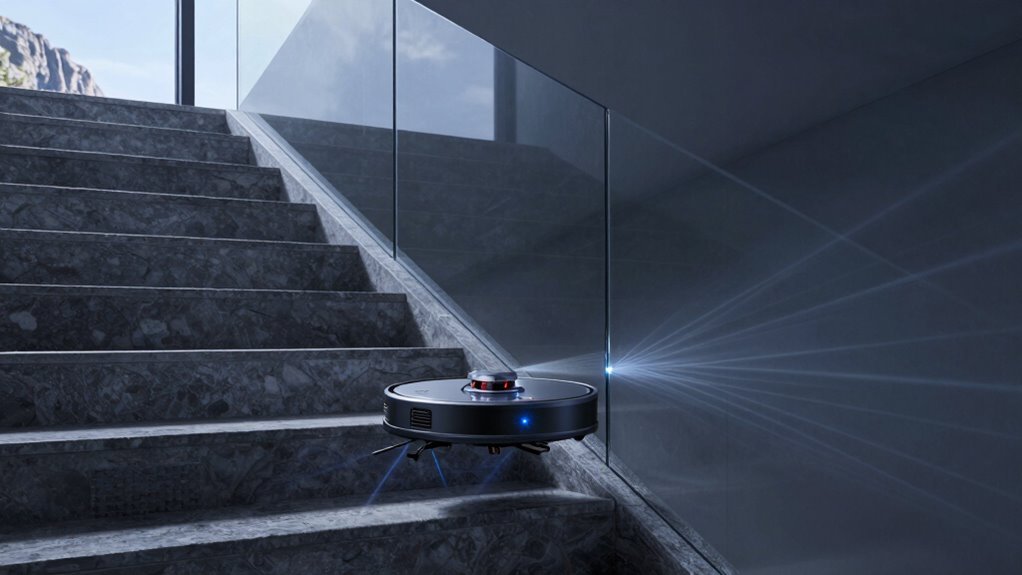
Robot vacuums use infrared sensors located underneath to detect cliffs like stairs. These sensors emit invisible signals that bounce back when they hit the floor—if the beam doesn’t return, the vacuum knows there’s a drop and avoids it.
The sensors are arranged around the robot for 360-degree coverage, providing reliable edge detection. This allows the robot vacuum to navigate safely near staircases and elevated surfaces without falling.
Some models also use time-of-flight technology, especially in low-light conditions, to enhance cliff detection accuracy. For consistent performance, keep the sensors clean—dirt can interfere with their ability to sense drops.
How Robot Vacuums Detect Stairs
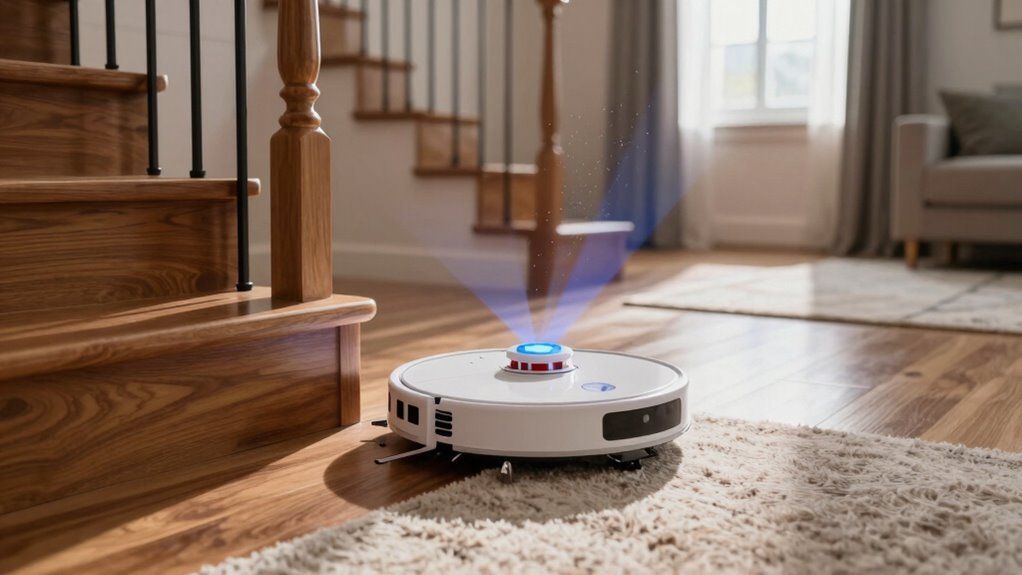
Ever wonder how your robot vacuum doesn’t take a tumble down the stairs? Well, it’s not magic—though it’s pretty close! Your little cleaning buddy uses infrared sensors on its belly to zap the floor with invisible signals.
When the signal bounces back, everything’s good. But if it doesn’t? Boom—cliff ahead! That’s when your robot hits the brakes or pivots fast.
Multiple sensors watch all angles, so it never misses a drop-off of 30mm or more.
They’re always scanning, even in the dark, thanks to infrared tech.
Paired with smart navigation, like LiDAR or SLAM, it maps safe paths and dodges edges like a pro.
You can even set up virtual barriers in the app—because who wants a vacuum pancake at the bottom of the stairs?
With all this brainpower, your robot stays upright, focused, and hilariously determined LiDAR mapping.
Can Any Robot Vacuum Climb Stairs?
Your robot vacuum knows how to dodge staircases like a ninja, thanks to those smart sensors we just talked about—but what if you actually want it to climb them instead of backing away in fear?
Well, here’s the twist: most can’t, but a few daring models are stepping up—literally.
The Dreame X60 Max Ultra climbs steps up to 3.4 inches, while Dyson’s robot manages 0.8 inches with ease.
For bigger leaps, the Saros Rover walks up stairs like a tiny robot goat using wheeled legs, and the wild Cyber X prototype uses rubber treads and legs to conquer 9.8-inch steps—even spirals!
Carriers like eufy’s MarsWalker tote your vacuum between floors like a loyal backpack.
Sure, they’re heavy, power-hungry, or still in testing, but hey, we’re closer than ever.
Stair climbing isn’t sci-fi anymore—it’s just *really* tricky engineering with a side of awesome.
Advanced sensors enable these bots to detect stair edges and navigate safely, though full staircase traversal remains a challenge for most.
How Cliff Sensors Prevent Falls
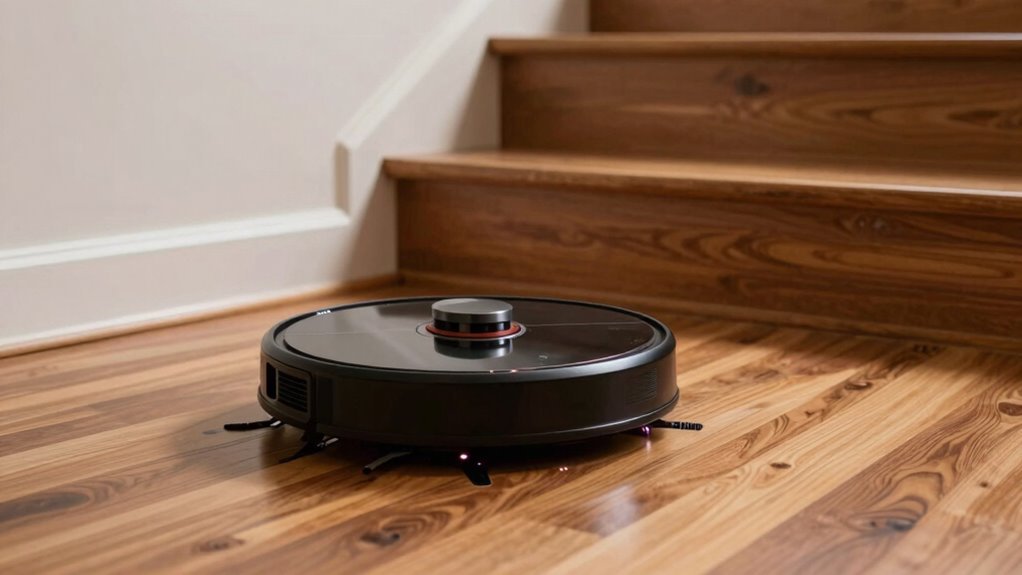
Those little eyes on the bottom of your robot vacuum? They’re your floor’s best friends!
Equipped with infrared beams, they constantly zap the ground below, checking for a solid surface.
When the beam bounces back strong, you’re golden—floor’s there!
But if the light vanishes or returns weak, whoa, danger: it’s a cliff!
Your robot instantly hits reverse, dodging stairs like a pro stunt driver.
Most models pack multiple sensors around the undercarriage, so they’ve always got eyes on the edge—360 degrees, no blind spots.
Premium bots may even use Time of Flight or structured light tech for sharper detection, especially in the dark.
Combined with smart software, these sensors keep your vacuum from taking a nosedive.
Just remember to wipe them clean once in a while—dirt can be a sneaky party crasher.
Seriously, without these clever little guards, your robot might just become a tumble-prone disaster.
What If Cliff Sensors Malfunction?
What happens when your robot’s trusty cliff sensors start acting up?
You might find it nervously halting on flat floors or, worse, inching too close to stairs like it’s auditioning for a stunt show.
Dust, hair, or grime can block the infrared signals, while bumps may knock sensors out of alignment.
Low battery or firmware glitches can confuse it, too.
Your Shark might flash Error 7, your Roomba could go “ehh!”, or your LG might politely ask you to clean the bottom.
Don’t panic!
A quick wipe with a microfiber cloth or cotton swab often fixes it.
Just avoid harsh chemicals.
If problems persist, reboot it, check for updates, or run a sensor test.
But remember—tape won’t truly disable sensors, and dark rugs might trick your bot.
When in doubt, reach out to support.
Your robot’s cliffhanger moment shouldn’t end in a real fall!
How to Keep Your Robot Safe on Stairs
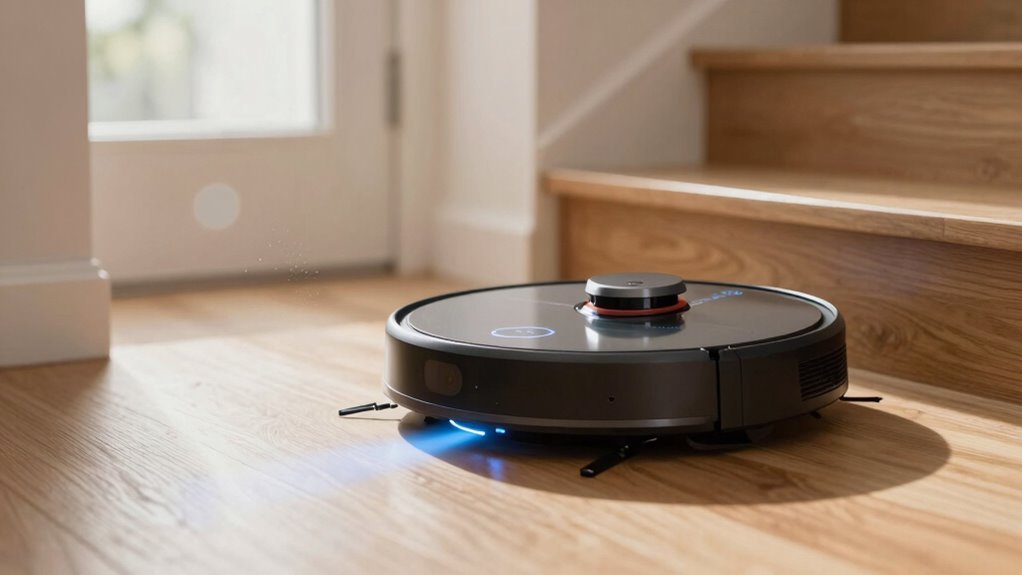
Infrared eyes on the lookout, a steady path forward—your robot’s cliff sensors are its personal bodyguards against staircase mishaps.
Keep them clean with a quick wipe weekly using a microfiber cloth, and dodge direct sunlight that can blind their infrared vision.
Test them monthly by letting your bot flirt with a stair edge—you’ll love how it dramatically backs away!
Set up virtual walls in the app, 6 to 12 inches from danger zones, and map each floor separately so it doesn’t get adventurous.
Install baby gates for extra security (yes, your robot’s on toddler lockdown).
Clear clutter, secure rugs, and slap on high-contrast tape for better edge detection.
Schedule cleanings smartly, monitor live feeds, and use no-go zones like a pro.
With these tricks, your robo-pal stays safe, sane, and off the stairs—because nobody wants a vacuum pancake.
Best Robot Vacuums for Staircase Homes
Ever wished your vacuum could conquer stairs like a tiny, determined mountain climber?
The Roborock Saros Rover’s got your back—it uses smart, extendable legs to climb and clean stairs directly, powered by 19,000 Pa of suction.
It’s like a robot goat with serious cleaning skills!
The Dreame Cyber X isn’t far behind, teaming a vacuum with a carrier that tackles 9.8-inch steps using tank-like treads—though it’s still in prototype, so hold your excitement.
MOVA’s Zeus 60 also promises stair-climbing action, with cool modular tricks.
For homes with thresholds instead of full staircases, the Roborock Saros 20 Series and Dreame X60 handle bumps like champs.
And don’t sleep on the xLean TR1—it transforms into a manual cleaner with a handle, because hey, sometimes teamwork makes the dream work.
These bots don’t just avoid stairs—they own them.
Frequently Asked Questions
Can Robot Vacuums Clean Carpeted Stairs Effectively?
No, most robot vacuums can’t clean carpeted stairs effectively—they’ll stop at the edge to avoid falling.
You’d still need to grab the vacuum and carry it up, like a robo-pet who refuses to climb.
But hey, some cool new models with retractable legs are starting to tackle stairs!
Until then, keep your mop handy or treat your vacuum to a stair-free zone.
It’s not lazy—it’s just safety-minded!
Do Robot Vacuums Work With Smart Home Systems?
Yeah, robot vacuums totally work with smart home systems!
You can control them with your voice, set schedules, or clean specific rooms using apps like Alexa or Google Home.
Some even join your Home Assistant setup or work through Apple’s HomeKit via Matter.
Just check your model—newer ones play nicer.
Imagine saying, “Hey Siri, vacuum the chaos,” and it actually does.
Pretty slick, huh?
How Often Should I Clean the Cliff Sensors?
You should clean your cliff sensors weekly if you use your robot vacuum daily—dirt builds up fast!
For lighter use, every two to four weeks works.
Got pets or dusty floors?
Wipe them more often.
Just flip the vacuum, grab a soft cloth, and gently clean all four sensor spots.
No water, no fuss.
Your robot’ll stay smart, dodge disasters, and keep zooming—no more cliffside panic attacks!
Are Robot Vacuums Safe Around Pets on Stairs?
Yes, your robot vacuum’s got your pet’s back—even on stairs.
Think of it as a tiny knight with a radar shield, dodging drop-offs and fluffy foes alike.
It spots gaps, stops fast, and turns before trouble starts.
With smart sensors and pet-aware smarts, it zips around, not into, your curious pup or snoozing cat.
Just keep the path clear, and let the little guardian guard—safely, smoothly, and with style.
Can I Schedule Cleanings for Specific Stair Areas?
No, you can’t schedule cleanings for specific stair areas yet — sorry, stair master!
Current models don’t let you set timers just for steps, even if they can climb them.
The tech’s still focused on getting robots safely between floors, not vacuuming each tread on a schedule.
But with smart mapping and AI evolving fast, your dream of autonomous stair scrubbing might hit the landing sooner than you think!
Conclusion
You’d be surprised—nearly 80% of robot vacuum mishaps happen near stairs, but cliff sensors keep your little cleaner from becoming a daredevil. These smart sensors scan the floor ahead, spotting drops before tumbling down. So while your robot won’t climb stairs like a mountain goat, it’ll dodge them like a pro. Trust the tech, clear the path, and let your robo-pal vacuum freely—without face-planting into the basement!
References
- https://ca.narwal.com/blogs/robot-vacuum/robot-vacuum-fall-down-stairs
- https://www.ecovacs.com/us/blog/will-robot-vacuums-fall-down-stairs
- https://www.techtimes.com/articles/313856/20260108/ces-2026-roborock-saros-rover-robot-vacuum-conquers-stairs-obstacles-like-never-before.htm
- https://vacuumwars.com/the-rise-of-the-stair-climbing-robot-vacuum-ifa-2025/
- https://www.youtube.com/watch?v=b14Ic7t45lg
- https://www.youtube.com/watch?v=cgNPSMY6JOk&vl=en
- https://technori.com/2025/04/21965-robot-vacuum-can-now-climb-stairs/marcus/
- https://www.engadget.com/home/dreames-latest-robot-vacuum-concept-has-slightly-terrifying-legs-that-can-climb-full-size-stairs-210000399.html
- https://community.eufy.com/t/marswalker-is-here-the-world-s-first-stair-climber-for-robot-vacuums/5751680
- https://www.dreametech.com/blogs/blog/robot-vacuum-stairs-climbing-guide