How Do Robot Vacuums Detect Obstacles and Cliffs?
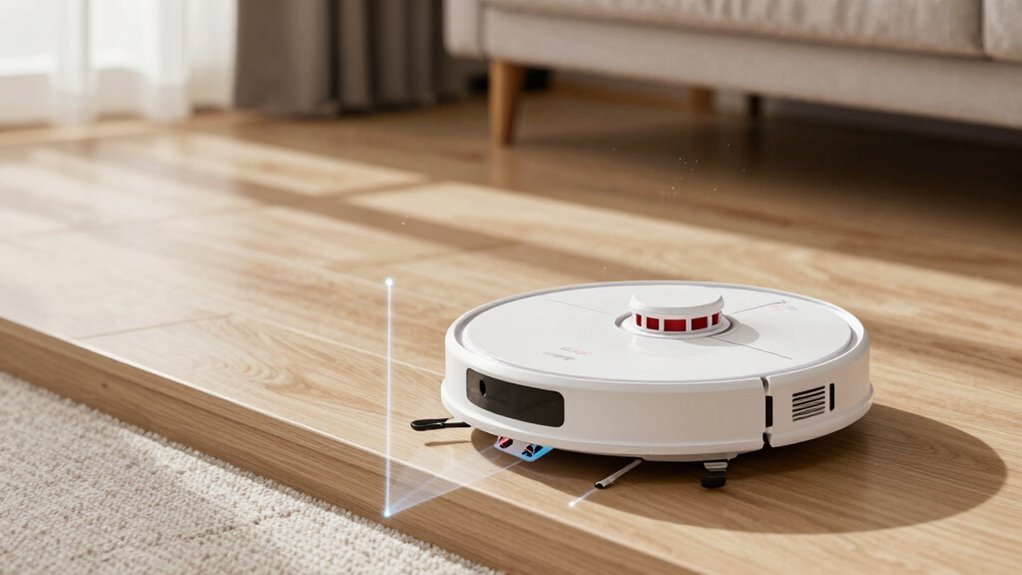
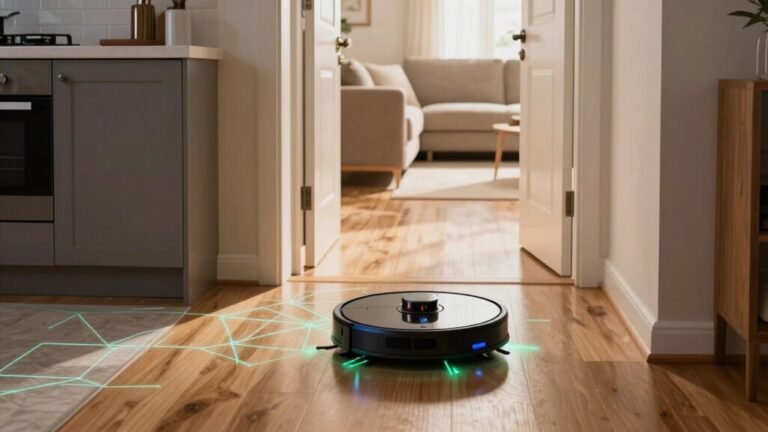
You’ve got a tiny robot ninja in your home that dodges couches, avoids cliffs, and never takes a tumble down the stairs. Robot vacuums detect obstacles and cliffs using a combination of advanced sensors and intelligent navigation systems.
It uses invisible infrared beams to spot walls, bouncing signals off obstacles to detect their presence. Bump sensors activate when the robot physically contacts an object, ensuring it can adjust its path even if other sensors miss something.
Ultrasonic waves help detect furniture and narrow spaces by measuring reflections, while LiDAR scans the room in 360 degrees to create a precise map. Cliff sensors work similarly, emitting infrared light downward to detect sudden drops like stairs by sensing the absence of a surface.
Even glass tables can trick it—sometimes—because reflective surfaces don’t always return consistent signals. But with clever sensor fusion, your robo-vacuum stays sharp, combining data from all systems to navigate safely and efficiently.
How Robot Vacuums ‘See’ Without Cameras
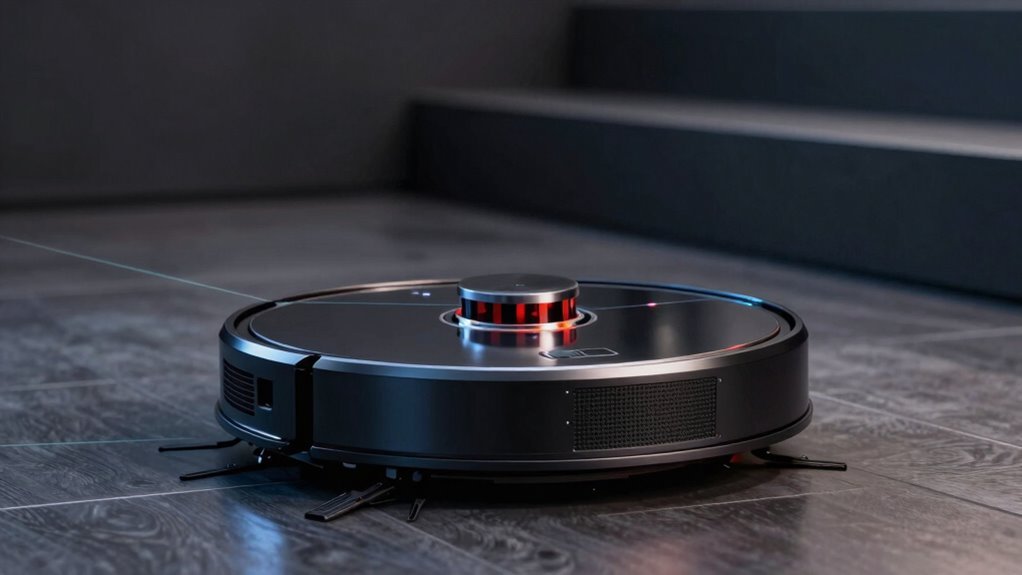
Ever wonder how your robot vacuum zooms around the living room without smashing into the dog—or tumbling down the stairs?
It’s not magic—it’s smart tech!
Your little helper uses ultrasonic sensors that “listen” for echoes, like a bat, to spot obstacles and drops with millimeter precision.
These sound-based eyes work in total darkness and don’t care if something’s black, shiny, or invisible to cameras.
Wide-angled and quick, they catch pets and toys before collisions happen.
Some models even rely on Time-of-Flight sensors that zap the room with safe light pulses, measuring how fast they bounce back to judge distances.
Sensor fusion combines multiple detection methods to improve reliability in real-world conditions.
Together, these sensors give your vacuum a rich sense of space—no camera needed.
So while you sip coffee, your bot dodges socks, avoids cliffs, and never once squints into the sun.
Pretty clever for something that can’t *actually* see, right?
Infrared Sensors: Spotting Walls and Furniture
Meet your robot vacuum’s secret weapon: infrared sensors.
These clever little helpers shoot out invisible beams that bounce off walls, furniture, and stray sneakers.
When the beam returns, your bot measures how fast it came back to judge distance—like a tiny, super-quick game of infrared tag.
Unlike regular cameras, these sensors work just fine in the dark, so your vacuum won’t crash into your couch during a midnight cleaning spree.
Early models used them to slow down before smacking into walls, and today’s versions are even smarter.
Paired with other sensors, infrared beams help your robot see obstacles clearly, decide whether to steer around them, or stop short like it’s avoiding a landmine.
It’s not magic—it’s science, and it keeps your bot (and your furniture) safe.
Who knew cleaning could be this high-tech?
LiDAR and SLAM integration enables real-time mapping and precise navigation by combining distance data with environmental awareness.
Can Robot Vacuums Detect Glass Tables?
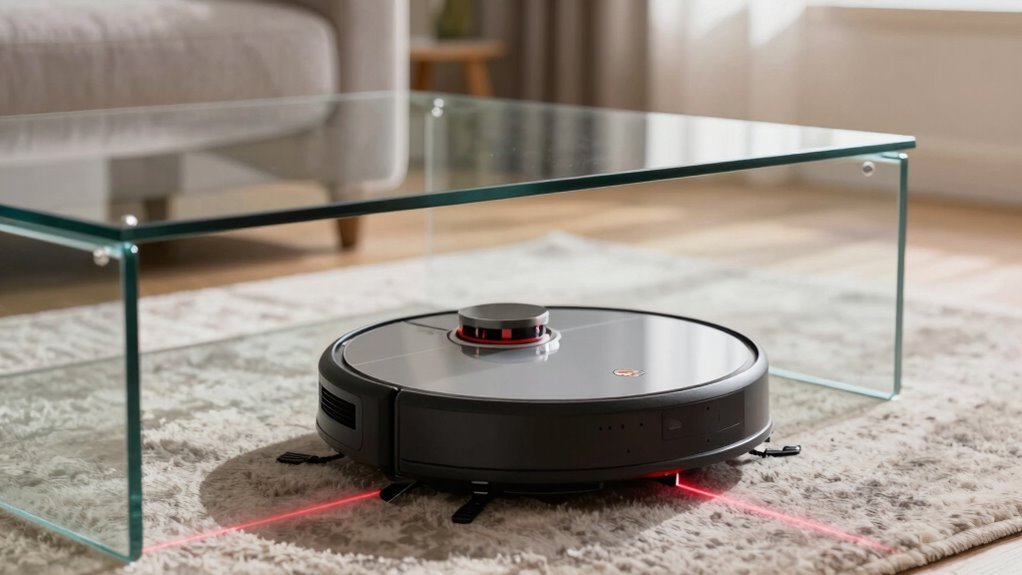
How does your robot vacuum handle a sleek glass table—graceful detour or full-speed fumble? Chances are, it’s the latter.
Most robot vacuums struggle with clear glass tables because their sensors use infrared or laser beams that pass right through the glass or bounce off unpredictably.
That shiny tabletop might as well be invisible!
Without opaque frames or legs, your robot may not see the table until it bonks into it—or worse, tries to climb underneath.
Even high-end models like the Roborock S6 and Lambot A1 often miss glass obstacles, detecting them only on impact.
Users report robots getting stuck or nudging glass bases repeatedly, confused by the reflection.
The fix? Try adding tape or using virtual walls.
How Robot Vacuums Avoid Falling Down Stairs
Your robot vacuum might fumble at glass tables, mistaking them for open floor space, but when it comes to stairs, it’s got serious smarts to avoid a face-first fall.
It’s like your robo-pal has a built-in sixth sense for drop-offs, thanks to clever tech working behind the scenes.
Here’s how it stays safe on the edge:
- Cliff sensors shoot invisible infrared beams downward—no signal means “yikes, a void!” and it backs up fast.
- Multiple sensors check edges every second, reacting instantly if they detect a sudden drop.
- AI and dual cameras recognize stairs like a pro, even in dim light, using pattern-matching magic.
- LiDAR and VSLAM maps remember stair locations, so it knows exactly where *not* to go—no guesswork needed.
No stair tumbles here—just smart, swift pivots and confident cleaning.
Bump Sensors: Bouncing Off When They Hit Something
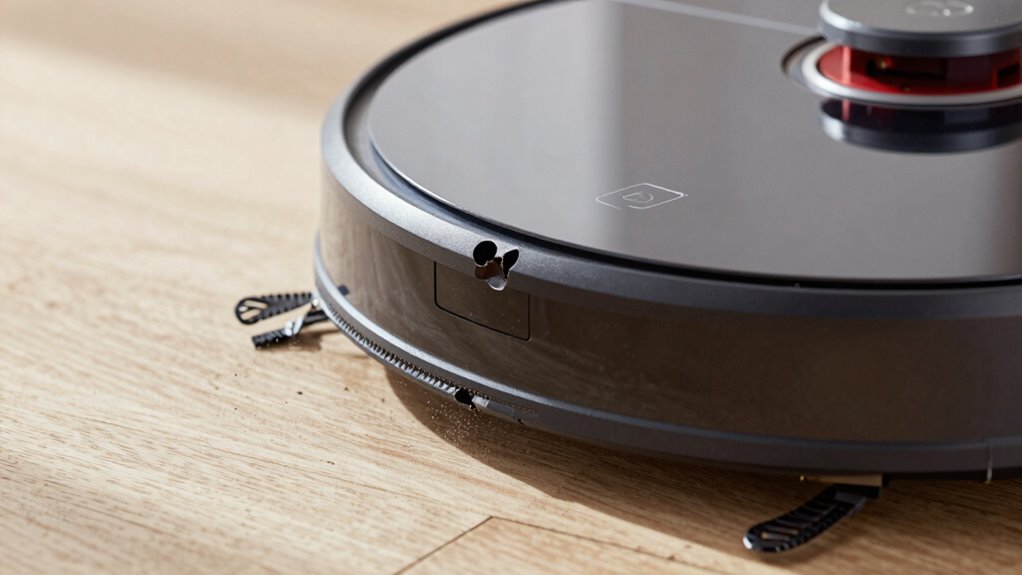
Even if your robot vacuum sometimes plays a game of bumper cars with the furniture, it’s not just clueless—it’s actually using smart, spring-loaded bump sensors to figure out when it’s hit something.
When the bumper presses back on impact, tiny switches or sensors inside—like micro-switches, Hall-effect, or IR detectors—trigger a signal.
Your robot instantly knows it bumped into something and which side was hit.
Then, like a pinball, it reverses and turns to bounce away safely.
Springs snap the bumper back so it’s ready for the next bump.
Some models even sense how hard the hit was, thanks to clever magnetic or optical tech.
While it can’t avoid every crash, this “bump and run” trick helps it explore without getting stuck.
It’s not clumsy—it’s just taking the scenic route!
How Robot Vacuums Track Position on Floors
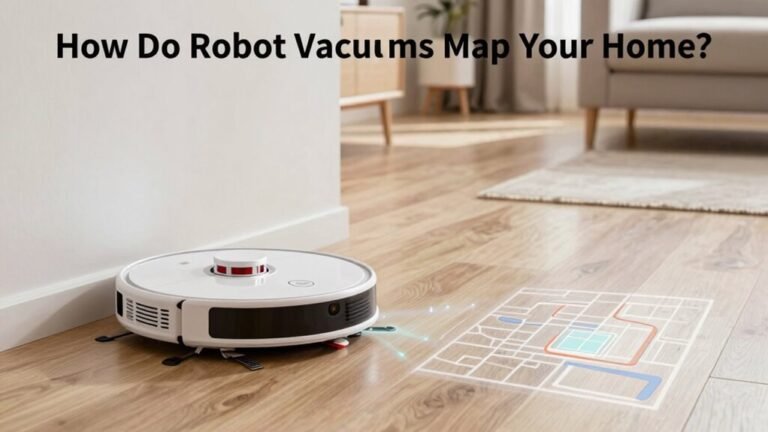
While you might wonder how a little disc on wheels knows exactly where it’s going, the truth is it’s not just wandering aimlessly—it’s mapping the joint like a robot spy on a mission. It’s using smart tech to track every move and clean like a pro. Here’s how:
- LiDAR lasers sweep the room 360°, bouncing light to measure distances and build a real-time map.
- Cameras with vSLAM spot visual clues—like wall art or furniture edges—and follow them like breadcrumbs.
- IMUs and wheel sensors track turns and distance, so even if the lights go out, it won’t lose its cool (or completely lose its way).
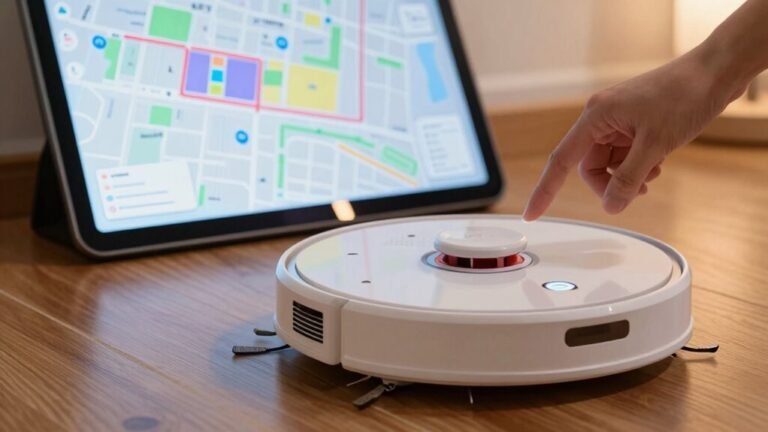
- SLAM smarts blend all that data, correct mistakes, and remember your floor plan—like a robot with a photographic memory and a GPS fetish.
It’s not magic—it’s mapping on the move!
How Sensors Work Together to Navigate
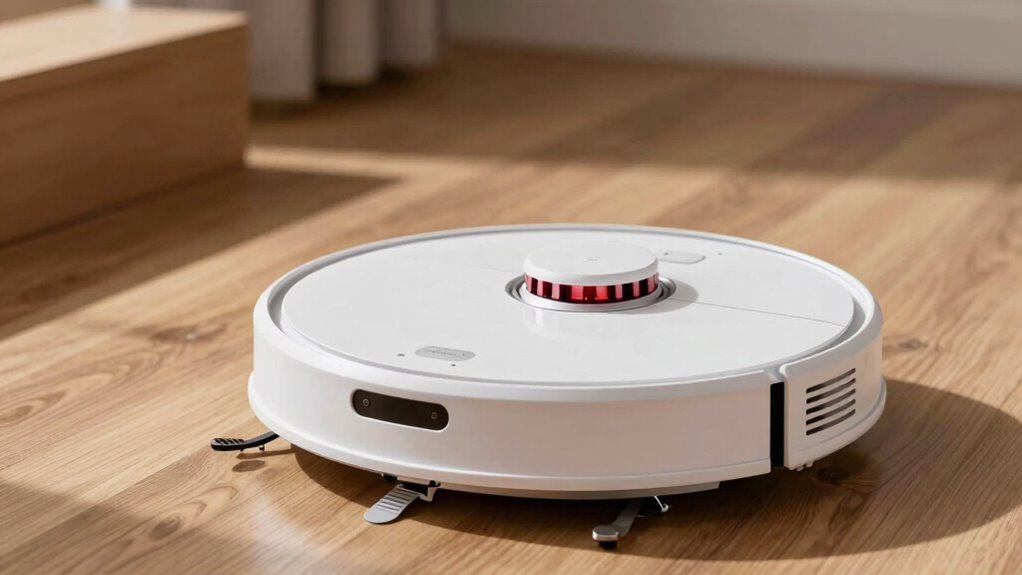
Now that you’ve seen how robot vacuums map your home like tiny secret agents with a knack for geometry, let’s talk about how they actually *use* those maps without crashing into your pet’s water bowl or taking a nosedive down the stairs.
Your vacuum doesn’t just see—it *thinks*, combining data from lasers, cameras, and infrared eyes to build a real-time picture of where it’s safe to go.
It’s like having a GPS, radar, and sixth sense all in one.
LiDAR spots furniture from afar, while ultrasonic sensors hear the dog zooming by.
If it bumps something (oops!), contact sensors confirm the surprise.
Near stairs? Downward IR beams catch the drop, and the IMU checks if it’s tipping.
All these inputs mix in smart algorithms—like a tiny brain filtering noise from truth—so your vacuum smoothly dodges disasters and keeps cleaning on autopilot.
Teamwork makes the dream work!
Why Robot Vacuums Still Get Stuck Sometimes
How does your trusty robot vacuum go from a sleek, autonomous cleaner to a helpless lump stuck under the couch?
Even with smart sensors and clever mapping, real homes are full of surprises.
Cords become trap wires, toys turn into landmines, and fluffy rugs turn into suction quicksand.
Sometimes, it’s not the robot’s fault—it’s just physics, clutter, and the occasional dark floor tricking its cliff sensors.
Here’s what trips them up most:
- Cords, toys, and tassels wrap around brushes and jam wheels.
- High thresholds, rugs, and uneven floors block their path or steal traction.
- Furniture mazes and tight corners confuse sensors, trapping the bot.
- Dirty sensors or low battery make even simple tasks impossible.
Your robot’s doing its best—just maybe tidy up those wires and fluff that rug edge!
Frequently Asked Questions
Can Robot Vacuums Detect Pets and Avoid Them?
Yeah, your robot vacuum can usually spot pets and dodge them—pretty cool, right?
Using smart sensors and cameras, it sees your cat or dog, slows down, and takes a detour like a tiny ninja.
It’s not perfect, especially if your pet’s napping in stealth mode, but it tries hard to avoid surprise run-ins and keep everyone happy.
Do Robot Vacuums Work in the Dark?
Yeah, your robot vacuum’s got night vision like a cat—no problem cleaning in the dark!
It uses infrared eyes and smart sensors to dodge furniture and avoid stairs, even in pitch-black rooms.
You don’t need to leave the lights on for it to see.
It’s zipping around confidently, tackling dust bunnies (and maybe *being* one) without a single stumble.
Total cleanup ninja!
How Often Should I Clean the Sensors?
You should clean your robot vacuum’s sensors once a month—seriously, it’s like giving it glasses after a dusty workout!
If you’ve got pets or run it daily, bump that up to every two weeks.
Just grab a soft microfiber cloth, wipe the sensors gently, and keep gunk from turning your smart vac into a confused bumper car.
Clean sensors mean happy navigation, fewer wall crashes, and no stair-jumping stunts!
Can Robot Vacuums Detect Charging Dock Direction?
Yes, you bet!
Robot vacuums can totally find their way back to the charging dock and know which direction it’s in.
They use smart maps, remember their path, and catch infrared signals from the dock like a homing beacon.
As they get close, special sensors and emitters help fine-tune the angle—so they don’t just crash in.
It’s like they’re playing docking darts… and winning!
Do Robot Vacuums Recognize Different Room Types?
Yeah, your robot vacuum totally knows the difference between rooms—it’s not just cleaning blindly!
It maps out your space, spots doorways and furniture, and says, “Ah, this is the kitchen!” or “Bedroom vibes here.”
You can even tell it to skip the bathroom or mop only the dining area.
It’s like giving your home a brain—and it remembers everything, so you don’t have to.
Pretty smart for a little guy, huh?
Conclusion
You zip through life like a tiny, curious explorer, sensing walls with invisible beams and tiptoeing around drop-offs like a cat testing hot pavement. Bumps? Just high-fives with furniture. Your smart brain weaves sensor magic, turning chaos into order. Sure, you sometimes snack on socks or panic near dark rugs—but hey, no navigator’s perfect. You’re the fearless little Roomba with a mission, and the floor’s your playground.
References
- https://vacuumwars.com/best-robot-vacuums-with-obstacle-avoidance/
- https://us.narwal.com/blogs/robot-vacuum/obstacle-avoidance-sensors
- https://www.therobotreport.com/sensor-breakdown-how-robot-vacuums-navigate-and-clean/
- https://www.welivesecurity.com/en/privacy/gathering-dust-and-data-how-robotic-vacuums-can-spy-on-you/
- https://www.youtube.com/watch?v=5O8VmDiab3w
- https://www.youtube.com/shorts/drmEY6nQH9Y
- https://ipcamtalk.com/threads/robotic-vacuum-vs-pir-sensors.41221/
- https://www.srhythm.com/blogs/stories/how-does-a-robot-vacuum-work-how-does-it-detect-obstacles-like-a-sofa-or-table
- https://de.3itech.com/en/blogs/news/how-robot-vacuums-avoid-certain-areas
- https://www.lefant.com/blogs/reviews/avoidance-technologies