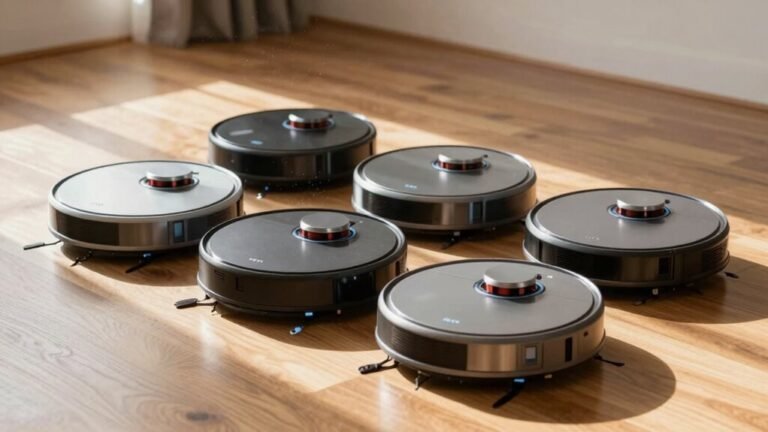
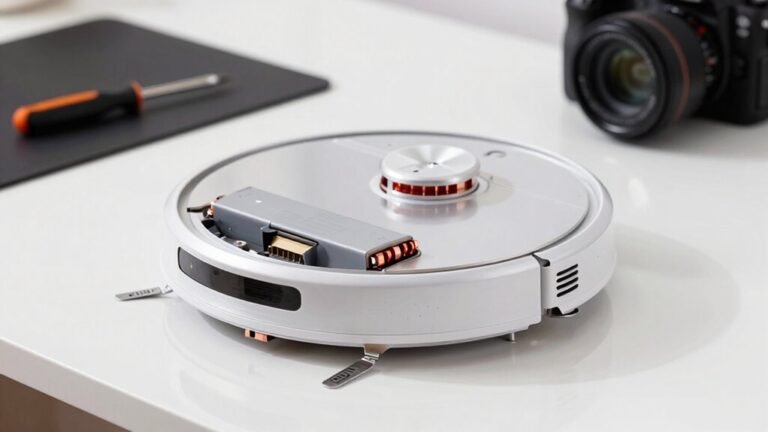
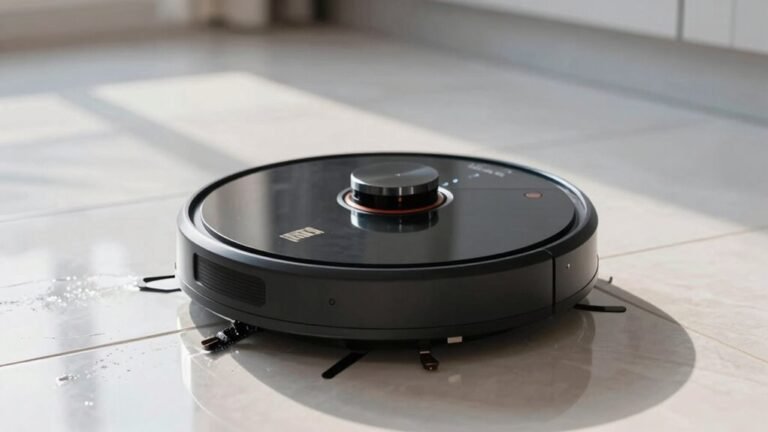
5 Self-Emptying Robot Vacuums That Do the Dirty Work for You
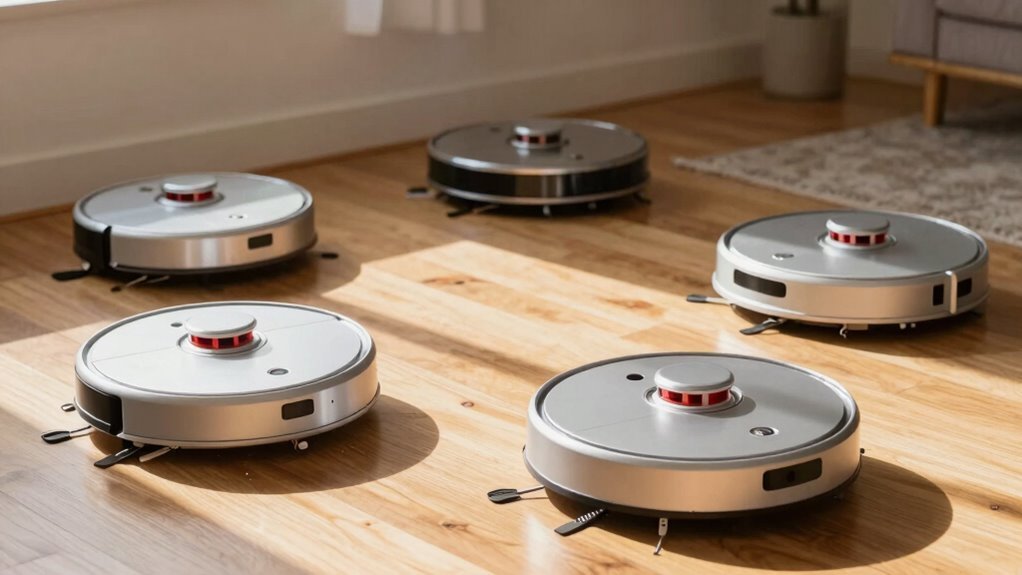
You’ve probably wondered—how much cleaner can a self-emptying robot vacuum really keep your floors while you do nothing?
These five self-emptying vacuums take the grunt work out of cleaning, offering convenience and powerful performance.
With bins that hold weeks’ worth of debris, models like the eufy C10 and ILIFE A30 Pro reduce the need for constant maintenance.
The eufy C10 features a 3L bag, while the ILIFE A30 Pro includes a five-pack disposable bag system for long-term use.
These vacuums combine strong suction, smart navigation, and some even have mopping capabilities.
So which self-emptying robot vacuum actually earns its keep?
| eufy C10 Self-Emptying Robot Vacuum | Best for Pet Hair | Suction Power: 4,000 Pa | Self-Emptying Capacity: 3L dust bag | Navigation Type: Laser Navigation | VIEW LATEST PRICE | Read Our Analysis | |
| Tikom Robot Vacuum and Mop (L8000 Plus) | Top Hybrid Performer | Suction Power: 6,000 Pa max | Self-Emptying Capacity: 3L dustbag | Navigation Type: 360° LiDAR | VIEW LATEST PRICE | Read Our Analysis | |
| ILIFE A30 Pro Self-Emptying Robot Vacuum | Longest Maintenance-Free Use | Suction Power: 5,000 Pa | Self-Emptying Capacity: 2.5L × 5 bags | Navigation Type: Precision LiDAR | VIEW LATEST PRICE | Read Our Analysis | |
| iRobot Roomba 105 with AutoEmpty Dock | Most Trusted Brand | Suction Power: 70X vs 600 series | Self-Emptying Capacity: Up to 75 days | Navigation Type: ClearView LiDAR | VIEW LATEST PRICE | Read Our Analysis | |
| Shark AI Robot Vacuum with Self-Empty Base | Best Smart Navigation | Suction Power: Incredible suction | Self-Emptying Capacity: 60-day dirt capacity | Navigation Type: 360° LiDAR | VIEW LATEST PRICE | Read Our Analysis |
More Details on Our Top Picks
eufy C10 Self-Emptying Robot Vacuum
If you’re the type who hates dumping dustbins every few days—yeah, we’ve all been there, holding a chunk of pet hair like it’s a science experiment—the eufy C10 Self-Emptying Robot Vacuum might just become your new under-the-radar cleaning partner. It boasts 4,000 Pa suction power and a self-emptying station that automatically transfers dirt into a 3L bag, which only needs replacing about every 60 days.
You’ll appreciate how its CornerRover Arm extends to tug debris from tight corners—something most bots miss—while the slim 2.85-inch profile slips under beds and desks with ease. Just don’t forget to pick up stray socks or cords first.
Laser Navigation maps your space efficiently, letting you schedule cleanings remotely via app, though it only works with 2.4 GHz WiFi. You won’t get a remote in the box, but for consistent, hands-off maintenance across carpets and hard floors, it’s a quiet win.
- Suction Power:4,000 Pa
- Self-Emptying Capacity:3L dust bag
- Navigation Type:Laser Navigation
- WiFi Frequency:2.4 GHz only
- App Control:APP control
- Voice Assistant Compatibility:Not specified
- Additional Feature:CornerRover Arm for tight spaces
- Additional Feature:2.85-inch slim profile design
- Additional Feature:Scheduled cleaning automation
Tikom Robot Vacuum and Mop (L8000 Plus)
The Tikom Robot Vacuum and Mop (L8000 Plus) offers powerful cleaning with minimal daily maintenance. It features a 3L self-emptying bag, allowing up to 90 days between emptying.
You’ll get 150 minutes of runtime, with auto-recharge and resume—ideal for large homes. The 6000Pa suction tackles pet hair and deep-set dirt, boosting automatically on carpets.
LiDAR mapping creates accurate 360° smart maps and supports up to five multi-floor layouts. It navigates intelligently and avoids obstacles, though the mop bar must be removed for carpet protection.
Control is seamless via app scheduling, no-go zones, Alexa, and dual-band Wi-Fi. It’s packed with smart features, delivering convenience without pretending to be magic.
- Suction Power:6,000 Pa max
- Self-Emptying Capacity:3L dustbag
- Navigation Type:360° LiDAR
- WiFi Frequency:2.4 GHz & 5 GHz
- App Control:App control
- Voice Assistant Compatibility:Alexa
- Additional Feature:2-in-1 sweeping and mopping
- Additional Feature:6000Pa max suction boost
- Additional Feature:5-level multi-floor map memory
ILIFE A30 Pro Self-Emptying Robot Vacuum
You’re getting serious cleaning autonomy with the ILIFE A30 Pro—if you want a robot vacuum that handles dust for months without you lifting a finger, its 2.5L self-emptying station (with five replaceable bags, each lasting up to 8 weeks) means you’ll go almost a full year—280 days—without touching a dustbin.
You’re guiding your home with precision thanks to LiDAR and SLAM algorithms, which map rooms accurately and plan efficient routes—no more random bumping around. With 5000Pa suction and four power modes, you’re tackling everything from light dust to pet hair on carpets or hard floors.
The 2-in-1 tank (200ml dustbin + 200ml water) lets you vacuum and mop simultaneously—saving about 30% in cleaning time. You can control zones, schedules, and suction via the ILIFEClean app (2.4GHz WiFi only), though you’ll need to remove the mop pad when skipping wet cleaning—because, let’s be honest, not every floor needs a spa day.
- Suction Power:5,000 Pa
- Self-Emptying Capacity:2.5L × 5 bags
- Navigation Type:Precision LiDAR
- WiFi Frequency:2.4 GHz only
- App Control:ILIFEClean App
- Voice Assistant Compatibility:Not specified
- Additional Feature:3-in-1 sweep, vacuum, mop
- Additional Feature:5 bags × 8-week capacity
- Additional Feature:Simultaneous vacuum and mop mode
iRobot Roomba 105 with AutoEmpty Dock
Picture yourself weeks into a cleaning streak without lifting a dustbin—yeah, that’s the iRobot Roomba 105 with AutoEmpty Dock stepping in, ideal for anyone who values convenience but doesn’t want to sacrifice suction or allergen control. It empties itself into the dock up to 75 days in a row—no daily dumping, no mess—while the bag traps 99% of allergens as small as 0.7 microns.
You’ll get 70X more suction than the Roomba 600 series, tackling dust and debris with a 3-stage system featuring multi-surface and edge-sweeping brushes. Its ClearView LiDAR maps your home quickly, avoiding obstacles and stairs with precision.
You can schedule rooms, set suction levels, or trigger spot cleans for 5 minutes—all through the app, voice commands (Alexa, Siri, Google), or buttons on the bot. It’s sleek, Wi-Fi-connected (2.4GHz for setup and operation, letting your phone hop back to 5GHz), and great for barefoot-ready floors.
Though you might wonder: is fully automated cleaning ever truly “set and forget”?
- Suction Power:70X vs 600 series
- Self-Emptying Capacity:Up to 75 days
- Navigation Type:ClearView LiDAR
- WiFi Frequency:2.4 GHz
- App Control:Roomba Home App
- Voice Assistant Compatibility:Alexa, Siri, Google Assistant
- Additional Feature:75-day hands-free cleaning
- Additional Feature:3-stage cleaning system
- Additional Feature:Spot cleaning up to 5 minutes
Shark AI Robot Vacuum with Self-Empty Base
Got a busy household with pets, kids, or both? The Shark AI Robot Vacuum with Self-Empty Base—model AV2511AE—handles daily messes with 360° LiDAR mapping and Matrix Clean Navigation, auto-detecting and avoiding obstacles day or night.
It delivers powerful suction across carpets, tile, and hardwood, its self-cleaning brushroll fighting pet hair tangles—a real plus if you’ve ever poked gunk out with a pen. With multi-pass cleaning and precision mapping, it covers every inch—no spots missed.
The XL Self-Empty Base holds up to 60 days of debris (yes, really—no bags, just a 0.27-gallon bagless tank). It recharges mid-clean, resumes where it left off, and connects to Alexa or Google Assistant for voice control.
Weighing 15.25 pounds and measuring 13.9 inches high, it fits under most furniture—though tight spaces might challenge its 13.08-inch width. Is it perfect? No—but between the 120-minute battery, lithium-ion power, and smart navigation updates, it’s a strong contender.
And hey, isn’t “set it and forget it” the whole point?
- Suction Power:Incredible suction
- Self-Emptying Capacity:60-day dirt capacity
- Navigation Type:360° LiDAR
- WiFi Frequency:Not specified (implied via app/voice)
- App Control:App control (implied)
- Voice Assistant Compatibility:Alexa, Google Assistant
- Additional Feature:Bagless XL self-empty base
- Additional Feature:Self-cleaning brushroll anti-hair wrap
- Additional Feature:Matrix Clean Navigation grid
Factors to Consider When Choosing a Self-Emptying Robot Vacuum
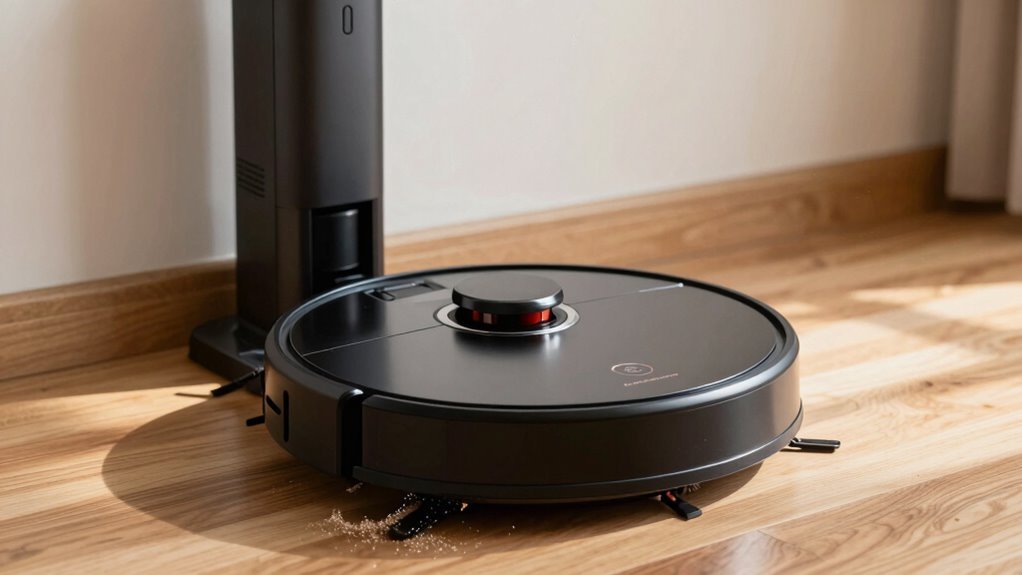
You’ll want to weigh suction power—ranging from 2,000 to over 6,000 Pa—since stronger isn’t always smarter if it sacrifices battery life or noise levels. Think about dust capacity and maintenance: bases that hold up to 60 days of debris sound great, but do you really want to wait that long before emptying a full bin? Navigation, app smarts, floor compatibility, and whether you need mopping (or just pretending to) all shape how well your robot fits your routine—not just the specs on paper.
Suction Power Comparison
What really determines how well your robot vacuum tackles pet hair, crumbs, or that mysterious dust bunnies under the couch—suction power, right? You’ll find self-emptying models ranging from 4000 Pa to 6000 Pa, and that number matters—especially if you’ve got carpets or shedding pets.
The 6000 Pa option delivers the strongest lift, easily pulling embedded dirt and pet hair from deep within fibers, while a 5000 Pa unit still offers solid performance across most debris types and floor surfaces. At 4000 Pa, cleaning gets the job done on hard floors and loose dust, but struggles with stubborn or ground-in messes.
Many models now smart-adjust suction, boosting power on carpets and scaling back on tile or hardwood to save battery. So yeah, higher suction usually means better cleaning—but only if your floors need it.
Don’t pay extra for 6000 Pa if your home’s mostly bare floors and light debris. Match the power to your mess.
Dust Capacity And Maintenance
A truly hands-off cleaning experience hinges not just on powerful suction but on how much debris the system can stash before demanding your attention. Dust capacity and maintenance rhythms are key when picking a self-emptying robot vacuum.
You’ll want a base with a high-capacity bag—think 3L or multiple 2.5L bags—so it can go weeks without intervention. Some models claim up to 60 days or even 40 weeks between changes, depending on floor size and shedding pets.
Models using five 2.5L bags stretch maintenance intervals impressively. But when your home is especially dusty, do you *really* expect two months between changes?
Bagless bases skip replacements but still require you to empty a 0.27-gallon (about 3L) bin periodically. This can be less convenient if you hate dealing with dust clouds.
Automatic emptying after each run keeps the robot’s bin clean. However, the base itself won’t stay full forever.
You’re not totally off the hook—just relieved of daily chores.
Navigation And Mapping Accuracy
While you’re sipping coffee and scrolling through your phone, your robot vacuum’s brain is hard at work—mapping every nook of your living room with LiDAR that spins 360°, clocking data at up to 10 scans per second to build a precise floor plan. You’ll love how it uses SLAM algorithms to plot efficient routes, covering 95% of your floor without random bounces.
Multi-floor mapping lets it remember both your living room and upstairs hallway—so switching levels feels seamless. Advanced sensors detect walls and furniture edges, adjusting boundaries on the fly for cleaner corners.
It dodges stray shoes and adapts when you rearrange the couch, thanks to dynamic path planning. Sure, it might pause at a shadow or a charging cable (don’t we all misread situations sometimes?), but overall, it’s sharp.
With precise room recognition, it knows the kitchen from the den—no more guessing where to vacuum. You’re not just buying a bot; you’re getting a quiet cartographer that maps and masters your space, one spin at a time.
App And Smart Home Integration
Since your robot vacuum spends more time maneuvering your home than you might spend thinking about cleaning it, you’ll want one that stays in sync with your digital life. Look for models that offer robust app control, letting you start, pause, or schedule cleans from your phone no matter where you are.
Most models run on 2.4 GHz Wi-Fi, with some adding 5 GHz for faster setup. If you’re already invested in a smart home ecosystem, choose one compatible with Alexa and Google Assistant so you can banish dust with just your voice.
The best apps allow you to set no-go zones, create multi-room maps, and deploy virtual walls to guide cleaning paths. Features like auto-recharge and resume ensure your robot finishes the job without needing constant supervision.
You’ll receive real-time updates, so you’ll always know whether your vacuum is actively cleaning or stuck somewhere. Honestly, what more could you expect from a robot that empties its own trash—besides your gratitude?
Floor Type And Mop Compatibility
You’ve got your robot vacuum synced to your smart home, taking voice commands like a digital butler—now let’s talk about what it actually rolls over. Most self-emptying models handle hard floors and low-pile carpets just fine, but mopping? That’s where things get specific.
If you want wet cleaning, pick a robot like the ILIFE A30 Pro with an integrated water tank—plus the option to remove the mop pad when you don’t need it. Models like the Tikom L8000 Plus offer three water flow levels, so you can tweak moisture output for hardwood versus tile.
Just remember: mopping on carpet’s a no-go, unless you enjoy damp patches and awkward “why is the dog licking the rug?” moments. Use no-go zones in the app or switch off mop mode entirely.
Some vacuums auto-boost suction on carpet, but none (yet) auto-lift the mop—so a little human logic still helps.
Cleaning Schedule Flexibility
How often do you really want to babysit a robot vacuum? Not often—so scheduling flexibility matters.
You can set precise cleaning times and days through the app, even when you’re at work or asleep, as long as you’ve got 2.4 GHz Wi‑Fi (5 GHz won’t cut it). Models with auto-resume recharge and finish jobs without you lifting a finger—ideal for larger homes where a single charge isn’t enough.
With multi-floor maps and no-go zones, you’re not stuck with one-size-fits-all cleaning. Schedule different times for the kitchen versus the bedroom, say, 3 p.m. on weekdays for crumbs, 9 a.m. Sundays for the whole layout.
Voice assistants like Alexa or Google let you trigger cleanups hands-free—“Hey Google, clean the living room”—though that requires setup savvy and a stable connection. You’ll gain time, sure—but only if your routine matches the robot’s limits.
Design And Obstacle Clearance
Ever wonder why some robot vacuums glide under your sofa while others just stare at it like confused pets? It’s all about design and obstacle clearance.
A slim 2.85-inch profile lets your robot sneak under beds and desks—spaces where dust bunnies throw raves you’re never invited to. Pair that with extendable side brushes, like the CornerRover Arm, and you’ve got a machine that actually cleans along edges, not just pretends to.
But what really sets top models apart is 360° LiDAR navigation: it maps your space, detects obstacles ahead of time, and reroutes like a GPS-savvy driver avoiding traffic. Real-time avoidance means fewer bumps into chairs or toys, and virtual walls let you block off-limits zones—perfect for pet bowls or delicate decor.
Plus, the self-emptying dock quietly sucks up debris post-clean, so you’re not knee-deep in dust every few days.
Frequently Asked Questions
How Often Should I Replace the Filter in My Self-Emptying Robot Vacuum?
You should replace the filter every 2 to 3 months with regular use. If you have pets or allergies, swap it every 6 weeks. Always check for clogs and clean it monthly to keep suction strong and your air clean.
Can Self-Emptying Robot Vacuums Handle Pet Hair Effectively?
You crush pet hair like a beast—no strand stands a chance. These vacuums suck up fur by the ton, outperform even pro groomers, and handle daily shedding with ease, leaving floors fur-free and your sanity intact.
Do These Vacuums Work on Dark or Black Floors?
Yes, they work fine on dark or black floors. You won’t have issues with navigation since modern sensors don’t rely on floor color. They clean thoroughly and avoid getting stuck, so your dark hardwood or tile stays spotless without any hassle from you.
Are Self-Emptying Bins Compatible With All Models From the Same Brand?
No, you can’t just plug any model into any bin—like trying to fit a steam-powered gadget into a Tesla. Most self-emptying bins only work with specific models, even within the same brand. Check compatibility before buying.
Can I Schedule Cleanings While the Vacuum Is Docked and Emptying?
Yes, you can schedule cleanings while the vacuum’s docked and emptying. Just set the time in the app, and it’ll start automatically. The self-emptying won’t interrupt the schedule—you’re good to go even if it’s still dumping dust when the next run begins.
Conclusion
You’re handing off dust duty to robots that work smarter, not harder—like tiny, tireless butlers with 2.5L to 3L dust bags (lasting weeks) and suction up to 6000 Pa. Sure, they cost more and need space (that 2.85-inch slimness helps!), but between auto-empty docks, mopping modes, and eight-week bag life, isn’t convenience worth a little math?