Why Do Some Robot Vacuums Need Light to Clean?
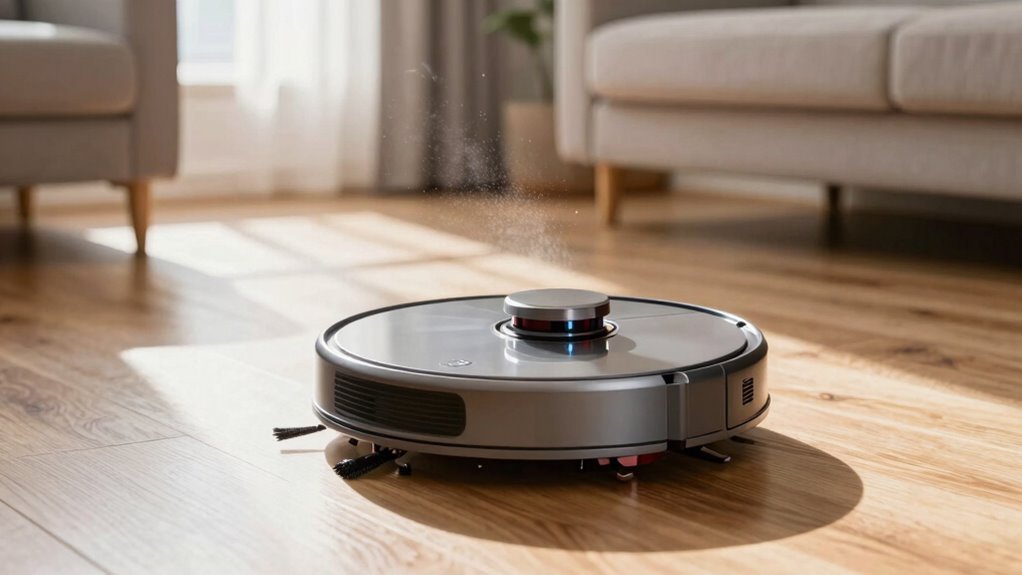
Some robot vacuums need light because they rely on cameras to “see” and map your room, much like how you might need a nightlight to navigate in the dark. Without sufficient lighting, these models can struggle, often spinning in circles or missing spots, especially in dimly lit corners.
However, many robot vacuums use LiDAR or infrared sensors instead, allowing them to clean efficiently even in complete darkness. Think of it as night vision for robots—no light required. There are also simple tricks to help your robot vacuum glide smoothly, even after the lights go out.
Why Do Robot Vacuums Need Light to Navigate?
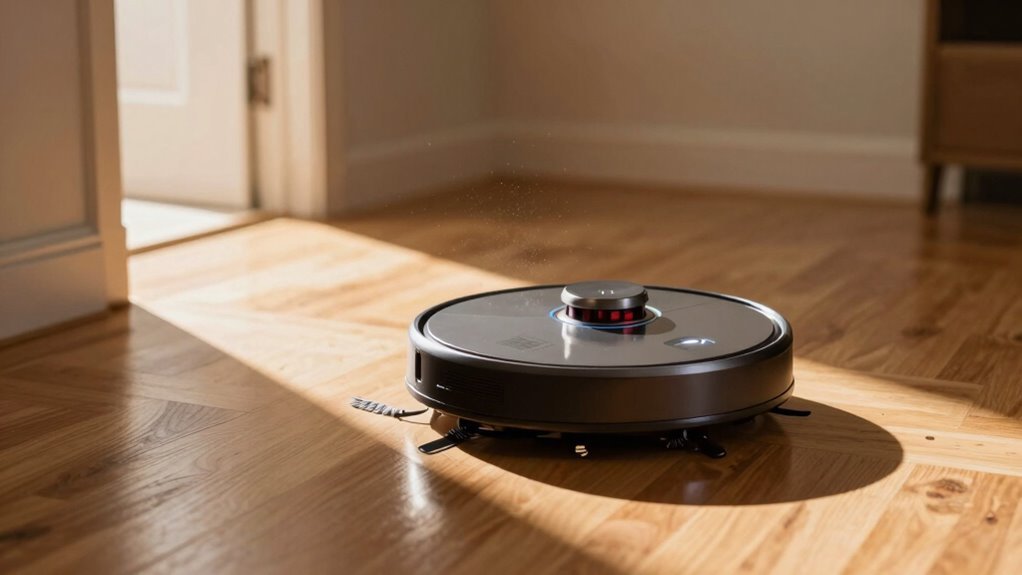
Ever wonder why your robot vacuum seems a little lost in the dark?
Well, many of them rely on cameras to “see” your room, using visual landmarks like furniture and walls to map out their path.
It’s kind of like how you’d find the kitchen at night—if the hall light’s off, you might bump into a few things.
Without enough ambient light, those smart little eyes can’t grab clear images, so your vacuum might spin in circles or miss spots entirely.
Some models even use ceiling details to navigate, which means pitch-black rooms really throw them off.
While they won’t call for backup (unlike you in a dark basement), they do their best—often with a clumsy charm.
Cameras on some models require a certain amount of light.
Can Robot Vacuums Clean in the Dark?
How do your robot vacuum’s adventures go when the lights go out?
Just fine, thanks to smart tech like LiDAR and infrared sensors.
You don’t need to leave a nightlight on—these vacuums map your home with lasers and invisible light, cleaning every corner in total darkness.
They dodge toys, hug walls, and won’t tumble down stairs, even on black floors that look like cliffs.
LiDAR spins and scans, while infrared beams detect obstacles, so your robot never trips blindly.
With sensor combos and AI smarts, it adapts in real time, cleaning under beds and around furniture like a pro.
Models like the Narwal Freo X Plus even use tri-laser navigation to avoid trouble in the dark.
Best part? It uses barely more battery and runs quietly while you sleep.
This reliable performance is due to sensor fusion + AI, combining multiple inputs for accurate night navigation.
How Do Cameras Help Robot Vacuums See in Low Light?
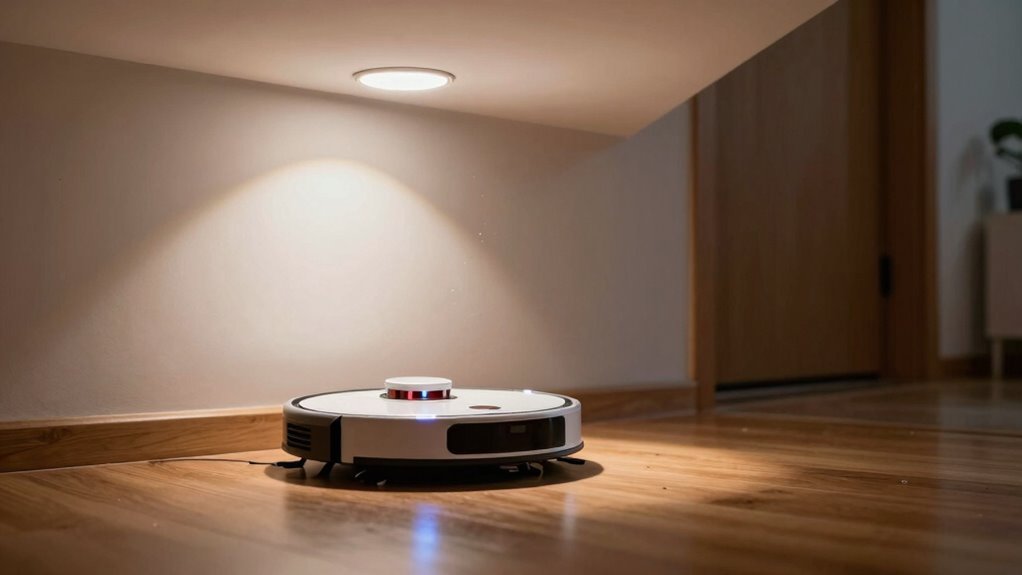
Why do some robot vacuums still stumble in the dark when yours glides so smoothly? Well, your smart little helper likely uses a camera paired with a bright LED ring to see in low light—kind of like turning on a flashlight in a dim room.
While basic cameras struggle without ambient light, that glowing ring lights up floors and corners, helping your vacuum spot obstacles and avoid smacking into legs or pet toys.
It’s not night vision, but it’s clever enough to keep things moving.
Plus, sensors like gyroscopes jump in when things get too dark, helping your vacuum stay on course like an internal compass.
Sure, it’s not perfect—complete darkness still stumps it—but with a little help, your camera-powered buddy handles twilight zones under sofas and dim hallways like a champ.
Who knew robots could be so resourceful?
LiDAR vs. Camera Navigation: Which Works Better in the Dark?
What if your robot vacuum could map the whole house without needing a night-light? Good news—you can ditch the hallway bulb! LiDAR robots use invisible laser pulses to “see” in total darkness, building precise maps while you sleep. Camera-based (vSLAM) models? They’re like us—they need light to spot edges and furniture. In the dark, they stumble, slow down, or just give up. LiDAR wins hands-down for nighttime cleanups.
| Feature | LiDAR | vSLAM (Camera) |
|---|---|---|
| Works in total dark | Yes, easily | No, needs light |
| Mapping speed | Fast, one pass | Slower, multiple scans |
| Accuracy | Millimeter-precise | Less consistent |
Skip the spotlight—LiDAR’s got night vision built-in. Your floor’s always ready for a clean!
Which Rooms Are Hardest for Robot Vacuums Without Light?
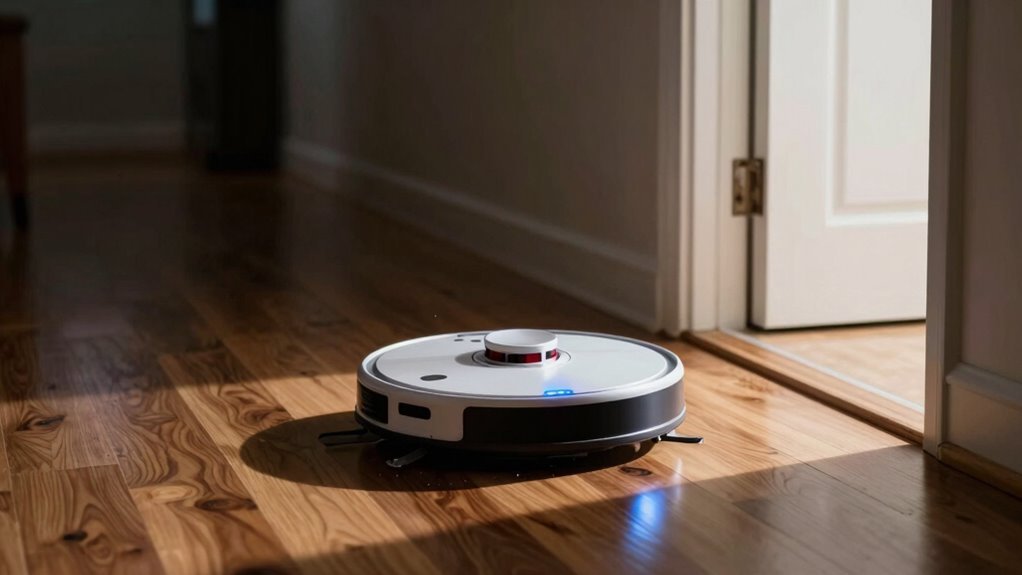
Ever tried sending your robot vacuum into a dimly lit room only to find it spinning in confusion like it’s auditioning for a confused robot spin-off series?
Dark carpeted bedrooms are a nightmare—your vacuum sees shadows as deadly drops and refuses to step in.
Glossy tile kitchens? Those shiny floors bounce sensor beams everywhere, making your bot dizzy.
Cluttered living rooms with cords and pet bowls turn into obstacle courses it can’t navigate without light cues.
Narrow hallways and shadowy spaces under low furniture?
They’re like robot black holes—once it goes in, it mightn’t come out.
Even cluttered closets or dim home offices trick cliff sensors and scramble mapping.
Without enough light, your vacuum’s brain fumbles, taking wild turns or freezing up.
It’s not being lazy—it’s just lost in the dark, doing its best impersonation of a confused Roomba on a caffeine crash.
How Can I Improve My Robot Vacuum’s Performance in the Dark?
You just saw how dark corners and tricky floors can turn your robot vacuum into a spinning, stuck, or confused mess—like a tiny metallic tumbleweed lost in a moonless desert. But don’t panic!
You can boost its dark performance easily.
Pop in a nightlight or smart bulb on a timer to give camera-based bots just enough glow. Keep sensors clean and pick models with LiDAR or dToF—they don’t need light to map.
Pre-map your space when it’s bright so it remembers the layout. Set virtual walls and no-go zones to avoid trouble spots.
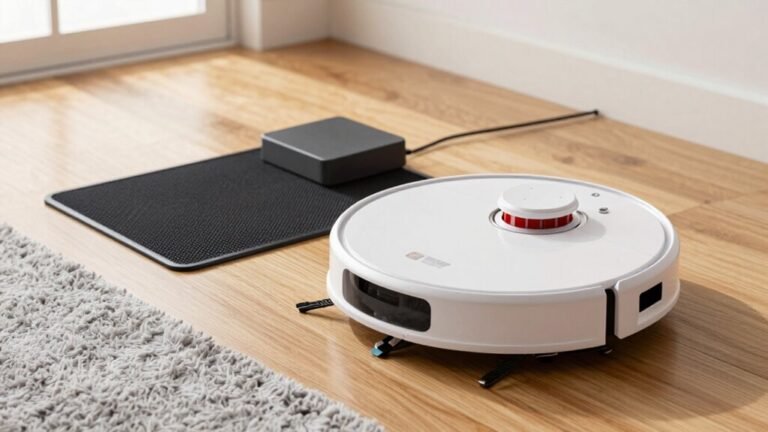
Toss down mats on glossy floors that trick lasers, and clear small clutter before bedtime cleanups.
Choose bots with long batteries and front LEDs for better night vision. With the right tweaks, your robot won’t just survive the dark—it’ll own it. Who knew bedtime was cleaning o’clock?
Do All Robot Vacuums Need Light to Work?
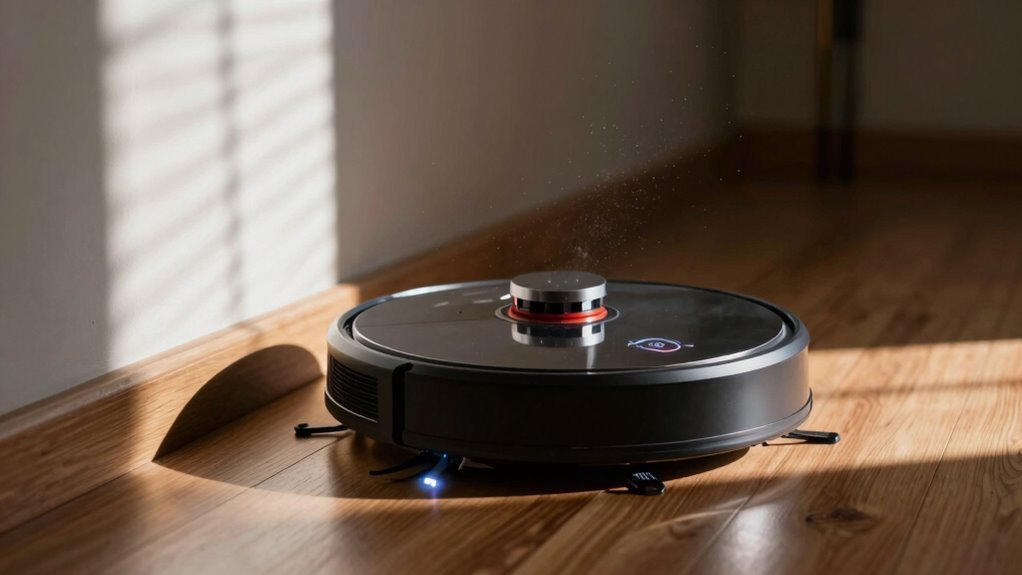
Curious if your robot vacuum will fumble around in the dark like a toddler in a haunted house? Good news: not all of them do.
If your model uses LiDAR, ultrasonic sensors, or an IMU, it zips around just fine in total darkness—no light needed.
These robots map your home with lasers or sound waves, seeing the world like a bat in a basement.
But if your vacuum relies on camera vision (like VSLAM), it needs some light to “see,” unless it has built-in lights to help.
Bump and cliff sensors keep it from tripping, even in pitch black.
High-end models from Dreame, Narwal, or Wyze handle night duty like pros, thanks to dToF LiDAR and smart AI.
Frequently Asked Questions
Do Robot Vacuums Work on Carpet in Low Light?
Yeah, robot vacs can work on carpets in low light, but it really depends on the model.
If yours has smart sensors or infrared tech, it’ll zoom around like a pro, even in the dark.
But cheaper models might freak out over dark rugs, thinking they’re cliffs.
Turn on a lamp, and suddenly they’re fine.
Can Dark Furniture Confuse Robot Vacuum Sensors?
Nope, dark furniture won’t fool smart robot vacuums—they’re sneaky, but not that sneaky!
If your vacuum’s packing LiDAR or infrared, it zips around ebony tables and charcoal couches like a ninja in the night.
These sensors don’t care if it’s pitch black or bright sunlight.
So relax, your mysterious-looking sofa won’t become a secret robot trap.
Whew!
Do Shiny Floors Affect Robot Vacuum Navigation?
Yeah, shiny floors can totally mess with your robot vacuum’s sense of direction.
The gloss reflects laser and camera sensors, making it think walls moved or obstacles vanished—cue the bumper taps and confused spins.
It’s like giving your robot sun glare!
But don’t worry, newer models use dToF sensors or LiDAR combos that laugh at reflections.
They navigate like pros, even on slick, mirror-like tiles.
Smart tech for slick floors!
Will Stairs Fool Robot Vacuums in Dim Light?
You’re in good hands—stairs won’t pull the wool over most robot vacuums, even in dim light.
They use cliff sensors and LiDAR, so they spot drops like pros.
Infrared beams bounce off edges, keeping your bot from taking a nosedive.
Sure, some wobble in low light, but they recover fast.
Think of it as their version of tiptoeing in the dark—smart, careful, and a little dramatic.
Can Pet Toys Block Robot Vacuums in the Dark?
Yeah, pet toys can totally block your robot vacuum in the dark, especially if it relies on cameras or optical sensors.
Without enough light, it mightn’t see that rogue tennis ball or chew toy in its path.
It’ll bump into it, maybe even get stuck—like a sleepy pet stumbling over toys at night.
LiDAR or infrared models handle this better, but always tidy up first.
Save the surprise obstacles for playtime, not clean time!
Conclusion
So, your robot vacuum freaks out in the dark? Don’t worry, it’s not scared—just bad at hide-and-seek without a nightlight. Some bots stumble like toddlers without light, while others use fancy lasers and still find your lost socks. If yours needs a disco ball to work, maybe it’s time to upgrade… or throw it a glowstick party. Either way, your floor’s still getting cleaner, even if your robot’s a bit dramatic about ambiance.
References
- https://robotklinsmann.com/do-robot-vacuums-need-light/
- https://forums.wyze.com/t/does-the-robot-vacuum-need-light/234384
- https://robotvacuums.com/blogs/blogs/a-complete-overview-of-robot-vacuum-navigation
- https://in.dreametech.com/blogs/tips-tricks/how-robot-vacuum-navigation-works-sensors-mapping-smart-cleaning-explained
- https://www.ecovacs.com/us/blog/robot-vacuum-dark-floors-environments
- https://www.switch-bot.com/blogs/robot-vacuum/robot-vacuums-lidar-dark-cleaning
- https://support.dyson.com.sg/supporthome.aspx/Vacuums/Robots/360visnav/448852-01/using-your-robot/my-robot-gets-lost-in-dark-areas
- https://www.eufy.com/blogs/robovac/how-do-robot-vacuums-work
- https://ca.narwal.com/blogs/product/robot-vacuum-work-at-night
- https://us.narwal.com/blogs/product/can-robot-vacuum-work-night