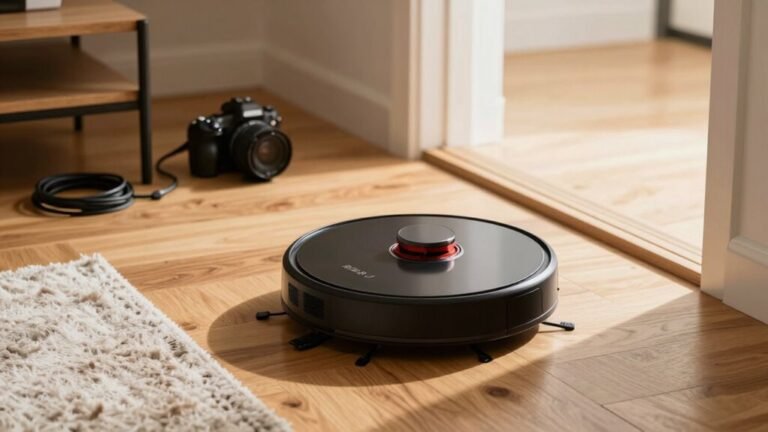
How to Train Your Pet to Get Used to a Robot Vacuum
Start by placing the robot vacuum off and still, letting your pet sniff it at their own pace—this helps your pet get used to a robot vacuum. Offer treats to create a positive association and let the experience unfold slowly.
Gradually turn the robot vacuum on without moving it, allowing your pet to hear the sound while staying calm. Run it nearby in short bursts, rewarding relaxed behavior with praise or snacks.
Watch for signs of fear, such as cowering or hissing, and slow down the process if needed. Turn cleaning into a game by pairing robot vacuum sessions with playtime or treats.
Keep training sessions short and consistent, ideally at the same time each day. A daily routine helps your pet get used to a robot vacuum more effectively.
When your pet finally naps near the buzzing bot, you’ll know you’ve won—and there’s an even smoother ride ahead.
Spot Signs Your Pet Fears the Robot Vacuum
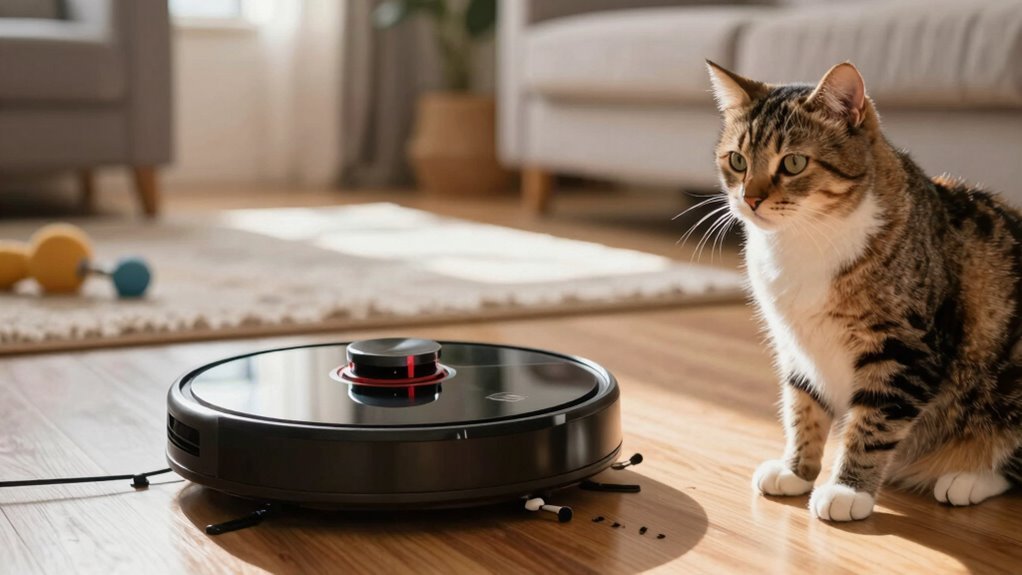
While your robot vacuum might seem like just a helpful little gadget to you, your pet could be seeing—okay, maybe *overreacting* to—it as a tiny, noisy invader from another planet.
You might catch your cat frozen in place, ears flat, pupils huge, like they’ve seen a ghost.
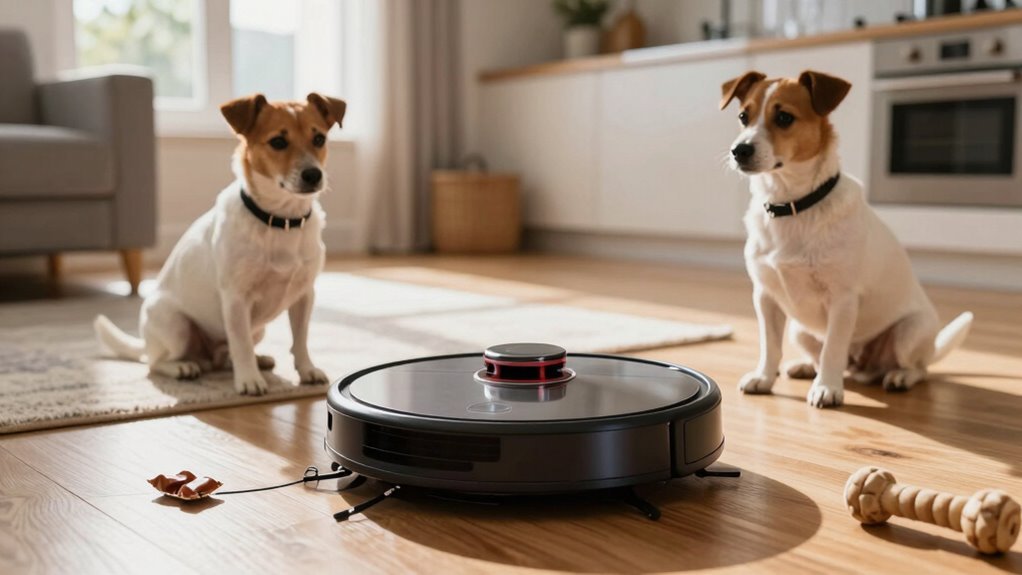
Or maybe your dog suddenly crouches low, tail tucked, as if the vacuum growled at them.
Hissing, swatting, or frantic meowing? Yep, that’s fear talk.
Even if they don’t run, trembling, piloerection (hello, Halloween cat!), or darting away when it moves unpredictably are red flags.
You mightn’t notice right away, but excessive grooming or hiding afterward means stress stuck around.
And let’s be real—55-65 decibels isn’t quiet for sensitive ears; to them, it might as well be a thunderstorm on wheels.
If your pup treats it like fireworks or your cat acts like it’s committing home invasion, they’re not being dramatic—they’re scared.
Spotting these signs early means you can help them chill—before the robot becomes public enemy number one.
Unpredictable movement triggers primal fear because pets perceive sudden motions as potential threats.
Start With the Robot Vacuum Powered off
Getting your pet comfortable with their new robo-roommate starts with something surprisingly simple—just plopping the robot vacuum down, powered off, like it’s napping in the middle of the living room.
Keep it at a distance at first so your furry friend can check it out without feeling spooked.
Let them observe it like it’s a weird, silent sculpture.
Toss in treats and sweet talk whenever they glance at it—make its presence equal yum and love.
Gradually move it a few inches closer over days, rewarding calm vibes each time.
No zoomies? That’s a win.
This slow, snack-filled intro builds trust without scary sounds or sudden moves.
You’re basically teaching them, “Hey, this disc isn’t alive, but it brings snacks!”
Stick to this routine, and you’ll lay the groundwork for a peaceful, clean home—minus the pet panic.
This method supports positive reinforcement and gradual exposure to foster a peaceful coexistence.
Let Your Pet Sniff the Robot Vacuum
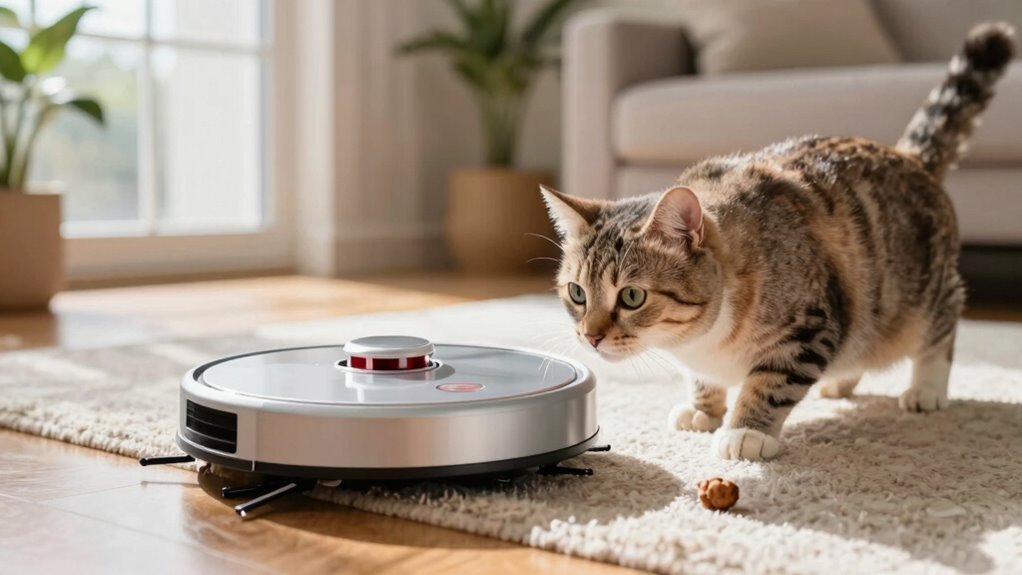
Go ahead and invite your curious critter in for a nose-to-metal meet-and-greet—yes, it’s basically a sniff test, but think of it as the most important first date your pet will ever have with a household appliance.
Place the robot vacuum off and still, letting your pup or kitty approach on their own terms.
Stay chill—pets pick up on your vibe.
Let them sniff, paw, or even circle it like it’s a mysterious jungle beast.
Offer treats the moment they sniff calmly, and toss in praise like you’re announcing a game show win.
High-value snacks? Even better.
Repeat this over a few days, and you’ll build good feels around the machine.
Sniffing helps them realize it’s not a predator—just a weird, quiet friend that fights fur bunnies.
With patience and treats, you’re not just avoiding vacuum wars—you’re setting the stage for peaceful coexistence.
Turn On the Robot Vacuum Without Cleaning
Now that your pet’s had a chance to sniff and inspect the robot vacuum like it’s some kind of futuristic metal rodent, it’s time to bring it to life—minus the cleaning.
Flip it on, but don’t let it move—just let it hum.
Start quiet and from a distance, so it’s not too startling.
The whirr might seem odd, but pairing it with a tasty treat makes it way more exciting.
Yes, that blue kibble counts as a paycheck now.
Watch your pet’s body language, keep things calm, and toss in lots of praise like confetti.
When they stay relaxed, mark it with a happy “good!” and a reward.
Slowly inch closer and turn up the volume, always respecting their comfort zone.
Think of it as robot karaoke night—low stakes, high vibes.
Short sessions work best, so quit while you’re ahead and end on a fun note.
You’re not just training—you’re building trust, one beep at a time.
Run the Robot Vacuum in Another Room First
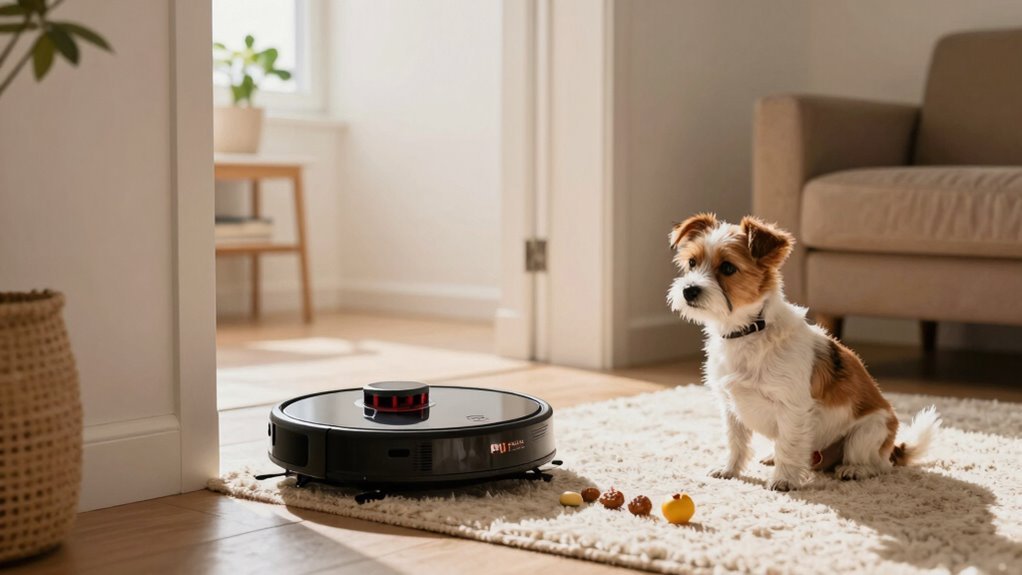
While your pet may not be ready to star in a robot buddy comedy just yet, kicking off the robot vacuum’s debut in another room is a smart, stress-free way to ease them into the act.
You’re building trust, not suspense—so keep it chill and positive.
Here’s how to smooth the intro:
- Turn on the vacuum in a distant room at low power, letting the hum stay background noise, not front-row drama.
- Pair the sound with treats, toys, or playtime so your pet thinks, “Hey, that noise means good stuff!”
- Keep sessions short—just a few minutes—so it’s a quick cameo, not a full feature film.
- Watch your pet’s body language and toss in high-value goodies when they stay cool.
You’re not just running a robot—you’re directing a mini blockbusters where calm wins the Oscar.
Ease Closer Over Days
Once your pet’s cool with the robot vacuum just sitting there like a weird metal paperweight, it’s time to slowly shrink the distance between them—think of it like setting up a series of tiny, no-pressure hangouts. Start close enough that your pet notices but doesn’t stress, then inch the vacuum forward a bit each day. Let them sniff, investigate, and build confidence at their own pace. Keep sessions short and sweet—5 to 10 minutes—and always end on a calm note.
| Phase | What You Do |
|---|---|
| Day 1–2 | Move vacuum 3 feet closer |
| Day 3–4 | Reduce to 1–2 feet away |
| Day 5+ | Let it sit right in their space |
Progress only if your pet stays relaxed—no rushing. This slow dance builds trust, turning fear into “meh.”
Reward Calm Behavior Around the Robot Vacuum
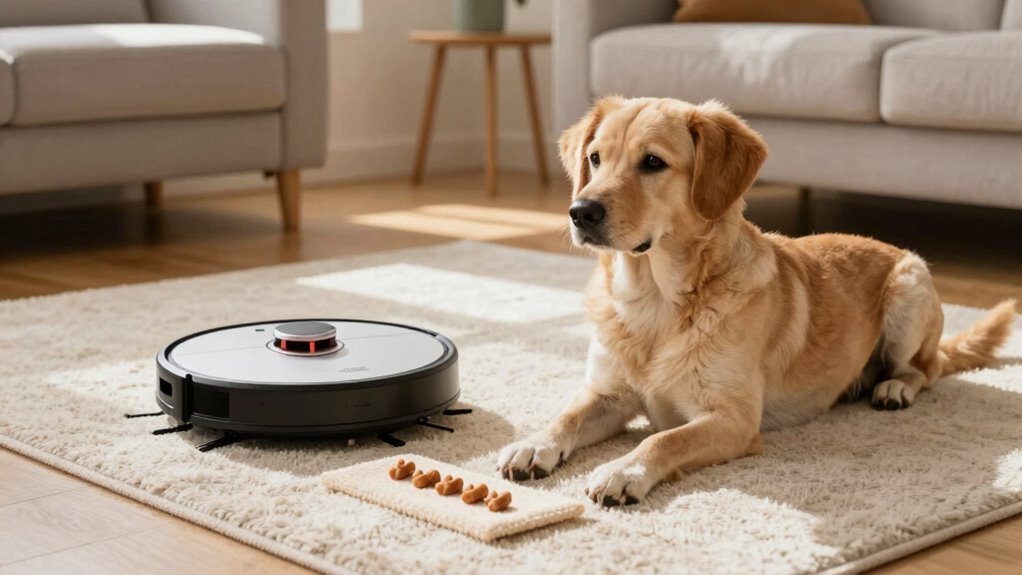
- Toss treats the second they stay cool near the off vacuum.
- Play soft vacuum sounds while showering them with goodies.
- Gradually toss snacks as the robot moves closer (but never force it).
- Swap in chew toys or puzzles to boost positive feelings.
Ignore zoomies or side-eyes, but never scold—fear doesn’t need a lecture.
With your love and treats, that robot will soon be their weird, beeping BFF.
Create a Daily Test Routine
Roll up your sleeves—it’s time to turn that cautious curiosity into full-on robot buddy vibes with a simple daily test routine. Start by leaving the powered-off robot in your pet’s favorite hangout spot so they can sniff and investigate—no pressure, just chill vibes. Keep it quiet, keep it calm, and let them approach on their terms.
Once they’re cool with its quiet presence, fire it up in another room to let the hum sneak into the background. Pair that whirring sound with treats or playtime so it means good things.
Then, launch short 2-3 minute test runs in open areas—supervised, slow, and drama-free.
Stick to the same time daily, especially in hairy hotspot zones, so your pet knows what’s coming. Predictability is your secret weapon.
With a little consistency (and maybe some popcorn-style treats), your pet won’t just tolerate the robot—they might just become its biggest fan.
Watch for Stress During Exposure
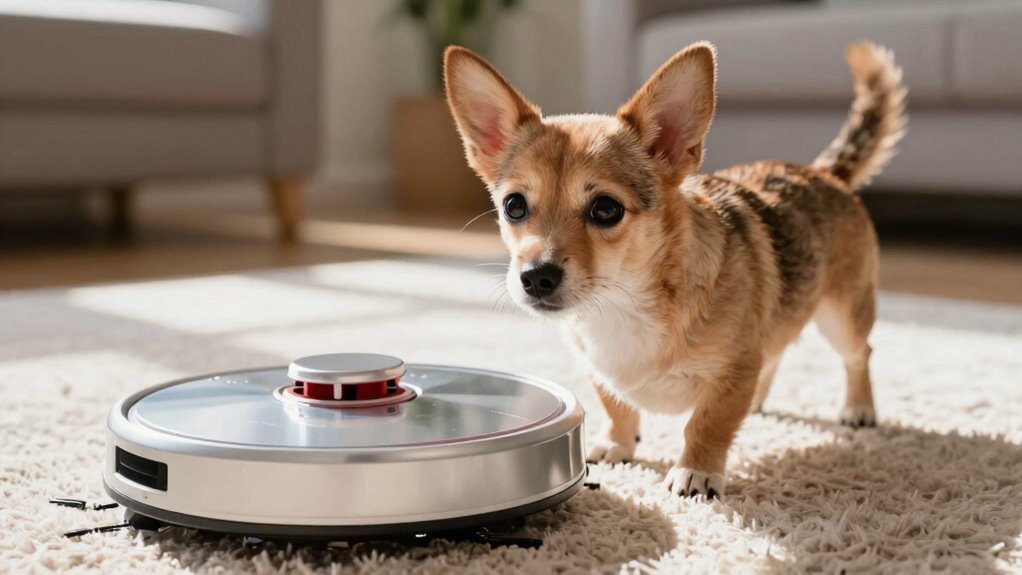
While your pet might act like the robot vacuum is a alien invader on a mission to steal their snacks, keeping a close eye on their reactions helps you catch stress before it spirals.
Watch closely, because even small signs can mean big discomfort. Here’s what to look for:
- Ears flat, tail tucked? That’s fear talking—your pet’s body is screaming they’re overwhelmed.
- Drooling or panting like they just ran a marathon? Loud noises or vibrations might be the culprit.
- Hiding, barking, or trying to bolt? These are SOS signals your pet wants out—fast.
- Twitching whiskers or crouching low? Unpredictable movement could be making them feel trapped.
Spotting these early means you can slow down, adjust, and help your furry buddy stay cool, calm, and collected—even with a rolling robot on the prowl.
Celebrate When Your Pet Accepts the Robot Vacuum
When your pup stops treating the robot vacuum like a hostile space robot and actually lounges nearby while it zips around, you’ll know you’ve hit the jackpot—celebrating these wins, big and tiny, keeps the momentum going and makes training feel like a game, not a chore. Every calm sit, every curious sniff, and every nap taken inches from the buzzing cleaner is progress worth cheering.
| Milestone | Why It Feels Like a Win |
|---|---|
| First calm sniff | “Hey, it’s not a monster!” |
| Staying in room | “I’ve leveled up!” |
| Ignoring it completely | “Victory dance—mission accomplished!” |
Treats, high-fives, and happy talk seal the deal. You’re not just training—you’re building confidence, one wobble-free pass at a time.
Frequently Asked Questions
Can I Leave the Robot Vacuum Running When I’M Not Home?
Yeah, you can leave it running when you’re out—just set the schedule and let it do its thing.
It’s smart, it’s safe, and it loves doing chores solo.
Just clear the floor, block big hazards, and make sure your pet’s not napping in the danger zone.
Think of it as a tiny, enthusiastic roommate who never sleeps but definitely won’t judge your mess… much.
What if My Pet Never Gets Used to the Robot Vacuum?
You won’t turn into a robot vacuum widow, promise—even if your pet acts like it’s the apocalypse every time it spins up.
Some pets never adjust, and that’s okay.
You’ll just keep using it when they’re napping, crated, or dramatically hiding under the bed like tiny, furry drama queens.
Life goes on.
You’ve got floors to clean and peace to keep—sometimes, that means picking battles.
And trust me, you’ve still got this.
Should I Use the Same Robot Vacuum for Multiple Pets?
Yeah, you can totally use the same robot vacuum for multiple pets—no need to buy a whole fleet!
Just pick one with strong suction, a big bin, and tangle-free brushes.
It’ll handle all that fur without throwing a fit.
Think of it as your pet-powered cleanup crew’s MVP. With daily runs and smart scheduling, it keeps up easy, even in hairy situations—literally!
Is It Safe if My Pet Licks the Robot Vacuum?
No, it’s not safe if your pet licks the robot vacuum—trust me, it’s not a treat! The brushes can trap yucky stuff like feces with E. coli or roundworms, and suction might’ve picked up chemical residue from cleaners. Even the mop pad could hold non-pet-safe gunk. Think of it like a floor-bound lint roller—would *you* lick that? Keep your curious furball busy with a toy instead, and always wipe the vacuum down after runs. Safety first, snacks second!
Can Loud Robot Vacuums Damage My Pet’s Hearing Over Time?
No, loud robot vacuums won’t damage your pet’s hearing over time.
Max, my neighbor’s curious cat, used to hide from the Roomba like it was a roaring dragon—but after weeks, he just yawns when it passes by.
Most models run below 75 dB, way under the 85 dB danger zone.
Short daily zips won’t hurt your pet’s ears, though older, noisier bots might need a tune-up—or quieter retirement.
Conclusion
You’ve both made it through the whirlwind adventure—congrats! That little machine isn’t such a “robo-monster” anymore, right? With patience, sniffs, and plenty of treats, you’ve turned chaos into calm. Now, you and your pet are a dream team, enjoying a cleaner home and smoother days. Give yourselves a high-five (or a paw bump)! The future’s shiny, quiet, and yes, full of naps—undisturbed by vacuum drama.
References
- https://us.narwal.com/blogs/robot-vacuum/cat-scared-of-vacuum
- https://www.eufy.com/blogs/vacuum/why-are-dogs-scared-of-vacuum
- https://www.cattitude-adjustment.com/blog/help-my-cat-is-afraid-of-the-vacuum
- https://www.ecovacs.com/us/blog/how-to-introduce-dog-to-robot-vacuum
- https://www.mentalfloss.com/article/649263/how-get-your-pet-stop-hating-your-robot-vacuum
- https://www.akc.org/expert-advice/training/how-to-get-your-dog-used-to-the-vacuum-cleaner/
- https://www.aol.com/video-bulldog-gets-woken-vacuum-112413942.html
- https://community.ezlo.com/t/anyone-got-a-dog-and-a-robot-vacuum-cleaner-do-they-get-along/215493
- https://www.robotreviews.com/chat/viewtopic.php?t=16187
- https://forum.roborock.com/discussion/6571/add-pet-absorbent-pads-to-object-avoidance-detection