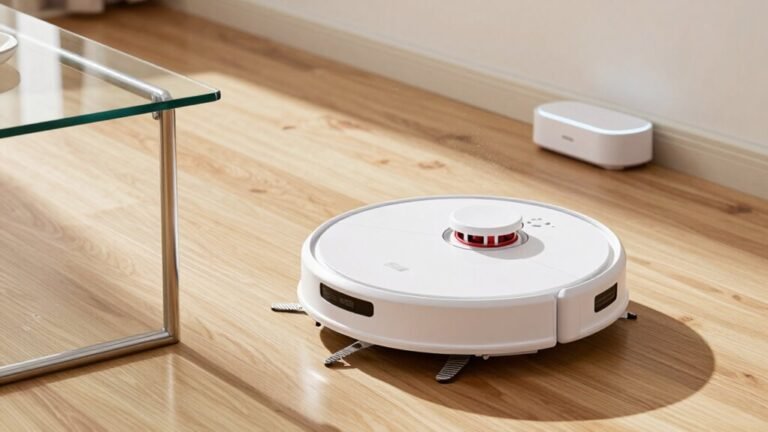
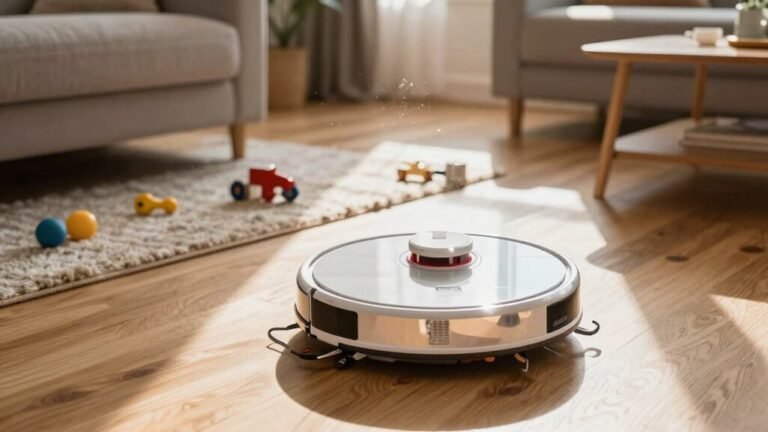
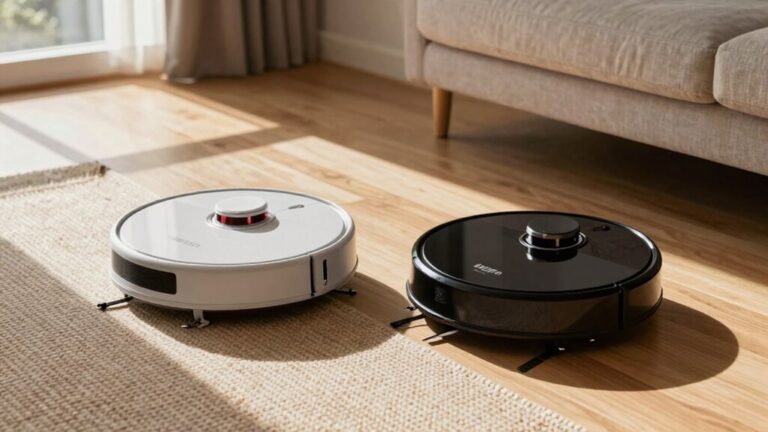
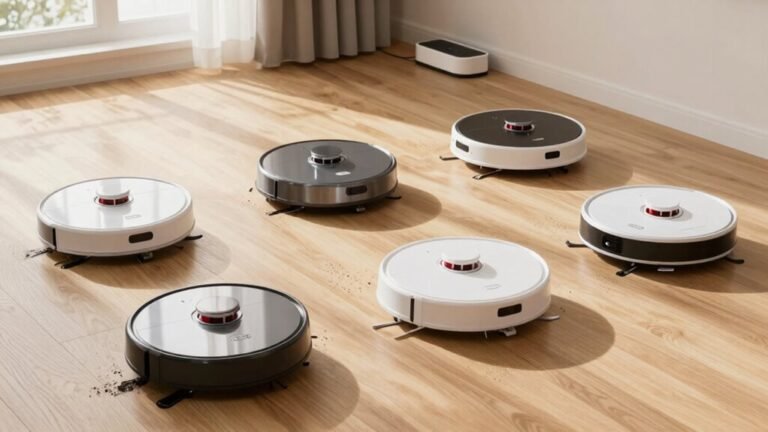
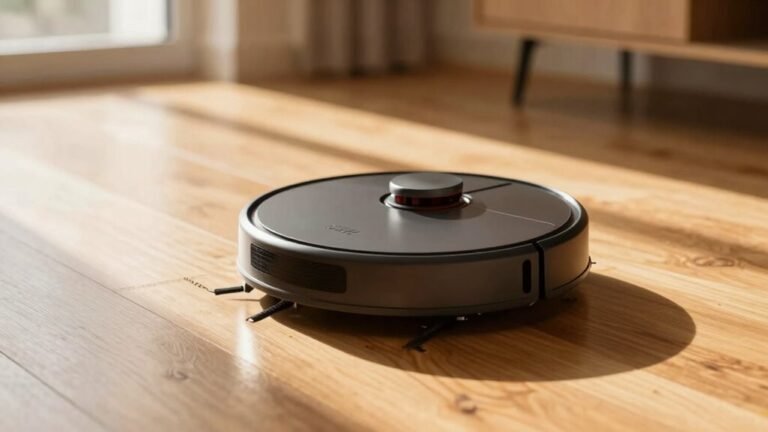
5 Best Robot Vacuums to Keep Allergy Triggers at Bay
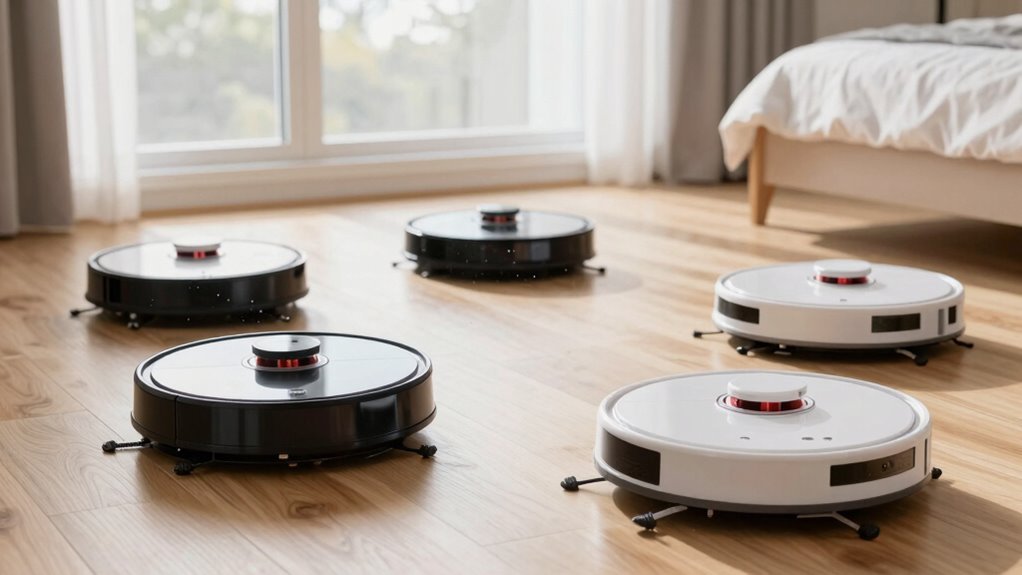
You want power, you want filtration, you want convenience—and wouldn’t it be nice if it all didn’t sound like a jet Qaeda?
The right robot vacuum tackles allergens like dust mites, pet dander, and embedded pollen, making it a must-have for allergy sufferers.
Models with true HEPA filters capture particles as small as 0.3 microns, ensuring effective allergen removal.
When shopping for the best robot vacuums to keep allergy triggers at bay, look for sealed airflow systems that prevent leakage of trapped contaminants.
High suction power of 5,000+ Pa ensures deep cleaning on carpets and hard floors.
Combining strong performance with self-emptying bases adds convenience while maintaining consistent air quality.
| ILIFE A30 Pro Self-Emptying Robot Vacuum & Mop | Best for Long-Term Hands-Free Cleaning | Suction Power: 5000Pa | Cleaning Modes: Four suction modes | App Control: ILIFEClean App | VIEW LATEST PRICE | Read Our Analysis | |
| iRobot Roomba 104 Vacuum & Mop Robot | Best Allergen Protection | Suction Power: 70X power-lifting suction | Cleaning Modes: Vacuum, mop, or combo modes | App Control: Roomba Home App | VIEW LATEST PRICE | Read Our Analysis | |
| Tikom Robot Vacuum and Mop Combo (G8000 Max) | Best Budget Combo | Suction Power: 5000 Pa | Cleaning Modes: Spot, Edge, Zig-zag, Manual | App Control: App-compatible | VIEW LATEST PRICE | Read Our Analysis | |
| Tikom Robot Vacuum & Mop (L8000 Plus) | Most Powerful Suction | Suction Power: 6000Pa max | Cleaning Modes: 3 suction levels, 3 water flow settings | App Control: App control | VIEW LATEST PRICE | Read Our Analysis | |
| ILIFE V2 Robot Vacuum Cleaner | Best for Pet Hair | Suction Power: Not specified | Cleaning Modes: Auto, spot, edge | App Control: Not specified | VIEW LATEST PRICE | Read Our Analysis |
More Details on Our Top Picks
ILIFE A30 Pro Self-Emptying Robot Vacuum & Mop
If you’re the type who values a clean home but hates the hassle of constant maintenance, the ILIFE A30 Pro Self-Emptying Robot Vacuum & Mop might just be your new best ally. It boasts 5000Pa suction power and a self-emptying station with a 2.5L capacity, using five disposable bags that each last up to 8 weeks—meaning you could go nearly 10 months without handling dust.
You’ll appreciate its LiDAR-guided navigation, powered by LDS lasers and SLAM algorithms, which accurately maps your home for efficient, thorough cleaning. This smart routing ensures maximum coverage with fewer missed spots, even in cluttered spaces.
Through the ILIFEClean app—which requires 2.4GHz Wi-Fi (no 5GHz support, unfortunately)—you can schedule cleanings and set no-go zones with ease. The app also lets you switch between four suction modes for customized cleaning based on your needs.
The 2-in-1 tank design integrates a 200ml dustbin and a 200ml water reservoir, enabling simultaneous vacuuming and mopping. This dual function can cut your cleaning time by up to 30%, streamlining maintenance without sacrificing results.
You stay in control: adjust suction strength, tweak water flow, or skip mopping entirely by simply removing the mop pad. The robot handles pet hair and debris effectively across both carpets and hard floors.
Keep in mind that using max suction drains the battery faster, so balance performance with runtime as needed. It’s not perfect, but for the price, the ILIFE A30 Pro comes impressively close.
- Suction Power:5000Pa
- Cleaning Modes:Four suction modes
- App Control:ILIFEClean App
- Self-Emptying:Self-emptying station (2.5L x 5 bags)
- Mop Functionality:Integrated mop (200ml tank)
- Navigation Type:LiDAR navigation
- Additional Feature:5 bags included (40 weeks)
- Additional Feature:30% faster cleaning with 3-in-1
- Additional Feature:2.4GHz WiFi only
iRobot Roomba 104 Vacuum & Mop Robot
You’ll get the most out of the iRobot Roomba 104 Vacuum & Mop Robot if you want a hands-off cleaning solution that tackles both dust and spills. Thanks to its 70X power-lifting suction and SmartScrub mop system, it’s built for homes where pet hair, tracked-in dirt, and sticky kitchen messes linger.
It navigates with ClearView LiDAR and auto-detects carpets to keep them dry. The micro-pump ensures consistent moisture, while the edge-sweeping brush boosts edge cleaning by 20%.
You’ll love the AutoEmpty Dock, which traps 99% of allergens down to 0.7 micron and enables up to 75 days of hands-free operation. Control the robot via app, voice, or buttons—just note that 2.4 GHz WiFi is required for setup.
- Suction Power:70X power-lifting suction
- Cleaning Modes:Vacuum, mop, or combo modes
- App Control:Roomba Home App
- Self-Emptying:AutoEmpty Dock
- Mop Functionality:Mop mode with micro-pump
- Navigation Type:ClearView LiDAR
- Additional Feature:99% allergen capture in bag
- Additional Feature:Smart carpet detection
- Additional Feature:3 control methods
Tikom Robot Vacuum and Mop Combo (G8000 Max)
The Tikom G8000 Max isn’t just another robot vacuum—it’s a no-fuss, dual-action cleaner built for pet owners and busy households. With strong 5,000 Pa suction, it tackles embedded pet hair, dust, and spills across hardwood, tile, and medium-pile carpets without constant supervision.
You can control it four ways: via app, remote, voice, or the button on top. This means you’re covered whether you’re lazy, hands-full, or just tech-curious.
It cleans using spot, edge, zig-zag, or manual modes, with zig-zag covering more ground than it sounds—like a tiny Roomba playing air hockey. At 2.99 inches tall, it slips under furniture, climbs thresholds, and avoids falls thanks to smart sensors.
The 450 ml dustbin and 300 ml water tank handle decent messes, making it suitable for regular cleanups. It runs up to 150 minutes in quiet mode, so it won’t die mid-job.
HEPA filtering helps only moderately with allergens, so don’t expect miracle results there. Still, with 3,699 five-star reviews averaging 4.4 stars, it’s clearly working for a lot of people.
Does “Max” mean maximum effort or just maximum hype? Probably both.
- Suction Power:5000 Pa
- Cleaning Modes:Spot, Edge, Zig-zag, Manual
- App Control:App-compatible
- Self-Emptying:Not specified
- Mop Functionality:Mop function (300ml tank)
- Navigation Type:Anti-collision sensors
- Additional Feature:Ultra-slim 2.99-inch design
- Additional Feature:HEPA-type filter included
- Additional Feature:4.4-star customer rating
Tikom Robot Vacuum & Mop (L8000 Plus)
Tikom’s L8000 Plus handles week-after-week floor maintenance with a 90-day hands-free cleaning cycle, making it a set-and-forget solution for busy households—especially those with pets or persistent dust buildup.
You get 6000Pa of suction—enough to yank embedded pet hair and fine dust from hardwood or tile, with auto-boost on carpets—plus 3 suction and 3 water flow levels for full control.
Its 360° LiDAR maps accurately, supports up to 5 floor plans, and avoids obstacles like rogue shoes or cords—though you must remove the mop pad (or set no-mop zones) to protect carpets.
With app scheduling, Alexa voice commands, and dual-band Wi-Fi, it’s smart—but is it too smart for its own good?
- Suction Power:6000Pa max
- Cleaning Modes:3 suction levels, 3 water flow settings
- App Control:App control
- Self-Emptying:Self-emptying (3L dustbag)
- Mop Functionality:Mopping with no-mop zones
- Navigation Type:360° LiDAR navigation
- Additional Feature:90-day hands-free cleaning
- Additional Feature:3L self-emptying dustbag
- Additional Feature:Dual-band Wi-Fi support
ILIFE V2 Robot Vacuum Cleaner
Who’d think a robot under three inches tall—just 2.99 inches, to be exact—could handle your pet’s shedding routine without turning into a hair-clogged disaster? You’ll love how the ILIFE V2’s tangle-free suction port grabs pet hair across hardwood, tile, laminate, and low-pile carpets—no yanking or manual untangling needed.
With 120 minutes of runtime, it covers large areas before automatically returning to its dock to recharge. You can schedule cleanings remotely or hit one button and forget it—its auto, spot, and edge modes tackle debris, crumbs, and corners just fine.
Infrared sensors prevent falls and collisions, though it struggles on dark rugs. It’s not perfect, but backed by a 12-month warranty and U.S. support, it’s a solid, no-fuss pick for light daily maintenance—especially if pet hair’s your main concern.
- Suction Power:Not specified
- Cleaning Modes:Auto, spot, edge
- App Control:Not specified
- Self-Emptying:Not specified
- Mop Functionality:Not specified
- Navigation Type:Infrared sensors
- Additional Feature:Tangle-free suction for hair
- Additional Feature:120 min runtime
- Additional Feature:1-year U.S. warranty
Factors to Consider When Choosing Robot Vacuums for Allergies
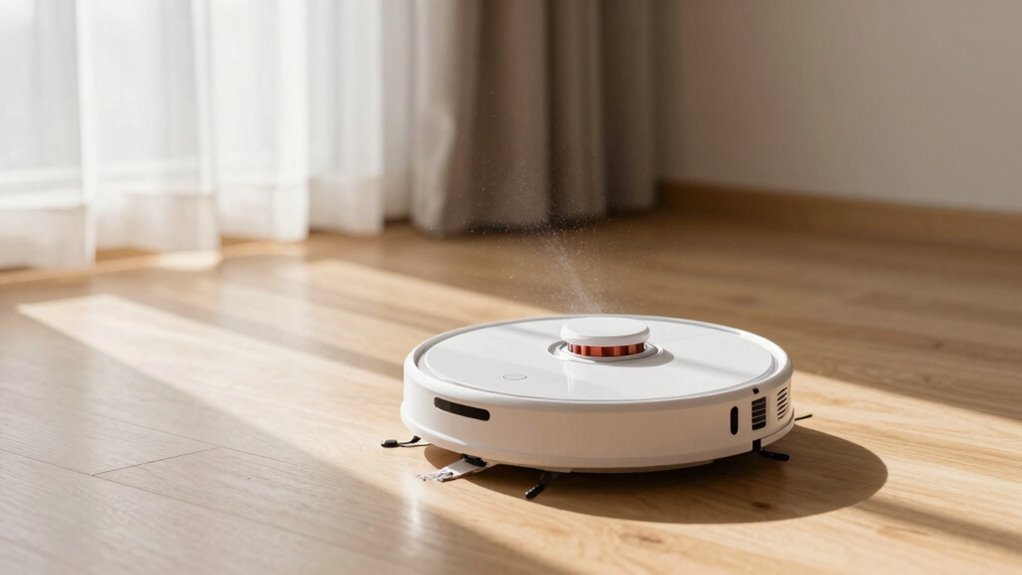
You’ll want strong suction—think 2,000+ Pa—so it can actually pull allergens from carpets, not just push them around like a glorified broom. Look for a sealed cleaning path with a HEPA filter that traps 99.97% of particles as small as 0.3 microns, because what good is cleaning if it leaks junk back into the air? And honestly, does anyone *really* want to empty a dusty bin daily—or would you rather have a self-emptying model that holds a month’s worth of gunk without blowing allergens everywhere?
Suction Power Efficiency
Ever wonder why some robot vacuums seem to vanish allergens while others just shuffle them around? It’s mostly about suction power efficiency—the real MVP when tackling dust, pollen, and pet dander.
You’ll want a model with at least a few hundred pascals (Pa), but ideally one that ramps up to 6,000 Pa for deep carpet cleaning where allergens hide. Smart vacuums that auto-boost suction on carpets save energy while maximizing pickup where it matters.
Models with adjustable suction let you fine-tune performance—lower settings for hard floors, high power for plush rugs. Just remember: strong suction means nothing if tiny particles escape back into the air.
Pair powerful suction with a filter that traps particles 0.7 microns or smaller. That way, you’re actually removing allergens, not just giving them a joyride.
Dust Containment Systems
Dust containment starts the moment your robot vacuum finishes its run. If you’re allergic to allergens flying back into the air every time you empty the bin, you’re not alone.
Auto-empty docks with sealed bag systems trap up to several liters of debris, minimizing how often you handle dust—some bags last months before needing a change. These enclosed bags, paired with disposable liners, ensure fine particulates (down to 0.3 microns) stay locked away instead of puffing into your space.
Think about it: would you really trust a vacuum that kicks up dust every time you empty it? Self-contained waste units prevent that mess, keeping your air—and hands—cleaner.
High-capacity bags reduce exposure, while sealed designs stop leakage more effectively than open bins. Compared to models without auto-empty, you’re cutting direct contact with allergens dramatically—sometimes by over 90%.
It’s not magic; it’s engineering that works quietly while you live comfortably.
Allergen Filtration Performance
Why do some robot vacuums claim to clean your floors but still leave the air feeling stuffy? Because not all filters actually trap the tiny particles—like pollen, pet dander, and dust mite debris—that float back into the room. If you’re allergic, that’s a problem.
You’ll want a model with true HEPA-type filtration, which captures at least 99.97% of particles as small as 0.7 microns—way smaller than what your eyes can see. These systems don’t just pick up dirt; they prevent it from re-entering your breath.
Look for high-efficiency sealing in the filter path and regular maintenance alerts—because even the best filter fails when clogged or old. Sure, it’s not glamorous, but cleaning or replacing filters every 2–3 months keeps performance steady.
You’re not just vacuuming; you’re managing your indoor air quality, so choose a robot that filters like it means it.
Sealed Cleaning Path
You’ve picked a robot with true HEPA filtration—great, that’ll snag 99.97% of particles down to 0.7 microns—but what if that filtered air leaks out through cracks before it even leaves the machine?
A sealed cleaning path guarantees allergens stay trapped from brushroll to dustbin, blocking escape routes via gaps in hoses, filters, or bin seams. Without it, even HEPA-grade suction loses its punch, letting dust and pollen seep back into your air.
Look for tightly mated components and gasketed joints—small design touches that keep 99% of fine particles contained. Some models pair this with HEPA-type filters and fully sealed AutoEmpty Docks, capturing allergens not just during cleaning, but during disposal, too.
It’s not enough to filter well—you’ve got to prevent leakage at every stage. A truly sealed system means you’re not just moving dust around; you’re eliminating it, cycle after cycle, with minimal exposure.
Smart containment beats powerful suction every time if allergies are the goal.
Self Emptying Convenience
That sleek robot gliding across your floor does more than vacuum—it’s your first line of defense against airborne allergens. With a self-emptying dock, you’re not just saving time, you’re cutting direct contact with dust, pet dander, and mold spores that pile up after every clean.
The dock automatically pulls debris from the robot into a sealed bag or bin, so you’re not fumbling with a dusty compartment weekly—maybe even monthly, depending on the model’s capacity. Most systems hold 30 to 60 days’ worth of dirt, especially helpful if you’ve got shedding pets or live in a dusty area.
Auto-empty kicks in after each run, keeping your robot ready without lifting a finger. Sure, you’ll still need to swap bags eventually—no magic here—but app alerts let you track fullness and schedule replacements.
Isn’t it nice, though, when “set it and forget it” actually works?
Advanced Navigation Accuracy
LiDAR paired with SLAM—simultaneous localization and mapping—builds a pixel-precise floorplan in as little as two cleanings, slashing cleaning time by up to 30% compared to random-bounce models. You’ll notice fewer missed spots thanks to 360-degree sensing that maps rooms quickly and accurately.
The system adaptively routes around furniture without constant bumping, using real-time obstacle and drop sensors to prevent collisions or stair tumbles. This means your robot won’t take a nosedive mid-clean—a small win, but a satisfying one.
Multi-floor mapping lets you store unique layouts for different levels, so basement allergens don’t hitch a ride upstairs. You can also set no-go zones to block off pet areas or cluttered spaces while still getting full coverage elsewhere.
Reflective surfaces can sometimes confuse sensors—no system’s perfect. But for consistent, thorough allergen removal, precise navigation isn’t just smart, it’s essential.
Frequently Asked Questions
Can Robot Vacuums Work on Dark-Colored Carpets?
Yes, they can work on dark-colored carpets, but some struggle with edge detection since dark surfaces absorb light. You’ll want a model with advanced sensors or infrared tech to avoid bumps and falls while cleaning your floors efficiently.
Do These Models Have Child-Lock Features?
You bet they do—child locks keep curious hands out of trouble. You’ll set it and forget it, like a digital babysitter. Just activate the lock, and peace of mind follows wherever the robot roams.
Are Replacement Parts Easily Available?
Yes, you’ll find replacement parts easily online or through the manufacturer. Most models offer filters, brushes, and batteries separately. You won’t struggle to keep your robot running smoothly—just order what you need and swap it out fast.
Can They Detect and Avoid Pet Waste?
You can’t rely on robot vacuums to detect and avoid pet waste—most won’t see it and might spread it. Some models with advanced sensors try, but it’s risky. Clean up first to avoid messes and protect your floors.
Do They Emit Strong Wi-Fi Signals?
You don’t need to worry—robot vacuums emit low-level Wi-Fi signals, similar to other smart home devices. They won’t overpower your space or harm your health. You can safely use them daily without exposure to strong radiation or interference with your home network.
Conclusion
You’ve seen the stats—5000 to 6000 Pa suction, filters trapping particles as small as 0.7 microns—so why settle for dusty compromises? These five robot vacuums don’t just glide across tile and carpet; they tackle allergens with precision, self-emptying hubs, and smart mapping (because who *really* wants to chase a robot with a full bin?). Sure, they’re not magic—but in a world where pet dander and pollen reign, isn’t cleaner air worth the upgrade?