Roomba i3 Vs Roomba i7: What’s the Difference?
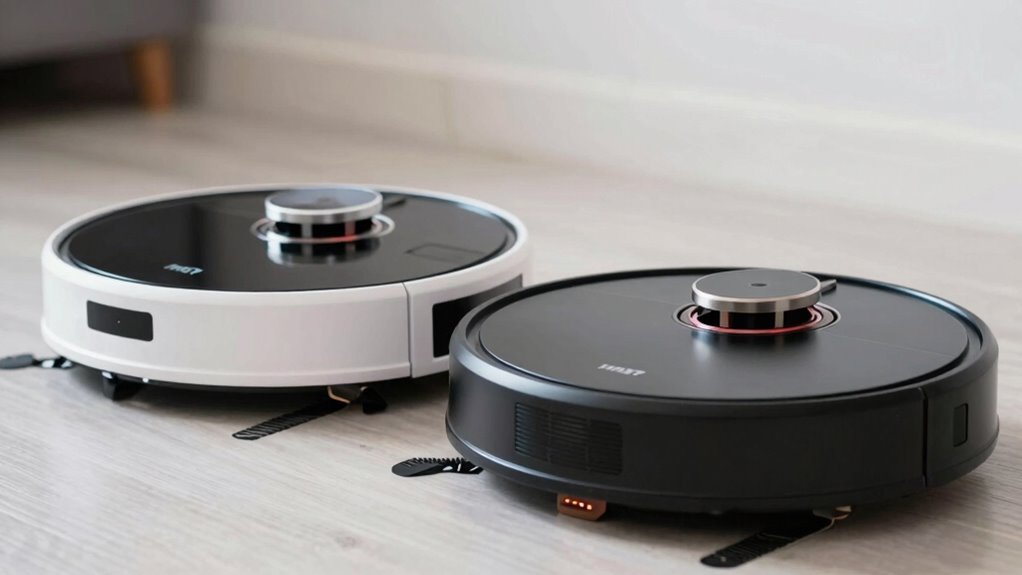
When comparing the Roomba i3 vs Roomba i7, the most notable difference lies in smart navigation. The Roomba i7 maps your whole home, remembers room names, and supports voice commands or app-based cleaning by room.
In contrast, the Roomba i3 cleans effectively but lacks advanced mapping—it remaps each time and offers no room labeling or keep-out zones. Both models deliver strong suction and solid performance on debris, making them reliable choices for everyday cleaning.
However, only the Roomba i7 learns your home’s layout over time, providing a more personalized experience. If you value smart features and precise control, the Roomba i7 is the better pick; for a more budget-friendly option, the Roomba i3 gets the job done.
Key Differences That Matter
So, what really sets these two Roombas apart?
You’re getting smarter tech with the i7—it maps your whole home like a pro, labels rooms, and even remembers up to 10 different floors (great if you’ve got a mansion… or just a basement you finally finished).
The i3 maps too, but it’s more basic—no keep-out zones or custom cleaning areas.
The i7 sees where it’s going with a camera, zipping around smoothly, while the i3 trundles along row by row, like it’s mowing a lawn.
Sure, both clean floors well, but the i7 hugs edges tighter and finishes faster.
Oh, and it charges quicker—2 hours vs. your pizza delivery time of 3.
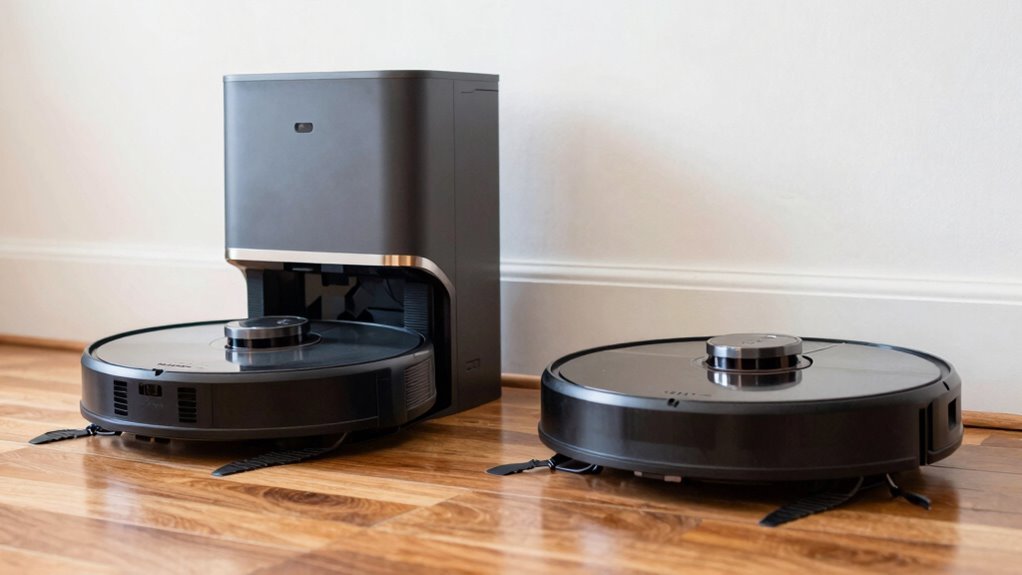
Both run 80 minutes, but here’s the kicker: only the *plus* models empty themselves.
The brush rolls are interchangeable, making maintenance simple across both models.
Suction Power: i3 Vs i7 Compared
You’ve seen how the i7 outsmarts the i3 with slick navigation and fancy mapping, but what about muscle?
Well, the i7 packs 1800 Pa of suction—about 6% more than the i3’s 1700 Pa.
Sounds impressive, right?
But here’s the twist: both clean 99% of debris on hardwood, low-pile, and high-pile carpets.
How?
Blame those genius dual rubber brush rolls.
They grab dirt so well, the tiny suction gap barely matters.
Think of it like this: it’s not just about sucking harder—it’s about touching more.
Both run 80 minutes, empty into the same 500ml bin, and use the same 1800 mAh battery.
The i7 even charges faster.
Both models support Smart Maps with app control and zoned cleaning.
Mapping Smarts: i7’s Room Recognition Edge
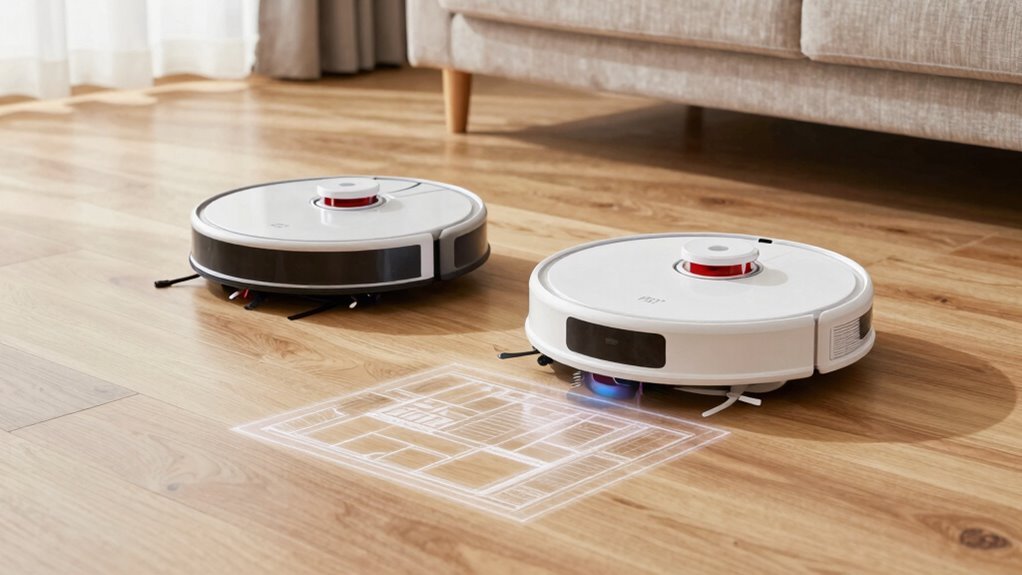
While the i3 zips around your home with basic instincts, the i7’s like the genius kid who remembers where everything goes—and actually labels it.
It captures over 230,000 data points per second using vSLAM tech, so it sees your space like you do—couch, coffee table, and all.
It builds smart, persistent maps, learns room names, and even notices if you move the dock.
Your i7 knows the kitchen from the living room and can clean them on different schedules.
It updates maps automatically, supports multi-floor homes, and lets you command it by room using Alexa or Google.
The i3? It remaps each time, forgets everything, and can’t tell your bedroom from a broom closet.
No labeling, no smarts—just good old guesswork.
With the i7, your home isn’t just cleaned; it’s understood.
Room-By-Room Cleaning: i7 Offers Custom Zones
Ever wish your robot vacuum could skip the kid’s toy minefield or focus extra attention on the spot where you spilled coffee?
With the i7, you can.
Using the iRobot app, draw custom cleaning zones to target messes or set keep-out zones to block off areas—no virtual walls needed.
It’s like giving your Roomba a map and a to-do list!
The i7 remembers up to 10 unique floorplans, perfect for multi-level homes.
It lets you clean room-by-room with precision.
Meanwhile, the i3 only labels rooms and cleans them whole—no custom zones, no no-go spots.
It can’t skip the LEGO battlefield or give your kitchen a daily deep-clean.
If you want smarter, more flexible cleaning that fits your life (and your messes).
The i7’s zone control turns your vacuum from basic to brilliant—fast.
App & Voice Control: Which Vacuum Is Smarter?
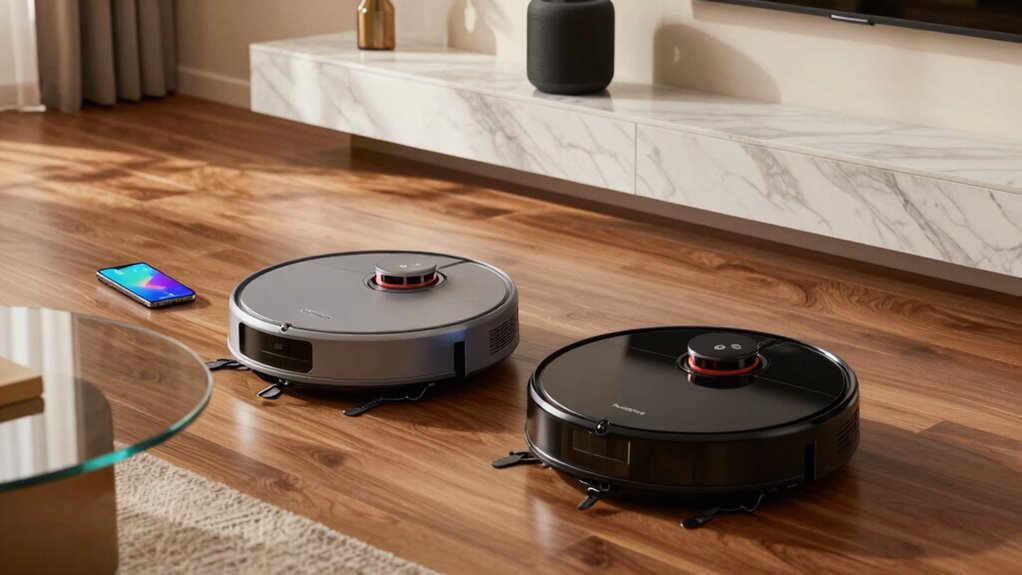
Roomba’s brain power really shines when it comes to app and voice control—and between the i3 and i7, one clearly thinks faster.
You’ll love how both robots respond to Alexa and Google Assistant, letting you kick back and say, “Clean the kitchen,” like a boss.
But the i7? It’s the smarter sibling. It lets you draw no-go zones, so your robot won’t chase the dog’s water bowl again—again.
The i3 can label rooms and clean by area, sure, but the i7’s app is packed with more automation, smoother navigation, and even talks to the Braava m6 mopper.
You get multi-floor maps, richer controls, and that “I’ve got my life together” feeling.
Both update automatically and accept voice commands when you’re lazy (or busy adulting), but the i7 just feels like the future—with less chaos and way more “ahh.”
Multi-Floor Homes: i7 Handles Multiple Maps
How does your Roomba handle a three-story mess or a basement full of dog hair?
If you own an i7, it’s got your back—literally, across all floors.
It stores up to 10 unique maps, so your basement, main level, and attic are no problem.
Thanks to its top-mounted camera and vSLAM tech, it learns your home’s layout fast and navigates like a pro.
You can set no-go zones, skip messy spots, or clean just the kitchen after dinner.
The i7 even remembers each floor’s map, so no confusion between your dusty rec room and spotless living room.
Meanwhile, the i3? It only holds one map, so it’s great for a single floor—but if you’ve got stairs, you’re lugging it up and down like a tiny, overworked pack mule.
For multi-level homes, the i7 isn’t just smarter—it’s your all-in-one cleanup co-pilot.
Self-Emptying Bases: i3+ Vs i7+ Compared
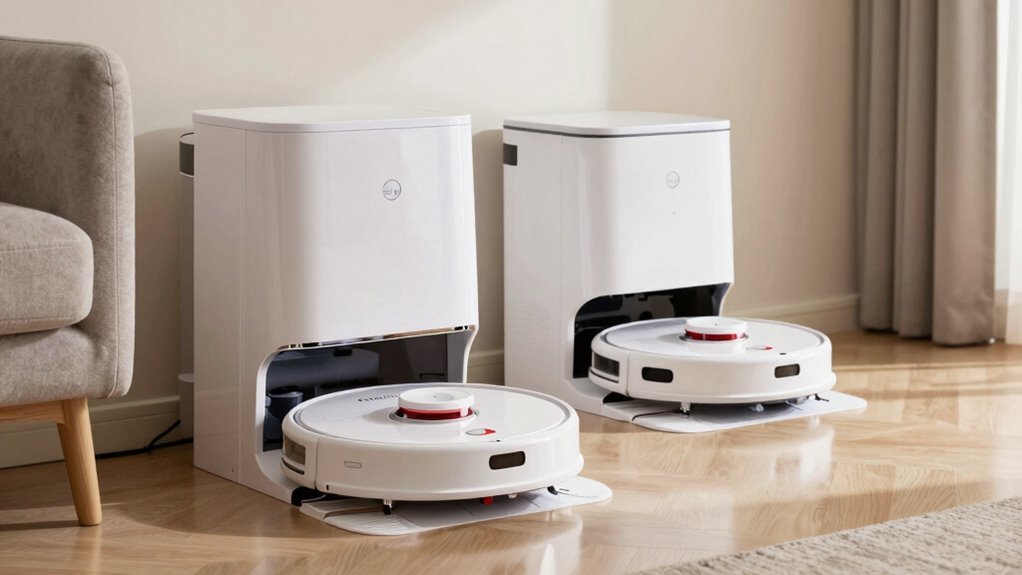
That sleek base your Roomba docks into? It’s not just a charger—it’s a self-emptying powerhouse for both the i3+ and i7+. When your robot finishes cleaning, the base vacuums debris straight from its bin into a sealed AllergenLock bag, so you don’t have to touch a speck of dust.
Fancy that—no more gagging at the dirt pile!
Both bases hold up to 30 loads, saving you from daily emptying for weeks, even months.
With 99% allergen trapping and odor-locking tech, it’s like giving your home a quiet, invisible janitor.
The i3+ and i7+ bases are twins in function and size—same height, width, and wall clearance—so swapping models won’t mean rearranging your space.
And guess what? That 10X suction power and flawless cleaning? Identical on both.
The real kicker? The i3+ gives you all this magic at a friendlier price.
Dustbin & Maintenance: Daily Ease Compared
Most days, you’ll barely give the dustbin a second thought—both the i3 and i7 handle messes like champs, thanks to their nearly identical 0.5 L capacity bins you’ll find on board. Sure, Roomba lists the i3 at 0.4 L, but in real life, they’re twins. You’ll empty either after heavy cleanups, especially with pets or kids on the loose. And hey, at least both bins are washable—no funky smells sneaking up on you.
Here’s a quick peek at what you’re dealing with daily:
| Feature | i3 & i7 Match? |
|---|---|
| Dustbin Size | ✅ Nearly identical |
| Washable Bin | ✅ Yes, both |
| Emptying Frequency | ✅ After ~80 min runs |
| Filtration Quality | ✅ High-efficiency both |
Cleaning’s a breeze—you’ll spend less time wiping and more time relaxing. Honestly, it’s hard to mess this up—even your cat couldn’t clog it (we hope).
Value Verdict: i3 for Budget, i7 for Control
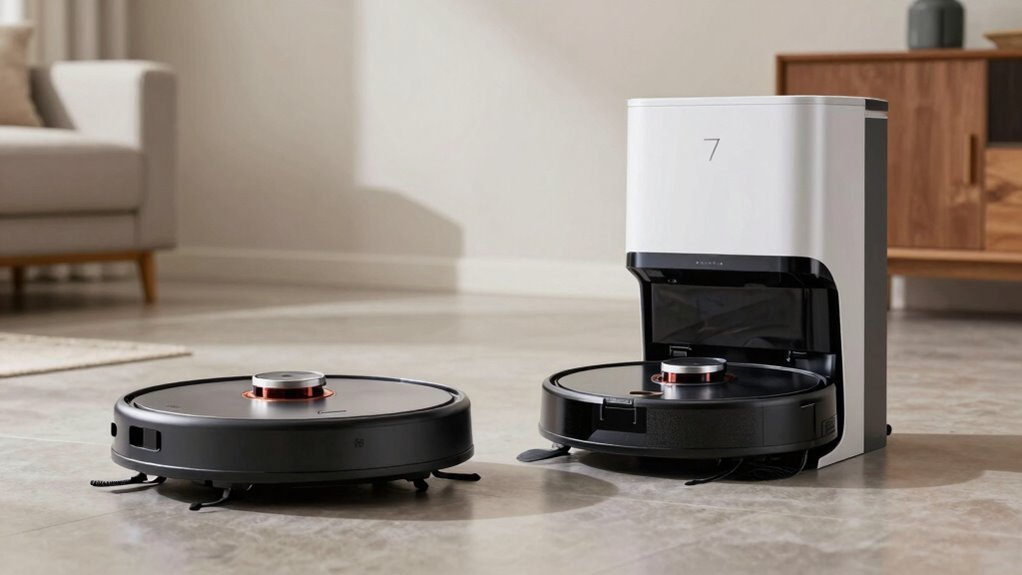
So, which Roomba actually fits your life—wallet and all?
If you’re tight on budget but still want a self-emptying robot, the i3+ is your best friend at $549.99, especially since the EVO update gave it smarter mapping.
It cleans just as well as the i7, lasts just as long, and handles small spaces like a champ.
But if you crave control and love tweaking tech, the i7 is worth the splurge.
Its camera-powered brain remembers up to 10 floors, lets you set no-go zones, and charges faster too.
You get custom schedules, smart automations, and app tricks the i3 can’t match.
Think of it this way: the i3 is the practical pick, while the i7’s the tech-savvy overachiever—both clean great, but one just likes to show off a little more.
Frequently Asked Questions
Can I Use the i3 or i7 Without Wi-Fi?
Yeah, you can totally use both the i3 and i7 without Wi-Fi!
Just press clean, and they’ll vacuum like champs.
No fancy maps or app control, but they’ll still tackle dirt and pet hair like pros.
Think of it as “dumb mode”—they’re not lost, just blissfully offline.
Perfect for quick cleanups when you don’t feel like tech drama.
Just don’t expect robot small talk—it’s all business!
Do the i3 and i7 Work With Third-Party Smart Home Systems?
Yep, you can totally connect both the i3 and i7 to third-party smart home systems—score!
While they don’t play nice with Apple HomeKit out of the box, you’ve got clever workarounds like AddToHomeKit or Homebridge to get Siri on board.
Pair either bot via iRobot HOME for Alexa or Google Assistant, and boom, voice control’s yours!
Just add Wi-Fi, a little setup magic, and you’re the proud wizard of a talking vacuum.
Not bad for robots that can’t blink!
Are Replacement Parts Readily Available for Both Models?
Yep, you’re in luck—replacement parts are easy to find for both the i3 and i7!
You can grab filters, brushes, and even cleaning heads from iRobot or trusted third-party sites like Robot-Advance and Sears.
Most goodies are in stock, with quick shipping—though a few might take until mid-January.
Just double-check your model, ’cause robots, like tacos, aren’t one-size-fits-all!
How Long Do the Batteries Last on Each Model?
You’ll get about 60 to 75 minutes of cleaning per charge, so picture your Roomba tackling two full episodes of your favorite show—without begging for a break!
With normal use, the battery lasts 1–2 years, though it’ll start slowing down after 8–10 months.
Just pop in a fresh, authentic battery when runtime drops to 15 minutes, and keep it charged every few days—you’ve got this!
Is There a Significant Noise Difference Between i3 and i7?
Nope, there’s no real noise difference between the i3 and i7 during regular cleaning—you’ll hear about the same mid-60s decibel hum from both.
Sure, they get loud when self-emptying (yikes, 111 decibels!), but that’s short-lived.
Think of it like a quick vacuum sneeze.
Honestly, you’d notice the i7’s smarter navigation way more than any sound.
Bottom line: they’re twins in noise, but brainpower? Totally different league.
Conclusion
You’re basically getting a robot butler with the i7—it maps rooms like a pro, cleans zone by zone, and empties itself like magic. The i3? Still solid, like a trusty sidekick with strong suction and smart moves. But if you want your vacuum to basically run your life, the i7’s the boss. For less cash, the i3 rocks—just don’t expect it to file your taxes next.
References
- https://www.youtube.com/watch?v=Bt1TNIVSoCQ
- https://moderncastle.com/robot-vacuums/roomba-s9-vs-i7-vs-i3-vs-e5-vs-675/
- https://vacuumwars.com/irobot-roomba-i3-vs-i7/
- https://www.reviewed.com/robotvacuums/features/irobot-roomba-i3-vs-i6-vs-i7
- https://www.youtube.com/watch?v=kZbq7BtqfYU
- https://www.bestbuy.com/site/questions/irobot-roomba-i7-wi-fi-connected-robot-vacuum-charcoal/6280530/question/72e8852b-8936-3fd6-a31e-a025db830b19
- https://www.rtings.com/robot-vacuum/tools/compare/irobot-roomba-i7-vs-irobot-roomba-i3/5890/18126
- https://www.irobot.com/en_US/comparison-chart.html
- https://www.youtube.com/watch?v=IdFwaQaVeVQ
- https://versus.com/en/irobot-roomba-i3-vs-irobot-roomba-i7-plus/suction-pa