Are Robot Vacuum Filters Washable?
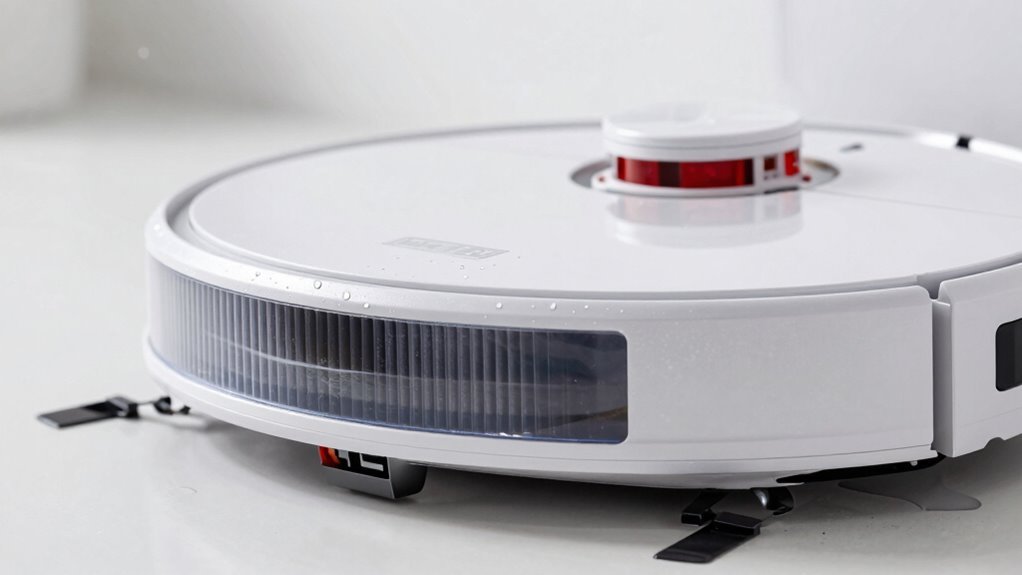
Some robot vacuum filters are wash daily, but it depends on the type. Foam and felt filters can typically be washed—just rinse them under lukewarm water and let them air-dry completely for at least 24 hours before reinserting.
Paper-based filters or those labeled as HEPA are not washable. Instead, gently tap them out or use a soft brush attachment on a regular vacuum to remove dust and debris.
Always check your robot vacuum’s user manual to confirm whether the filter is washable. Following the manufacturer’s guidelines helps maintain performance and avoids damage.
Proper filter care ensures your robot vacuum runs efficiently and lasts longer. A little maintenance goes a long way in preserving suction power and air quality.
Can You Wash Robot Vacuum Filters?
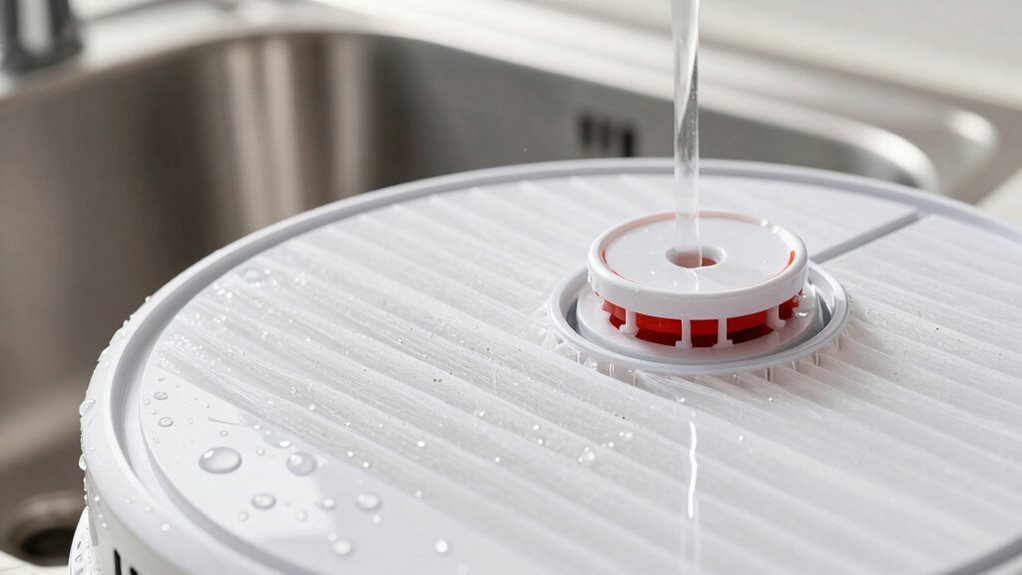
Can your robot vacuum’s filter take a dip in the sink? Well, not so fast—some filters would rather tap-dance than swim!
If yours is made of paper or HEPA material, keep it dry; a simple tap or brush works best.
Washing it? Big no. You’ll wreck the fibers, hurt suction, and maybe even fry the motor.
But hey, if your filter’s a foam or sponge type, lucky you—it’s shower-ready!
Just rinse it under lukewarm water, maybe give it a gentle soap massage, then let it air-dry for a full day.
No microwaving, no hair-drying (yes, some tried it).
Moisture’s a mold party waiting to happen.
Always check your manual—your robot’s not a mind reader.
When in doubt, keep it dry and save the splash for the sponge.
Always verify filter type before attempting washing or replacement.
Identify Your Robot Vacuum Filter Type
You’ve probably hovered over the sink with your robot’s filter in hand, wondering whether it’s safe to give it a rinse—turns out, that’s a great clue to start figuring out what kind you actually have.
Is it a simple mesh pre-filter catching hair and lint?
Or a dense, pleated block labeled H13 or E11?
Check the frame or manual—those tiny labels are gold.
Foam or mesh likely means washable; thick, paper-like material screams “keep it dry.”
Some bots use multi-layer cassettes, stacking pre-filters and HEPA in one snug unit.
And don’t be fooled by “High-Efficiency” or “AllergenLock” labels—dig deeper for real ratings like H13 or E11.
Spotting that tells you if it’s true HEPA or just pretending.
Identifying yours isn’t just nerdy—it’s the first step to cleaning it right and keeping your air (and robot) happy.
High-efficiency filters like H13 are designed to capture 0.3–1 μm range particles effectively, so wetting them can damage their filtration capability.
Which Filters Can You Safely Rinse?
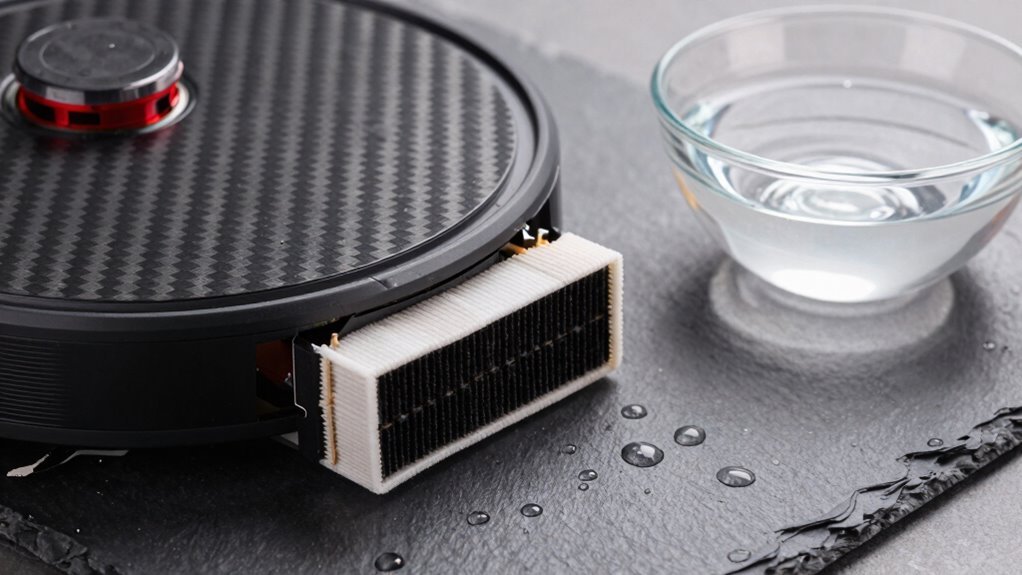
So, wondering which filters can take a dip without a meltdown?
Good news: genuine HEPA filters are usually washable and tough enough to handle a gentle rinse.
Yep, those bad boys trap 99.97% of tiny gunk and still keep working great after a bath—just use lukewarm water and skip the soap.
Foam and felt filters? They’re also bath-friendly, but we’ll talk more about that next.
Paper filters, though? Don’t even think about it.
They’re like paper towels in the rain—fall apart fast and need replacing.
Some synthetic filters can survive rinsing too, but check the make and model, because not all are built the same.
And skip the harsh detergents—they clog things up.
Just a quick splash, a good dry, and you’re golden.
Trust your vacuum’s real HEPA filter—it’s a champ in the wash and saves you cash long-term.
How to Wash Foam and Felt Filters
One quick rinse and a solid 24-hour dry spell are all it takes to bring your foam and felt filters back to life—like a spa day for your vacuum’s unsung heroes.
Grab the foam filter by its handle, then lift out the felt one underneath.
Rinse both under lukewarm water until the water runs clear—skip the soap, unless there’s gunk, then use a drop and a soft brush.
Shake off extra water and let them air-dry in a breezy spot; never in a dryer or microwave, or they’ll melt!
Patience is key: wait a full 24 hours.
Reinstall the felt first, then the foam—dry filters only, please, or you’ll invite mold to the party.
Do this monthly, more if you’ve got pets or a dusty home.
If they’re torn or ragged, toss them.
They’ve earned retirement.
Clean Non-Washable HEPA Filters (Without Water)
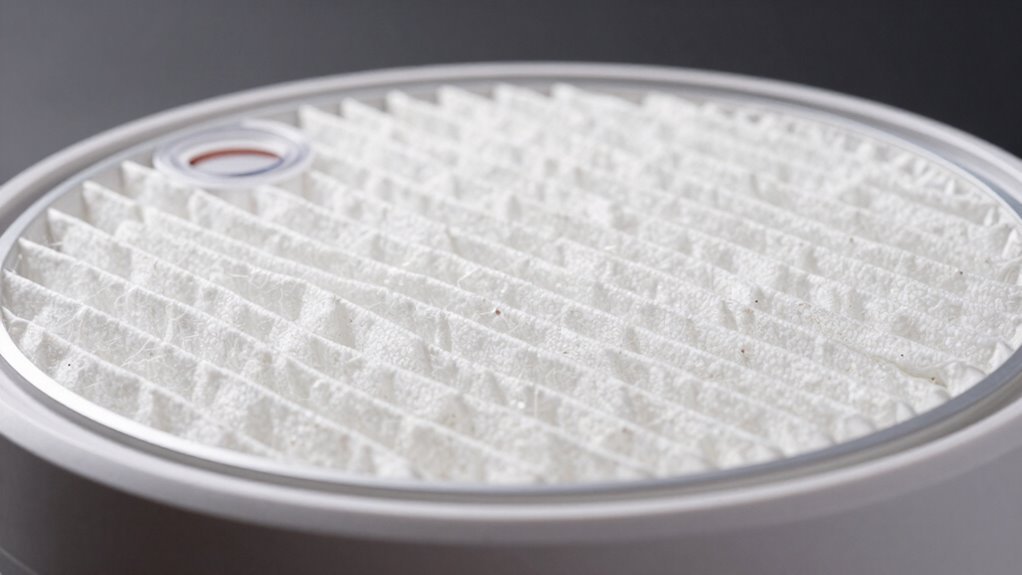
Now that you’ve given the washable filters their well-deserved spa moment, let’s turn our attention to their high-maintenance cousins: the non-washable HEPA filters.
These delicate paper-based filters hate water—so skip the rinse. Instead, stick to gentle, dry cleaning to keep them working like vacuum superheroes. Here’s how to do it right:
- Tap and shake the filter over a trash can or outdoors to knock loose dust without turning your kitchen into a dust storm.
- Brush lightly with a soft toothbrush or clean paintbrush—think of it as a spa massage, not a scrub-down.
- Vacuum gently with low suction or short bursts of compressed air to lift grit from the pleats, avoiding any Hulk-level pressure.
Handle with care, avoid sharp tools, and never bend the filter—you’re dust-busting, not origami-folding!
Dry Your Filter Completely Before Reinserting
Don’t rush the final step—give your filter the time it needs to air-dry fully before popping it back in.
Slapping in a damp filter might seem harmless, but trust us, it’s asking for trouble.
Moisture traps dust like a mud pit, clogs the pores, and makes your robot work harder—suction power drops, and nobody wants a wheezing vacuum.
Plus, damp = mold’s favorite playground.
You don’t want your robot doubling as a spore dispenser or smelling like a forgotten gym sock.
Let it dry at room temperature on a clean spot—24 to 48 hours for thick foam, less for thin mesh.
No ovens, hair dryers, or dramatic radiator scenes; heat warps, melts, or fakes dryness.
Check it thoroughly: no cool spots, no dark patches.
When it’s truly dry, it’s game on—your vacuum will thank you with strong suction and fresh, clean breath.
Patience pays off!
When to Replace, Not Wash, Your Filter
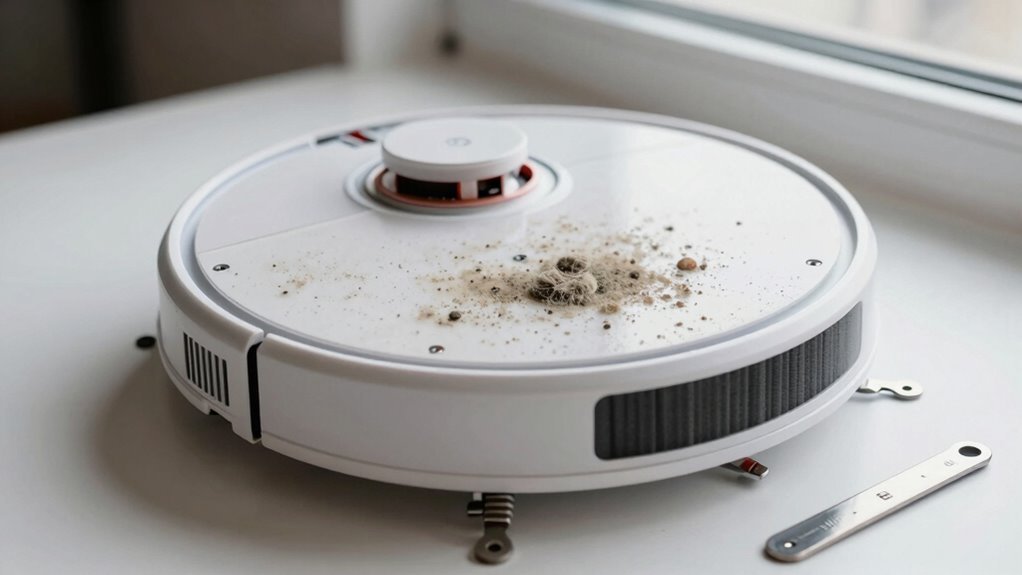
- It’s torn, warped, or covered in mold – if it looks like it survived a dust storm or a science experiment, let it retire in peace.
- The smell won’t quit – musty odors or lingering yuckiness mean bacteria or mold have moved in for good.
- Suction’s weak and the motor’s straining – when your robot sounds like it’s running a marathon, that filter’s done its best.
Don’t push a dead filter—your vacuum (and lungs) will thank you!
5 Mistakes That Ruin Robot Vacuum Filters
You’ve given your filter the boot when it’s past saving—good call, your vacuum (and nose) appreciates the mercy.
But don’t sabotage your next one!
Slipping a damp filter back in? That’s a mold party waiting to happen.
Let it dry fully—no shortcuts!
Tossing it in the dryer or blasting it with a hot hairdryer? Yikes!
You’ll melt, warp, or wreck it fast.
And please, skip the bleach or stiff brush—gentle rinse only, or you’ll shred the fibers.
Washing a “non-washable” filter? That’s like washing a “do not wash” hoodie—sad results guaranteed.
Skipping tap-outs between deep cleans clogs it faster, making your bot wheeze like it’s running a marathon.
And hey, popping it in crooked or storing it damp? Big no-nos.
Line it up right, keep it dry, and treat it kind—your robot’s lungs will thank you!
Frequently Asked Questions
How Often Should I Clean My Robot Vacuum Filter?
You should clean your robot vacuum filter about once a week, or every five cleanings—whichever comes first.
If you’ve got pets or run it daily, bump that up to twice a week.
Just tap it out to knock loose the dust—it’s quick, easy, and keeps your bot humming like a happy little vacuum ninja.
Can I Use a Vacuum Filter Without Washing It First?
Yeah, you can use a vacuum filter without washing it first—but you really shouldn’t skip the prep!
Tap it firmly to shake out loose dust and fibers, or you’ll blow tiny factory leftovers around your room.
Think of it like unwrapping a new gadget: give it a quick once-over before diving in.
A little pre-clean means better suction, cleaner air, and fewer “why’s there a dusty sneeze?” moments.
Trust us, your lungs will thank you—no one likes surprise glitter… unless it’s actually glitter.
Are There Replacement Filters Compatible With Multiple Models?
Yes, there are replacement filters that work across tons of models—like one superhero filter saving your Samsung, Roborock, or eufy from dustpocalypses!
You’ll love how they fit multiple bots, cut clutter, and shrink costs.
No more juggling ten different filters; one tidy pack’s got your back.
It’s like magic, but real—and way less messy than explaining why you lost another filter under the couch again.
What Happens if I Run the Robot Without a Filter?
You should never run your robot without a filter—trust me, it’s a bad idea.
You’ll lose suction fast, since dust rushes into the motor and clogs everything.
Your robot will overheat, wear out quicker, and start stinking like a dusty old attic.
Plus, it’ll blow dirt all over instead of trapping it.
It’s like sending a knight to battle without armor—poor guy won’t last five minutes!
Can I Dry the Filter With a Hairdryer?
Nope, you shouldn’t dry your filter with a hairdryer—68% of filter damage cases come from improper drying!
The hot air can melt fine fibers, warp plastic, and ruin the HEPA material.
Plus, think of it like blow-drying a soufflé: messy and doomed.
Just let it air-dry naturally, cool and calm, away from heat.
It’s safer, smarter, and keeps your vacuum breathing easy—no drama, no fumes, just fresh, clean airflow.
Conclusion
You’ve got this! Did you know 80% of robot vacuum issues come from dirty, poorly maintained filters? Yikes! So rinse that foam or felt filter, skip water on HEPA ones, and always, *always* let it dry fully—no soggy filters allowed! Treat it right, and your little cleaning buddy will keep humming happily. Replace when needed, avoid the rookie mistakes, and boom—clean floors with way less effort. Go team!
References
- https://www.ecovacs.com/us/blog/how-to-clean-robot-vacuum-filter
- https://us.narwal.com/blogs/product/how-to-maintain-robot-vacuum-filter
- https://www.youtube.com/watch?v=U31YebavU94
- https://www.youtube.com/watch?v=8l7UifaRhnI
- https://forums.wyze.com/t/how-to-clean-the-wyze-robot-vacuum-hepa-filter/183650
- https://www.youtube.com/watch?v=vgi19r563aY
- https://homesupport.irobot.com/s/article/2449
- https://www.snylifilter.com/news/air-filter-classification-82020522.html
- https://www.terrauniversal.com/blog/terra-cleanroom-filter-replacements-for-cleanrooms-and-controlled-environments
- https://i-teamanz.com/media-and-insights/insights/different-vacuum-filtration-options-standard-vs-hepa-vs-ulpa