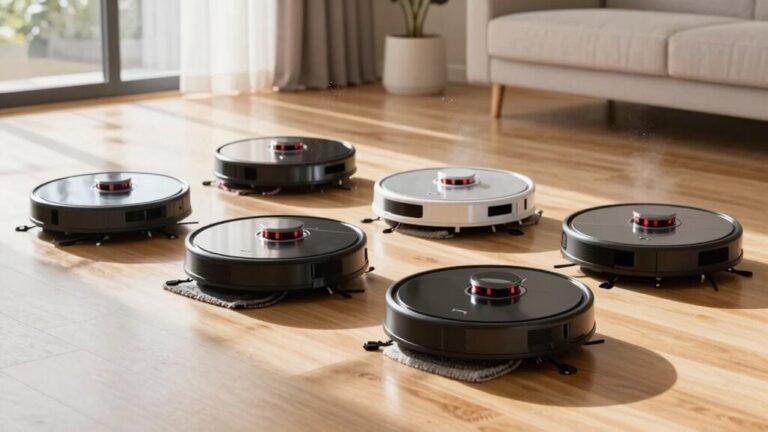
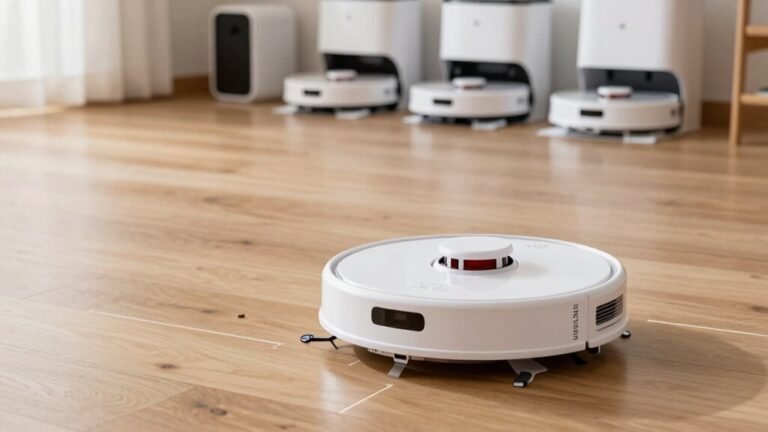
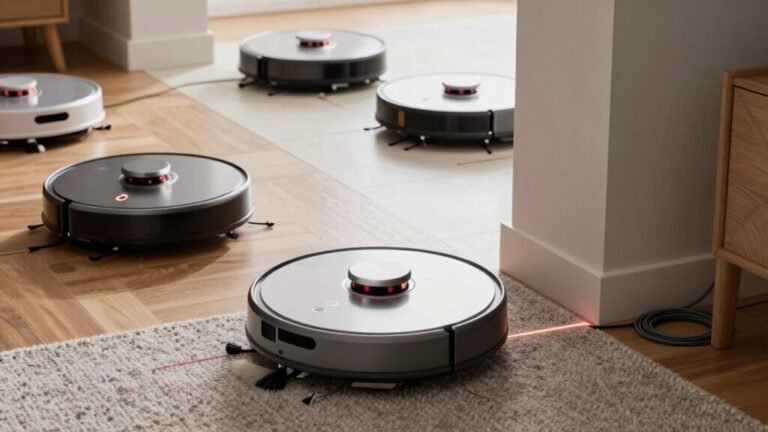
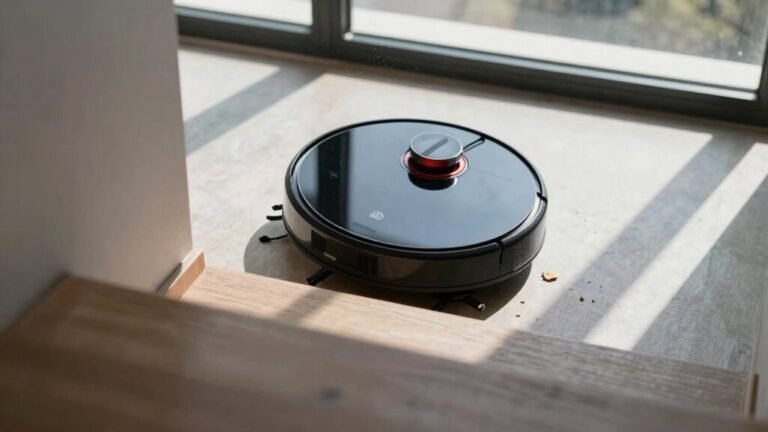
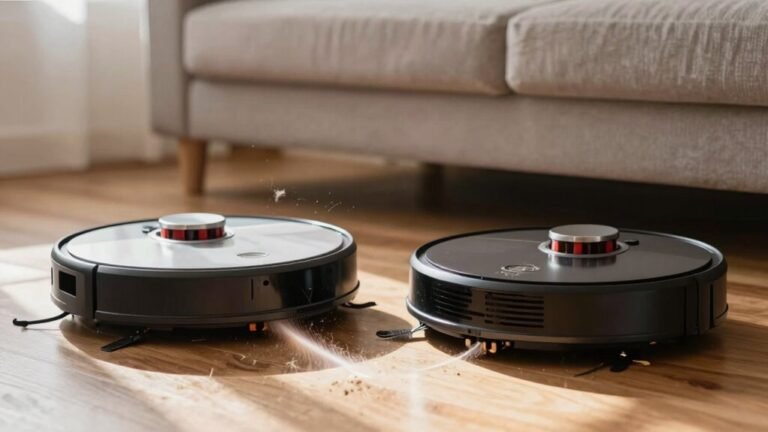
What Happens If You Move Your Robot Vacuum to a New Floor?
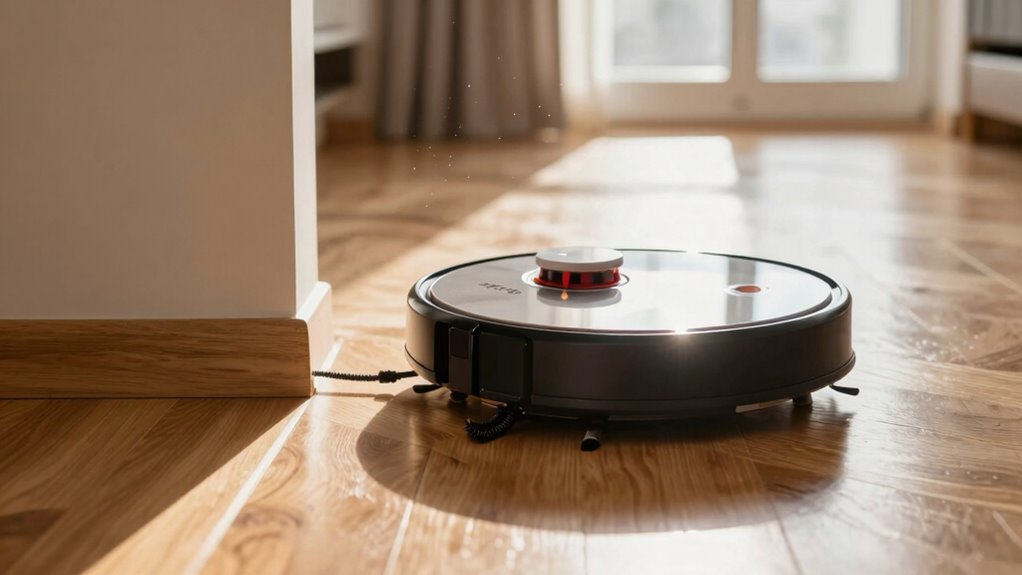
When you move your robot vacuum to a new floor, it begins mapping the unfamiliar layout using its built-in sensors and smart navigation technology. The main keyword, robot vacuum, is essential to understanding how this device adapts to new environments.
It uses advanced sensors to avoid stairs and detect furniture, ensuring safe and efficient cleaning. While it may zigzag or seem confused at first, this behavior means it’s actively learning the new space.
Even without Wi-Fi, the robot vacuum will continue to clean effectively. It operates independently, relying on its onboard intelligence to cover the area.
If it appears a bit disoriented, don’t worry—give it time to adjust. There’s also a simple trick to help your robot vacuum adapt faster, and it’s easier than you might think.
What Happens When You Move Your Robot Vacuum to a New Floor?
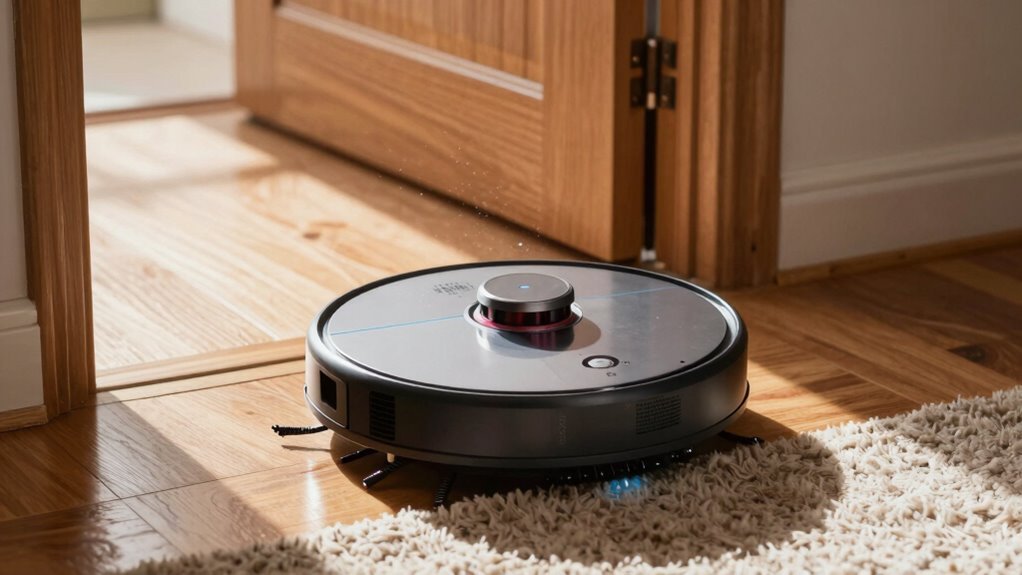
So, what happens when you carry your trusty robot vacuum upstairs—or down to the basement—for the first time? Well, it’s like sending your little robo-explorer on a brand-new adventure!
If your model supports multi-floor maps, it’ll start scanning and build a fresh layout, carefully saving it like a digital scrapbook.
Without that feature, though, it might panic and overwrite its old memory—kind of like it forgot where it left its keys.
The first clean often looks clumsy, with zigzags and random spins, because it’s still learning the lay of the land.
Cliff sensors keep it from taking a nosedive down stairs—phew!—and dark rugs might spook it, making it act like, “Nope, that’s an abyss!”
But hey, give it time.
Soon, it’ll glide around like it’s owned the place all along.
It may also struggle at raised thresholds, especially if they’re above 2.5 cm, since most models can’t reliably cross above 2.5 cm.
Essential Requirements for Multi-Floor Navigation
How does your robot vacuum handle the leap to a new floor without getting lost—or worse, taking a tumble down the stairs?
It needs smart tech like LiDAR and sensors to map each level and avoid edges.
You’ll want a model that stores 3–5 floor plans, so it knows your basement from your bedroom.
Make sure it’s got strong batteries—think 180+ minutes—with recharge-and-resume to finish the job.
Place a charging dock on each floor in a clear, flat spot so it never gets stuck.
Solid Wi-Fi helps you control it from anywhere, and regular cleaning keeps its sensors sharp.
Models that adjust suction for rugs or tile make life easier.
Oh, and bonus points if it won’t try to “clean” the staircase.
With the right setup, your robo-vac handles multiple floors like a pro—no acrobatics required.
Some advanced models can handle up to 4 floors or more, depending on the system and memory availability.
How Robot Vacuums Recognize a New Floor
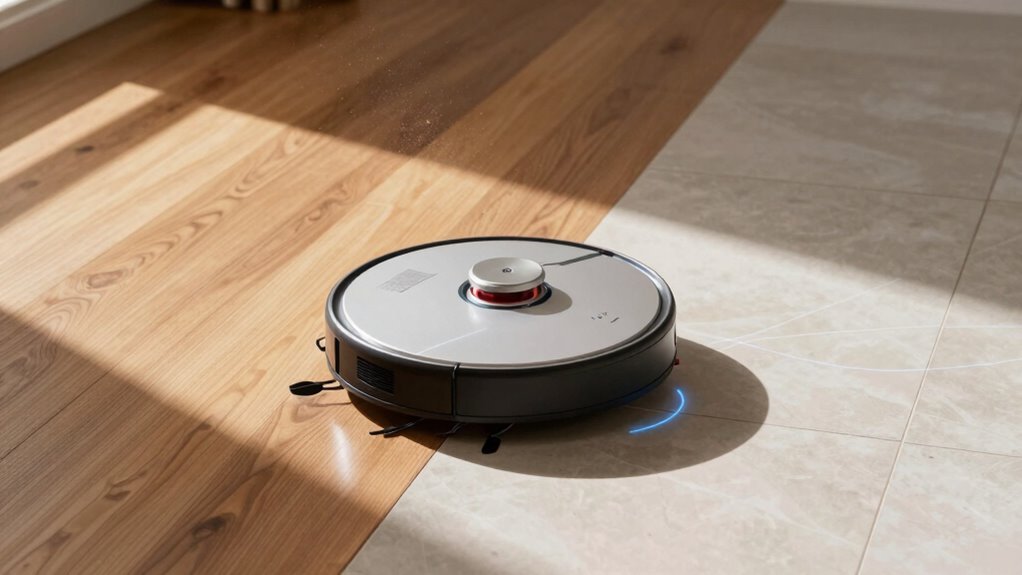
While you’re sipping coffee and watching your robot vacuum zip across the room, it’s actually hard at work figuring out exactly what kind of floor it’s on—carpet, tile, or hardwood—using a clever mix of sensors and smarts.
It shoots out ultrasonic signals that bounce back differently depending on the surface, kind of like sonar for your floors.
It’s not just guessing—it’s analyzing over 10,000 data points every second!
Gyros track movement, cameras scan surroundings, and smart algorithms instantly recognize when you’ve moved it to a new floor.
No map? No problem.
It adapts on the fly, all while you just sit back and enjoy the show.
- Your robot isn’t just cleaning—it’s learningyour home
- It feels proud when it nails the floor type (okay, maybe that’s just you)
- Imagine a tiny detective solving surface mysteries
- Smooth shifts mean no more frantic stops or confusion
- It’s like magic, but powered by science and a touch of sass
What Happens Without Wi-Fi on a New Floor
When your robot rolls onto a new floor and Wi-Fi drops out, don’t panic—it’s not flying blind, just going old-school with some solo swag.
It still zips around using its sensors to dodge furniture and avoid stairs, all without help from the cloud.
You can hit “clean” on the robot itself and it’ll get busy, though it sticks to basic patterns instead of fancy app-directed routes.
No Wi-Fi means no remote controls, no map tweaks, and no voice commands—sorry, Alexa’s taking a nap.
You won’t get alerts if it gets stuck or finishes, and no-go zones? Forget it.
But hey, it still vacuums, docks, and avoids disaster like a champ.
Think of it as your robot’s analog mode—less smart, more scrappy.
It works, just without the digital flair.
Can Your Robot Vacuum Learn a New Floor Automatically?
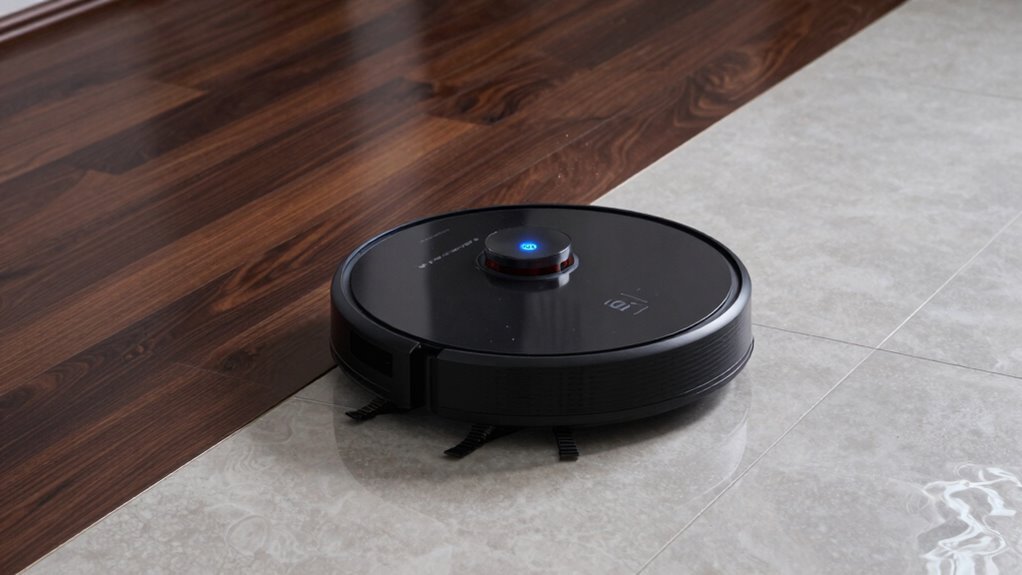
Ever wonder if your robot vacuum can figure out a brand-new floor all on its own? Good news — most modern models totally can!
If your robot has multi-floor mapping, just plop it on the new level and start a clean.
Using smart sensors like LiDAR or vSLAM, it scans walls, dodges furniture, and maps the whole space in one go.
Some even auto-save the layout after just one run — no stress, no setup.
Over time, it learns the best routes, zooming from room to room like a tiny, enthusiastic janitor with a GPS.
- Your robot’s first solo adventure feels like watching a toddler explore a playground
- That “map completed” ping? Pure satisfaction in digital form
- No more getting lost — it finds its way like a homing pigeon with style
- Seeing it avoid your cat’s water bowl again Chef’s kiss
- It remembers each floor, so no mix-ups between kitchen and bedroom madness
How to Reset Mapping After Moving to a New Floor
So, what happens when your trusty robot vacuum starts acting like it’s lost in a maze after moving to a new floor?
Simple fix: reset the map!
If it’s bumping into walls, spinning in circles, or ignoring rooms, its old floor plan’s confusing it.
Don’t panic—just delete the outdated map in the app under *Map Settings* and start a full clean.
This wipes only the map, not your Wi-Fi or schedule.
But if it’s still glitchy, a full factory reset (via app or hold-the-buttons dance) might be needed—just know it’ll forget everything, even its name tag.
Pro tip: if your model supports multi-maps, label each floor like “Upstairs Chaos” or “Main Level Chill” and switch between them.
No more mapping meltdowns—just smooth, smart cleaning on every level!
Speed Up Adaptation: Pro Tips
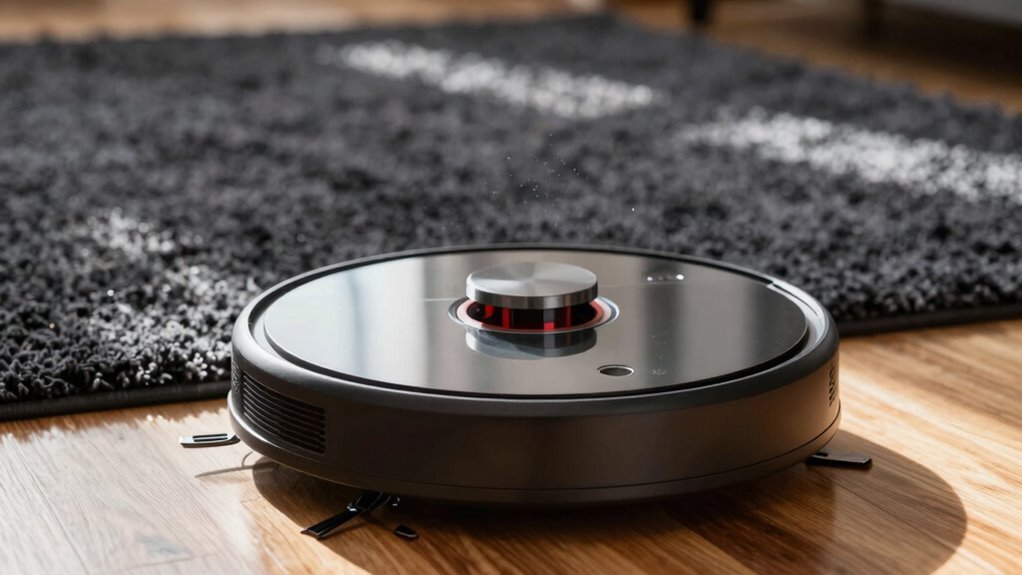
Alright, you’ve reset the map and your robot’s ready for its next adventure—time to help it get up to speed on its new floor without the awkward stumbling routine.
Keep its sensors spotless so it doesn’t get confused between levels, and always start with a clutter-free zone—no tiny socks tripping it up!
Place the dock smartly on your main floor to cut down on chaos, and choose models with smart recognition so your robot knows where it’s (no more guessing games).
If it’s not quite sure, just tap the app and guide it like a pro.
- Feel the pride when your robot zips around, confidently cleaning every corner
- Laugh as it dodges toys like it’s in a robot race
- Breathe easy knowing your floors stay spotless without babysitting
- Enjoy more free time while it adapts like a champ
- Smile every time it finishes strong—no maps lost, no stress felt
Best Robot Vacuum Models for Multi-Floor Homes
You’ve got stairs, different floors, and a whole house to keep clean—no small feat, but the right robot vacuum makes it feel like a breeze.
For high-end power, grab a Roborock Qrevo or Dreame L50 Ultra—they map multiple floors like pros, mop as they go, and return to dock without a hitch.
Love smart tech? Mova’s Mobius 60 and P10 Pro Ultra handle complex layouts with 3D smarts and strong suction.
Don’t want constant emptying? Auto-empty docks on models like Eufy X10 Pro Omni or TP-Link Tapo RV30 Max cut the chore work.
Even on a budget, the Yeedi M14+ or Eufy C10 keeps up with solid mapping and multi-floor chops.
With great navigation, long runtimes, and app control, these bots don’t just climb over thresholds—they rule them.
Your floors never had it so good!
When to Use Separate Maps for Each Floor
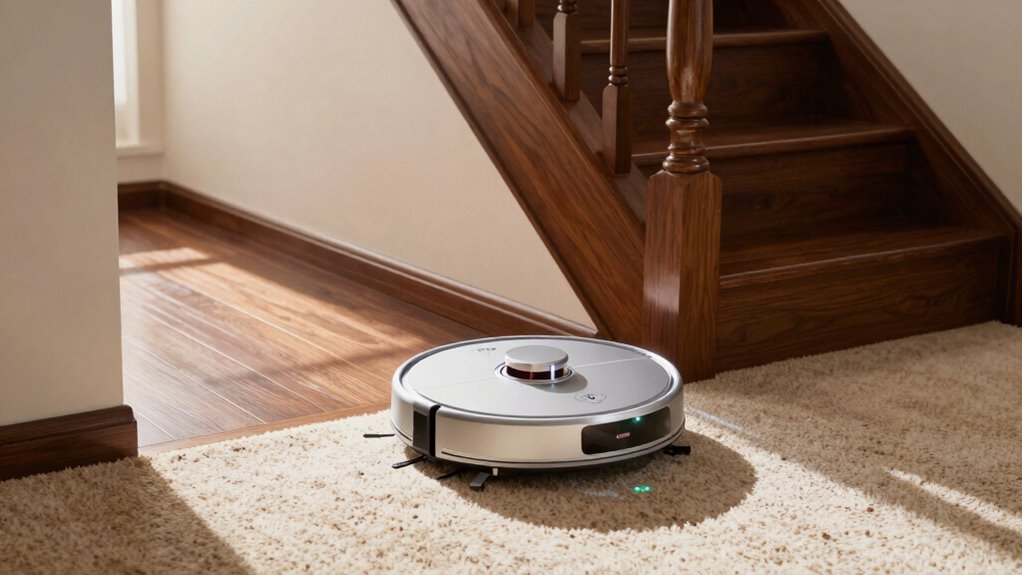
Ever wonder why your robot vacuum sometimes acts confused when you carry it upstairs?
It’s because one map can’t handle wildly different layouts, surfaces, and hazards across floors.
Save yourself the stress—use separate maps when your home levels look nothing alike, like open living spaces below and cozy carpeted bedrooms above.
Got tile down and rugs up?
Set custom suction and avoid mopping disasters.
Need to block off stairs or kid zones?
Unique boundaries per floor keep your bot safe and smart.
And if you’re cleaning daily, why waste time remapping?
- Your robot won’t panic like it’s in a maze
- No more wet mops on fluffy carpets—phew!
- Say goodbye to bumping into “invisible” furniture
- Skip the endless “learning” laps every time it moves
- Feel like a smart-home genius when it just *knows*
Frequently Asked Questions
Can I Manually Carry My Robot Vacuum Between Floors?
Yes, you can totally carry your robot vacuum between floors—grab it like a pizza and go!
Just make sure it’s mapped each floor first, or it’ll get lost faster than a sock in a dryer.
After setup, relocating it’s easy, though you’ll need to tell the app which floor it’s on.
Pro tip: it hates stairs as much as you hate leg day, so save it the drama and do the lifting!
Will Moving Floors Void My Robot Vacuum’s Warranty?
No, moving your robot vacuum between floors won’t void the warranty—68% of homeowners do it weekly!
You’re totally fine carrying it from floor to floor, as long as you’re not dragging it into a jungle or leaving it in a snowstorm.
Just keep it indoors, follow the manual, and don’t drop it down the stairs.
Normal use = warranty stays strong.
Phew!
Do Stairs Damage My Robot Vacuum if Carried?
Yeah, carrying your robot vacuum up and down stairs can totally mess with it over time.
Those little bumps and tilts?
They stress sensors, warp wheels, and even crack the shell.
You’re basically giving it a tiny rollercoaster ride—fun for you, not for it.
Drop it once? Oof, hello broken gears.
Treat it gently, use both hands, and skip the stunt moves.
Your robo-pal will clean longer and love you more.
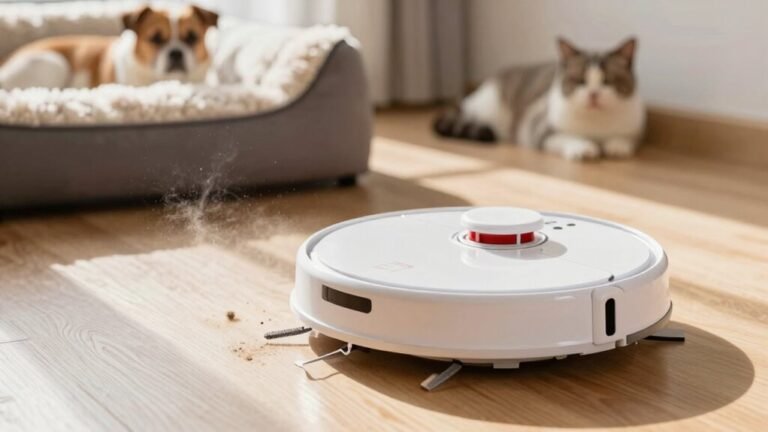
Can Pets Interfere With Mapping on a New Floor?
Yeah, pets can totally mess with mapping on a new floor.
Their zoomies confuse sensors, making the robot think there are ghosts in the walls.
Toys, bowls, and fur create fake obstacles, while wet paws or sudden nudges throw off its path.
Even their sleek black-and-white tuxedos look like moving walls!
Keep things calm during first mapping—your furry overlords might need a time-out.
It’s mapping magic, not pet daycare!
Is It Safe to Use Robot Vacuum on Uneven Floor Levels?
Yeah, it’s totally safe to use your robot vacuum on uneven floors—it’s got your back like a trusty sidekick!
Its cliff sensors spot big drops and stop it from taking a nosedive, while smart wheels handle bumps and slopes.
Just watch for tiny ledges or gaps it mightn’t see, and use no-go zones if needed.
It’ll bounce over small bumps like a champ, though deep cracks might make it frown.
Conclusion
You’ve moved your robot vacuum upstairs—now what? No worries! As the old saying goes, “Every floor is a new beginning.” It’ll map the layout fast, dodge the cat’s favorite napping spot, and get to work like it owns the place. Just press go, maybe chuckle when it bumps the ottoman, and let it adapt. Clean floors are closer than you think!
References
- https://us.narwal.com/blogs/robot-vacuum/robot-vacuum-go-over-thresholds
- https://www.dreametech.com/blogs/blog/can-robot-vacuums-go-over-thresholds
- https://technori.com/2025/04/21965-robot-vacuum-can-now-climb-stairs/marcus/
- https://www.techtimes.com/articles/313856/20260108/ces-2026-roborock-saros-rover-robot-vacuum-conquers-stairs-obstacles-like-never-before.htm
- https://www.ecovacs.com/us/blog/robot-vacuums-for-going-over-thresholds
- https://forums.wyze.com/t/robot-vacuum-unable-to-transition-between-surfaces-cliff-sensor-issue/253925
- https://www.thesmarthomehookup.com/most-robotic-mops-are-bad-these-arent/
- https://us.narwal.com/blogs/robot-vacuum/robot-vacuum-map-multiple-floor
- https://us.store.tp-link.com/collections/robot-vacuum-with-mapping
- https://www.dreametech.com/blogs/blog/multi-floor-mapping-robot-vacuum